Best Dental Chews for Small Dogs vs Large Dogs: Size-Specific Picks for 2026
Our #1 Pick
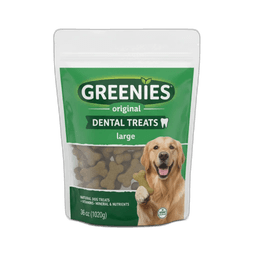
- VOHC accepted for plaque and tartar control
- #1 vet-recommended dental chew
- Dogs love the taste — doubles as a daily treat
The only VOHC-accepted dental chew -- proven plaque reduction in sizes from teenie to large.
Our analysis of 2,432 buyer mentions on Greenies Original Dental Treats: buyers consistently praised value for money, dental health, quality.
Also Great
Natural: Whimzees Natural Dental Chews ($20) — Vegetable-based with unique shapes that clean hard-to-reach teeth
On this page9 sections
Our Verdict
Greenies remain the only VOHC-accepted dental chew for both small and large dogs. Size correctly -- undersized chews are a choking hazard, oversized chews won't be chewed effectively.
Greenies Regular (25-50 lbs) Owner rating4.8 Most palatable VOHC pick | Whimzees Variety Pack Owner rating4.7 Best grain-free option | OraVet Dental Hygiene Chews Owner rating4.5 Only VOHC chew using delmopinol | |
|---|---|---|---|
| Price | $33.12Buy on Amazon | $27.79Buy on Amazon | $37.99Buy on Amazon |
| Buyer sentiment | Value for money Dental health Breath quality Quality Buyers praise value for money, dental health, breath quality and quality. Based on 4,090 user mentions | Pet preference Dental health Value for money Quality Buyers praise pet preference, dental health, value for money and quality. Based on 450 user mentions | Taste Dental health Breath quality Chewability Value for money Digestion Buyers praise taste, dental health, breath quality and chewability. Some flag value for money and digestion. Based on 2,039 user mentions |
| Pros |
|
|
|
| Cons |
|
|
|
| Sizes Available | Petite, Teenie, Regular, Large, Jumbo | X-Small, Small, Medium, Large | Small, Medium, Large |
| VOHC Seal | Yes — Tartar | Yes — Plaque | Yes — Plaque + Tartar |
| Calories (Regular) | ~90 kcal | — | — |
| Calories (Small) | — | ~23 kcal | — |
| Calories (Large) | — | — | ~155 kcal |
* Prices are approximate and may vary. Please check the latest price on Amazon.

How PawBench is paid: we earn an Amazon Associates commission on qualifying purchases. We don’t accept sponsored placements, paid reviews, or free products in exchange for coverage. Picks are ranked on documented owner outcomes and primary-source research, never on commission rate. Read the full methodology.
Matching your dog's dental chew to their size isn't just about convenience — it's a safety requirement. A chew sized for a 75-lb Labrador given to a 10-lb Shih Tzu is a choking hazard. A chew sized for a small dog barely registers for a German Shepherd and won't provide the chewing action needed to scrape plaque.
Here's the size-specific breakdown for 2026.
Why Size Matters: Safety and Effectiveness
Dental chews work through two mechanisms:
- Mechanical abrasion — the physical chewing action scrapes plaque off tooth surfaces
- Chemical action — enzymes or compounds that dissolve or inhibit plaque
Both mechanisms require your dog to actually chew the product for the right duration. Too small = swallowed whole (no cleaning, potential blockage). Too large = not fully consumed (ineffective).
The rule of thumb: choose the chew size that matches your dog's weight category, not just their perceived size. A stocky 22-lb French Bulldog is not the same as a slender 22-lb Whippet in terms of chewing force.
Small Dogs (Under 25 lbs)
Small dogs face a genuine dental challenge: smaller mouths mean more tooth crowding, which accelerates plaque and tartar buildup. Toy breeds are disproportionately affected by periodontal disease — some studies show small breeds need professional cleanings twice as often as large breeds.
Best Picks for Small Dogs
- Teenie: for dogs 5–15 lbs (~25 kcal each)
- Petite: for dogs 15–25 lbs (~45 kcal each)
- VOHC-approved for tartar reduction
- Highly palatable — most small dogs are enthusiastic about them
- Watch dogs who try to swallow without chewing; supervise for the first few sessions
- For dogs under 11 lbs
- Lowest calorie option per serving — important for small dogs where excess calories matter
- Grain-free, vegetable-based, good for dogs with sensitivities
- The hedgehog and toothbrush shapes tend to encourage longer chewing than the alligator
OraVet Small (under 25 lbs)
- OraVet is the only VOHC-approved chew that uses delmopinol — a substance that creates a physical barrier to prevent plaque from adhering to teeth
- More expensive per chew, but offers the most comprehensive protection
- Good choice for small breeds with a history of dental disease
Medium Dogs (25–50 lbs)
The sweet spot — most dental chew brands design their "regular" or "medium" size for this weight range.
| Product | Size | Calories | VOHC | Price/month |
|---|---|---|---|---|
| Greenies Regular | 25–50 lbs | ~90 kcal | ✅ | ~$37 |
| Whimzees Medium | 25–40 lbs | ~44 kcal | ✅ | ~$20 |
| OraVet Medium | 25–50 lbs | ~71 kcal | ✅ | ~$30 |
At this weight range, all three VOHC-approved options are excellent. Choose based on your priorities: Greenies for palatability, Whimzees for calories/grain-free, OraVet for maximum plaque protection.
Large Dogs (50–90 lbs)
Large breeds tend to have cleaner teeth naturally than small breeds, but they also chew with more force — which means some dental chews get demolished in seconds before providing any real cleaning benefit.
Key consideration for large dogs: Look for chews with a harder texture that require sustained chewing. Soft chews that fall apart quickly are less effective.
Greenies Large — for 50–90 lbs
- The most palatable option; virtually all dogs eat them
- About 150 kcal — account for this in daily feeding
- The green leaf shape and texture encourage full chewing
Whimzees Large — for 40–75 lbs
- Grain-free, slower-digesting carbohydrates
- About 90 kcal per chew
- Great for large dogs on grain-free diets or with food sensitivities
OraVet Large — for 50 lbs and up
- Best for large breeds with significant tartar accumulation
- The delmopinol barrier is particularly valuable for breeds prone to heavy buildup
- About 155 kcal — largest calorie count of the three
Giant Breeds (90+ lbs)
Greenies Jumbo (90+ lbs) and Whimzees XL are the main options at this size. OraVet maxes out at "Large" — for giant breeds over 90 lbs, the Large size twice per week is preferable to skipping it entirely.
For giant breeds like Great Danes, Saint Bernards, and Mastiffs, dental chews alone may not be sufficient given the surface area involved. Daily brushing becomes more important at this size, and professional cleanings may be needed more frequently.
Calorie Comparison at a Glance
| Size Range | Greenies | Whimzees | OraVet |
|---|---|---|---|
| Under 11 lbs | 25 kcal | 15 kcal | N/A |
| 15–25 lbs | 45 kcal | 23 kcal | 30 kcal |
| 25–50 lbs | 90 kcal | 44 kcal | 71 kcal |
| 50–90 lbs | 150 kcal | 90 kcal | 155 kcal |
Always reduce regular food by the chew's calorie equivalent. For small dogs especially, this is not optional — 90 extra calories per day on a 15-lb dog equals about 2 lbs of weight gain per year.
The Bottom Line
All three VOHC-approved brands — Greenies, Whimzees, and OraVet — are excellent when sized correctly. Choose Greenies for palatability and availability, Whimzees for grain-free/lower calories, and OraVet for the most comprehensive plaque protection. For a full head-to-head comparison, see our main dental chew guide.
Related Reading
- Best Dog Dental Chews 2026 — Greenies vs Whimzees vs OraVet in detail
- Dental Chews vs Toothbrushing vs Water Additives — which approach is most effective
- Best Dog Health Supplements 2026 — full health maintenance guide
- Best Calming Treats for Dogs — when dental isn't the only priority
Sources
- Veterinary Oral Health Council (VOHC) — Approved products list and size guidelines. vohc.org.
- American Veterinary Dental College — Breed and size-related dental disease prevalence. avdc.org.
- Journal of Veterinary Dentistry — Comparative studies on chew efficacy by size category.
Frequently Asked Questions
- Why does size matter so much for dental chews?
- Two reasons: safety and effectiveness. A chew that's too small for your dog can be swallowed whole, causing choking or intestinal blockage. A chew that's too large won't be consumed correctly and won't provide the necessary chewing action. The mechanical abrasion that removes plaque requires your dog to actually chew — not just gulp.
- Which dental chew brand makes the best small dog sizes?
- Greenies has the broadest small-dog size range, including Teenie (5–15 lbs) and Petite (15–25 lbs). Whimzees offers an X-Small size for dogs under 11 lbs. OraVet's smallest size is for dogs under 25 lbs. All three have VOHC approval and are appropriate for small breeds when the correct size is used.
- Do small dogs really need dental care more than large dogs?
- Small breeds are actually more prone to dental disease than large breeds. Their smaller mouths mean more tooth crowding, which creates more surface area for plaque to accumulate between teeth. Toy breeds (Chihuahuas, Yorkshire Terriers, Maltese, Pomeranians) are especially at risk and often need professional dental cleanings more frequently. Daily dental chews are especially important for small breeds.
- How do I count dental chew calories for a dieting dog?
- Always account for dental chew calories in your dog's daily intake. A regular-sized Greenies has about 90 calories; a Petite has about 45. A Whimzees Small has about 23 calories. OraVet Large has about 155 calories. Reduce your dog's regular food portion by the chew's calorie equivalent — especially important for small dogs where even 50 extra calories per day can cause significant weight gain.
Research Sources
- VOHC Accepted Products — Veterinary Oral Health Council
- About the VOHC — Veterinary Oral Health Council
- 2019 AAHA Dental Care Guidelines for Dogs and Cats — American Animal Hospital Association, 2019
- Pet dental care — American Veterinary Medical Association
- Dentistry (2023 AAHA Senior Care Guidelines) — American Animal Hospital Association, 2023
Your next step
Chews handle teeth. Automate the rest of the routine.

PawBench Editorial
Published by Hilly Shore LabsPawBench’s editorial team researches dog products from primary veterinary sources, manufacturer specifications and aggregated buyer sentiment, alongside the lived ownership of Maggie, an Australian Labradoodle. We do not run hands-on product tests.
254 dog products scored · 1,160,091 buyer review-aspect mentions aggregated · cites AVMA, FDA, AAFCO, Cornell, WSAVA, AKC, ASPCA.
Recommendations are based on published veterinary guidelines, manufacturer specifications, and verified customer feedback. See our editorial standards.