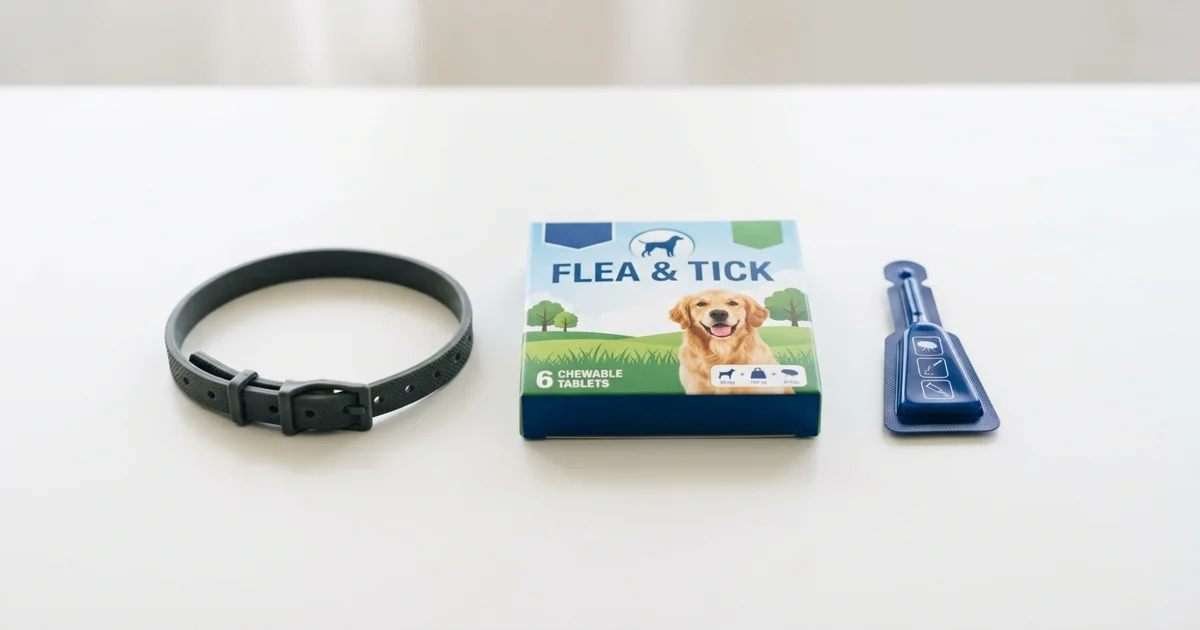
Can You Combine Flea & Tick Products on a Dog? Safe vs Risky
Quick Answer
Sometimes — it depends entirely on which two products you pair. Stacking two oral isoxazolines (NexGard, Simparica, Simparica Trio, Credelio, Bravecto are all the same drug class) is double-dosing one drug, not adding protection, and the FDA warns this class can cause neurologic reactions like tremors and seizures. Layering two products that both kill fleas is usually just redundant. The one combination that's often legitimate is adding a repellent that prevents tick attachment (a Seresto collar or a permethrin topical) on top of an oral isoxazoline that kills fast but only after a bite — useful in heavy-tick or Lyme regions, and only with your vet's sign-off. The AVMA warns preventives can interfere with each other and cause toxicities or ineffective doses, so the non-negotiable rule is to tell your vet every product your dog is on.
On this page8 sections
Our Verdict
Whether you can combine two flea-and-tick products comes down to the pair, not the count. Two oral isoxazolines (NexGard, Simparica, Simparica Trio, Credelio, Bravecto) are the same drug class — stacking them is double-dosing, which the FDA links to neurologic reactions, so pick one. Two products that both just kill fleas are usually redundant. The combination that earns its place is a repellent collar or permethrin topical that prevents tick attachment layered over a fast-killing oral, in heavy-tick or Lyme regions — because the oral doesn't stop a tick from biting first. Adding a heartworm preventive to a flea-only product isn't combining; it's covering a different parasite. The one rule that never bends: tell your vet every product your dog is already on, because preventives can interfere with each other.
Combining Flea & Tick Products: Safe, Redundant, or Risky
How the combinations owners actually search for sort out — based on whether the two products share a drug class, share a job, or cover different jobs. Always confirm with your veterinarian.
| Product | Verdict | Why | What to do |
|---|---|---|---|
| Two oral isoxazolines (e.g. NexGard + Simparica) | Risky — don't | Same drug class; this is double-dosing one drug, not adding a layer | Pick one isoxazoline; never run two at once |
| Simparica Trio + a separate isoxazoline chew | Risky — don't | Trio already contains sarolaner (an isoxazoline) | Trio already covers fleas/ticks + heartworm; add nothing in that class |
| Oral isoxazoline + fipronil topical (e.g. Frontline) | Usually redundant | Both kill fleas; little added benefit, extra cost and exposure | Choose one unless your vet flags a specific gap |
| Oral isoxazoline + repellent collar/topical (Seresto, K9 Advantix II) | Often legitimate (vet-guided) | Adds tick-attachment prevention the oral lacks | Reasonable in heavy-tick/Lyme areas; confirm spacing with vet |
| Flea-and-tick product + separate heartworm preventive | Not combining — it's covering two parasites | Flea/tick products don't prevent heartworm | Standard if you're not using an all-in-one like Simparica Trio |
| Dog-only product near a cat in the home | Handle with care | Cats can be poisoned grooming a dog-labeled product off the dog | Treat one pet at a time; separate until dry |

How PawBench is paid: we earn an Amazon Associates commission on qualifying purchases. We don’t accept sponsored placements, paid reviews, or free products in exchange for coverage. Picks are ranked on documented owner outcomes and primary-source research, never on commission rate. Read the full methodology.
Search "is Simparica Trio the best?" and the next thing owners ask is whether to add something to it — a Seresto collar for ticks, a NexGard chew "just in case," a flea collar layered over a monthly oral. The instinct makes sense: more protection feels safer. But with flea and tick products, "more" can mean redundant, wasteful, or genuinely dangerous, depending on which two products you stack.
Here is the framework that actually matters, grounded in FDA, AVMA, and Cornell guidance — not a brand ranking.
Key takeaways
- Two products from the same drug class is the real danger. NexGard, Simparica, Simparica Trio, Credelio, and Bravecto are all isoxazolines — the same class. Doubling up on isoxazolines means double-dosing one drug, not adding a second kind of protection.
- The one combination that's often legitimate is a repellent (a collar or permethrin topical that stops ticks from attaching) layered over an oral isoxazoline (which kills fast but only after a bite) — in heavy-tick or Lyme country, with your vet's sign-off.
- A flea-and-tick product is not a heartworm product. Pairing a single-parasite preventive with a separate heartworm preventive isn't "combining for safety" — it's covering two different parasites.
- The non-negotiable rule: tell your vet every product your dog is already on. The AVMA warns preventives "can interfere with each other, resulting in unwanted side effects, toxicities, or even ineffective doses."
First, know what you're actually stacking
Most "can I combine these?" mistakes come from not realizing two products share an active ingredient — or share a job. The FDA lists the entire isoxazoline class in one place, and it's longer than most owners expect:
The FDA-approved isoxazolines are the same drug family: Bravecto (fluralaner), Credelio (lotilaner), NexGard (afoxolaner), NexGard Plus, Simparica (sarolaner), and Simparica Trio (sarolaner + moxidectin + pyrantel). Stacking any two of these is double-dosing one class — not adding a second layer.
That single fact dissolves most of the popular pairings owners search for. "NexGard plus Simparica for extra coverage" isn't extra coverage — it's two doses of the same kind of drug, against the FDA's own dosing guidance.
The combine-or-not matrix
The honest answer to "can I use two at once?" is it depends entirely on the pair. Here's how the common combinations actually sort out.
Why "complement to Simparica Trio for ticks" is a real question — with a real answer
This is the most legitimate version of the combining question, and it has a genuine veterinary basis. Cornell's Riney Canine Health Center spells out the distinction most products bury:
- Oral isoxazolines (NexGard, Simparica, Simparica Trio, Credelio, Bravecto) do not prevent a tick from attaching. They have a fast kill time, but the tick has to bite first.
- Seresto collars and permethrin topicals (K9 Advantix II, Vectra 3D) repel ticks and prevent attachment in the first place.
Why does that gap matter? Because a tick that's killed after it attaches still had a window to attach. Cornell notes a tick generally must stay attached at least 1–2 days before it can transmit the bacteria that cause Lyme disease — so killing fast usually wins the race, but not always, and not for every disease. It's also why removing an attached tick promptly and correctly still matters on any product.
So in a high-Lyme region, or for a dog that lives in tick habitat, a vet may reasonably add a repellent layer (an EPA-registered collar or permethrin topical) on top of the oral chewable — pairing "prevents attachment" with "kills fast." That's not double-dosing; it's two different mechanisms doing two different jobs. The keyword is with your vet — because the EPA-vs-FDA labeling and the dog's history both factor in.
The reframe: the useful question isn't "what kills more?" It's "is anything attaching before it's killed?" If yes, and you live where tick-borne disease is common, that's the case for adding a repellent — not a second killer.
What most people get wrong
The dangerous assumption is that flea and tick products are like vitamins — harmless to layer, where worst case is "wasted money." They're not. The FDA's isoxazoline fact sheet exists because these drugs have been "associated with neurologic adverse reactions, including muscle tremors, ataxia, and seizures in some dogs," and notes seizures can occur even in dogs with no prior history. Two isoxazoline doses don't halve that risk — they raise the dose.
The other quiet trap is the cat in the household. The FDA's safe-use guidance is blunt: with spray or spot-on products, treat one pet at a time and keep them separated until dry, "to prevent one animal from grooming another and potentially ingesting the drug." A dog-only product groomed off onto a cat can poison the cat. Combining products in a multi-pet home multiplies that exposure.
A 30-second decision sequence
Before you add a second product, walk these in order:
- Same class? If both are isoxazolines (NexGard / Simparica / Simparica Trio / Credelio / Bravecto), stop — that's double-dosing. Pick one.
- Same job? Two products that both kill fleas (e.g., an oral chewable plus a fipronil topical) is usually redundant, not safer. Choose the one that fits your dog.
- Different job, real need? A repellent (collar/permethrin topical) added to an oral killer in tick country, or a heartworm preventive added to a flea-only product, are different jobs — discuss with your vet.
- Did the vet hear the full list? Per the AVMA, preventives can interfere with each other and with other medications. Your vet can only catch that if they know everything your dog is on.
If your vet says a single product is enough: for most dogs that's a monthly oral like Simparica Trio (prescription) or an 8-month Seresto collar — the collar for dogs over 18 lb, and the large-dog Seresto is the same product sized for bigger dogs. Frontline Plus remains the over-the-counter topical if you need something today. Pick one; don't stack them without the vet's say-so.
Three questions to bring to your vet
The AVMA's own owner checklist literally includes "Is there a need for more than one product?" and "How would I apply or use multiple products on my pet?" — so this is a question vets expect. Add:
- Given where we live and how my dog lives, do I need attachment prevention on top of a fast killer, or is the oral enough?
- If we layer, what's the safe spacing, and what reaction signs should send me back to you?
- Am I accidentally covering the same parasite twice, or leaving a gap (like heartworm) uncovered?
Why getting this right actually matters
Over-stacking isn't a cautious habit — it's an avoidable risk with no upside when the products do the same thing. Under-stacking (an oral killer alone in serious tick country) can leave a real gap. The win is matching mechanisms to your dog's actual exposure, with a vet who knows the full picture, instead of buying peace of mind by the bottle.
For our researched picks once you've settled on an approach, see Best Flea & Tick Prevention 2026, the Seresto vs NexGard vs Frontline head-to-head, our best flea collars roundup, how to pick a single format in oral vs topical vs collar, and the heartworm vs flea & tick coverage gap. More guides live in our dog health section.
This article is general education, not veterinary advice. Talk to your veterinarian before starting, changing, or combining any flea, tick, or heartworm preventive — and tell them every product your dog is already on.
Research Sources
- Safe Use of Flea and Tick Products in Pets — U.S. Food & Drug Administration
- Fact Sheet about Potential Adverse Events Associated with Isoxazoline Flea and Tick Products — U.S. Food & Drug Administration
- Safe use of flea and tick preventive products — American Veterinary Medical Association
- Flea and tick prevention — Cornell University College of Veterinary Medicine — Riney Canine Health Center

PawBench Editorial
Published by Hilly Shore LabsPawBench’s editorial team researches dog products from primary veterinary sources, manufacturer specifications and aggregated buyer sentiment, alongside the lived ownership of Maggie, an Australian Labradoodle. We do not run hands-on product tests.
331 dog products scored · 1,222,724 buyer review-aspect mentions aggregated · cites AVMA, FDA, AAFCO, Cornell, WSAVA, AKC, ASPCA.
Recommendations are based on published veterinary guidelines, manufacturer specifications, and verified customer feedback. See our editorial standards.