15 Indoor Cat Enrichment Ideas to Keep Your Cat Happy and Stimulated
Our Verdict
Two daily play sessions, puzzle feeders, and vertical space near a window are the highest-impact enrichment investments for indoor cats. Start there and expand based on your cat's personality.
As an Amazon Associate I earn from qualifying purchases. Product prices and availability are subject to change.
Key Takeaways
Two daily play sessions, puzzle feeders, and vertical space near a window are the highest-impact enrichment investments for indoor cats. Start there and expand based on your cat's personality.
Indoor cats live significantly longer than outdoor cats — an average of 12–18 years versus 2–5 years for outdoor cats, according to the UC Davis School of Veterinary Medicine. But that longer lifespan comes with a trade-off: without deliberate enrichment, indoor cats can develop boredom, stress, obesity, and behavioral problems.
Cats are natural hunters who, in the wild, spend hours stalking, chasing, and capturing prey. An indoor cat in an unstimulating environment is essentially a predator with nothing to hunt. Enrichment fills that gap. Here are 15 ideas that actually work.
Physical Enrichment
1. Vertical Space: Cat Trees and Wall Shelves
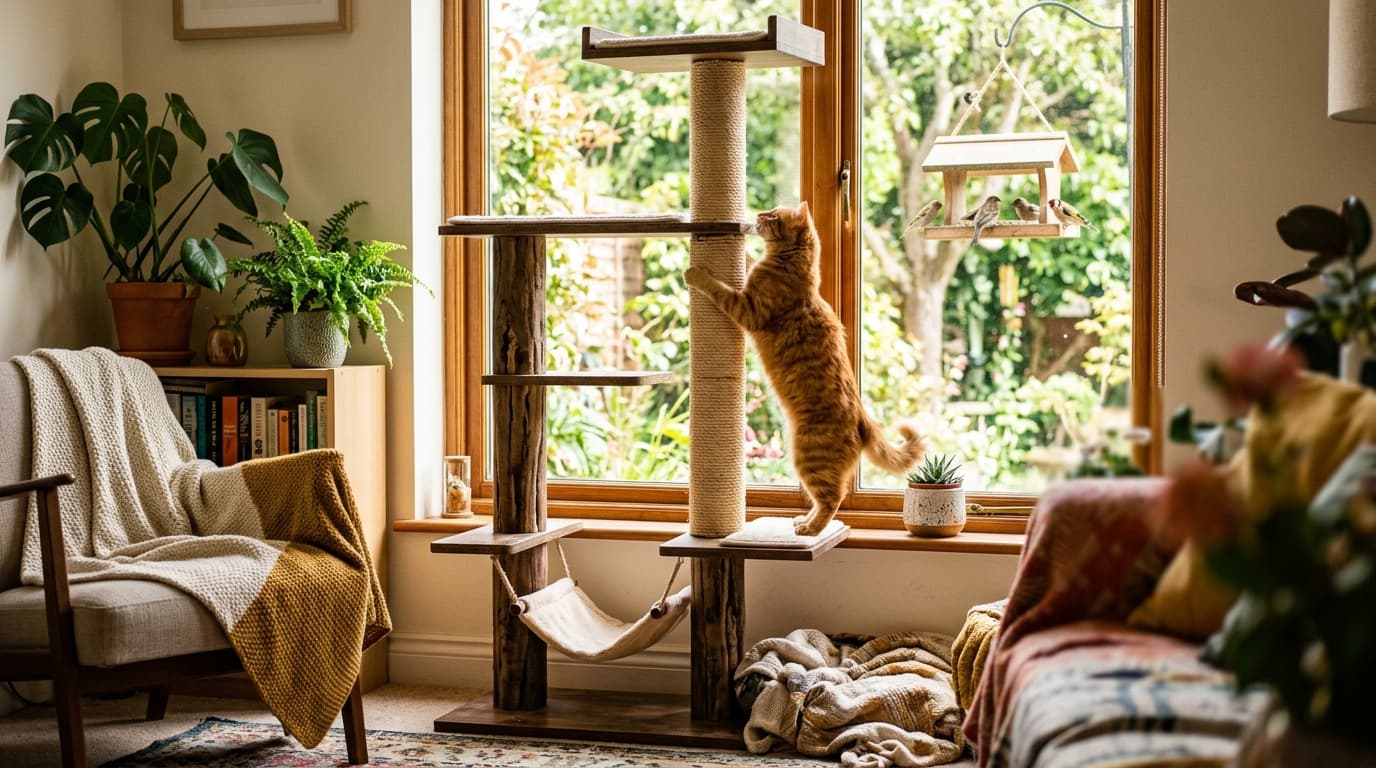
Cats think in three dimensions. Floor space is less important than vertical territory. A tall cat tree near a window or wall-mounted shelves that create an elevated highway around the room satisfies your cat's instinct to climb, perch, and survey their territory from above.
Tip: Place the cat tree near a window for built-in "cat TV" — birds, squirrels, and passing pedestrians provide hours of visual stimulation.
2. Interactive Wand Toys
The single most effective enrichment tool for cats. A feather wand or fishing pole toy triggers the full prey sequence: stalk, chase, pounce, catch. Play for 15–20 minutes twice daily — mimicking the movement of prey (erratic, darting away from the cat, not toward them).
Important: Let the cat "catch" the toy regularly. A hunt that never succeeds creates frustration, not enrichment.
3. Tunnels and Hiding Spots
Crinkle tunnels, paper bags (handles removed), and cardboard boxes satisfy cats' need to hide, ambush, and feel enclosed. Rotate different options to maintain novelty.
4. Cat Exercise Wheels
Yes, they exist — and many cats love them. Cat exercise wheels (like the One Fast Cat wheel) let high-energy breeds like Bengals, Abyssinians, and Siamese burn energy indoors. Not every cat will use one, but those who do can run for impressive distances.
5. Leash Walking and Catios
Indoor cats can safely experience the outdoors through harness training or enclosed "catios" (cat patios). Start harness training indoors, use a figure-H or vest-style harness (not a collar), and let the cat lead outdoor expeditions. Catios range from window box enclosures to full patio conversions.
Mental and Foraging Enrichment
6. Puzzle Feeders
Replace the food bowl with puzzle feeders that require your cat to work for their meals. This mimics natural foraging behavior and slows eating — reducing obesity risk while providing mental stimulation. Start simple and increase difficulty as your cat learns.
Budget option: Scatter kibble in an egg carton, muffin tin, or crumpled paper balls.
7. Food Scavenger Hunts
Hide small portions of food around the house in different locations each day. This turns mealtime into a hunting activity that engages your cat's nose, brain, and body. Start with obvious locations and gradually make them harder to find.
8. Catnip and Silver Vine
About 60–70% of cats respond to catnip, and many of those who don't respond instead to silver vine (which affects ~80% of cats, per a study published in BMC Veterinary Research). Offer fresh catnip, catnip toys, or silver vine sticks for periodic stimulation. The effect lasts 10–15 minutes.
9. Cat Grass
Wheatgrass or oat grass provides a safe, digestible plant for indoor cats to chew on. It satisfies the instinct to eat vegetation and provides fiber. Grow it on a windowsill for easy access.
10. Training Sessions
Yes, cats can be trained — and many enjoy it. Clicker training works just as well for cats as dogs. Start with simple tricks (sit, high-five, come when called) using high-value treats. Training sessions of 5–10 minutes provide meaningful mental stimulation and strengthen the human-cat bond.
Sensory Enrichment
11. Window Bird Feeders
Mount a bird feeder on the outside of a window where your cat can watch. This is passive enrichment that occupies cats for hours. Some owners report it's the single best thing they've done for their indoor cat's quality of life.
12. Cat-Specific Music and Videos
Research from the University of Wisconsin found that cats respond to "species-appropriate music" — compositions using frequencies and tempos within the cat vocal range. YouTube also has hours of "cat TV" videos featuring birds, fish, and squirrels that captivate many cats.
13. Rotating Toy Library
Cats lose interest in familiar toys. Instead of buying more, rotate them — put out 3–4 toys for a week, then swap them for a different set. Toys that have been hidden for two weeks feel new again.
Social Enrichment
14. Scheduled Play Sessions
Consistency matters more than duration. Two 15-minute focused play sessions per day (morning and evening, matching natural hunting peaks) is more effective than one random hour of play. Use different toys in each session to maintain interest.
15. A Second Cat (Maybe)
A compatible feline companion provides social enrichment that no human or toy can replicate. Key word: compatible. Two cats who don't get along create stress, not enrichment. If considering a second cat, match energy levels and temperaments, and follow a gradual introduction protocol.
Signs Your Cat Needs More Enrichment
- Over-grooming (bald patches, skin irritation)
- Excessive sleeping (even beyond normal cat napping)
- Aggression toward people or other pets
- Destructive behavior (scratching furniture, knocking things off surfaces)
- Overeating or loss of appetite
- Excessive vocalization
- Litter box avoidance
If you notice these signs, increase enrichment gradually and consult your vet to rule out medical causes.
Building an Enrichment Routine
You don't need to implement all 15 ideas at once. Start with the highest-impact options:
- Two daily play sessions with a wand toy (10–15 minutes each)
- A puzzle feeder for at least one meal per day
- Vertical space near a window
- Toy rotation weekly
Add more enrichment as you learn what your individual cat enjoys. Every cat is different — some go crazy for puzzle feeders while others prefer wand toys. Observe and adjust.
Sources
- UC Davis School of Veterinary Medicine — Indoor vs. outdoor cat lifespan data. vetmed.ucdavis.edu.
- Ohio State University Indoor Pet Initiative — Environmental enrichment for indoor cats. indoorpet.osu.edu.
- BMC Veterinary Research — "Responsiveness of cats to silver vine, Tatarian honeysuckle, valerian and catnip." bmcvetres.biomedcentral.com.
- University of Wisconsin — Species-appropriate music for cats research. news.wisc.edu.
- International Society of Feline Medicine (ISFM) — Indoor cat enrichment guidelines. icatcare.org.

Lloyd D'Silva
Founder & EditorDog owner for 5+ years, product researcher, and founder of PawBench. Every recommendation is based on hands-on experience with Maggie — my Australian Labradoodle — plus cross-referencing veterinary research from the AKC, AVMA, and peer-reviewed studies.
All product reviews are independently researched. Our recommendations are based on published veterinary guidelines, manufacturer specifications, and verified customer feedback. See our methodology.