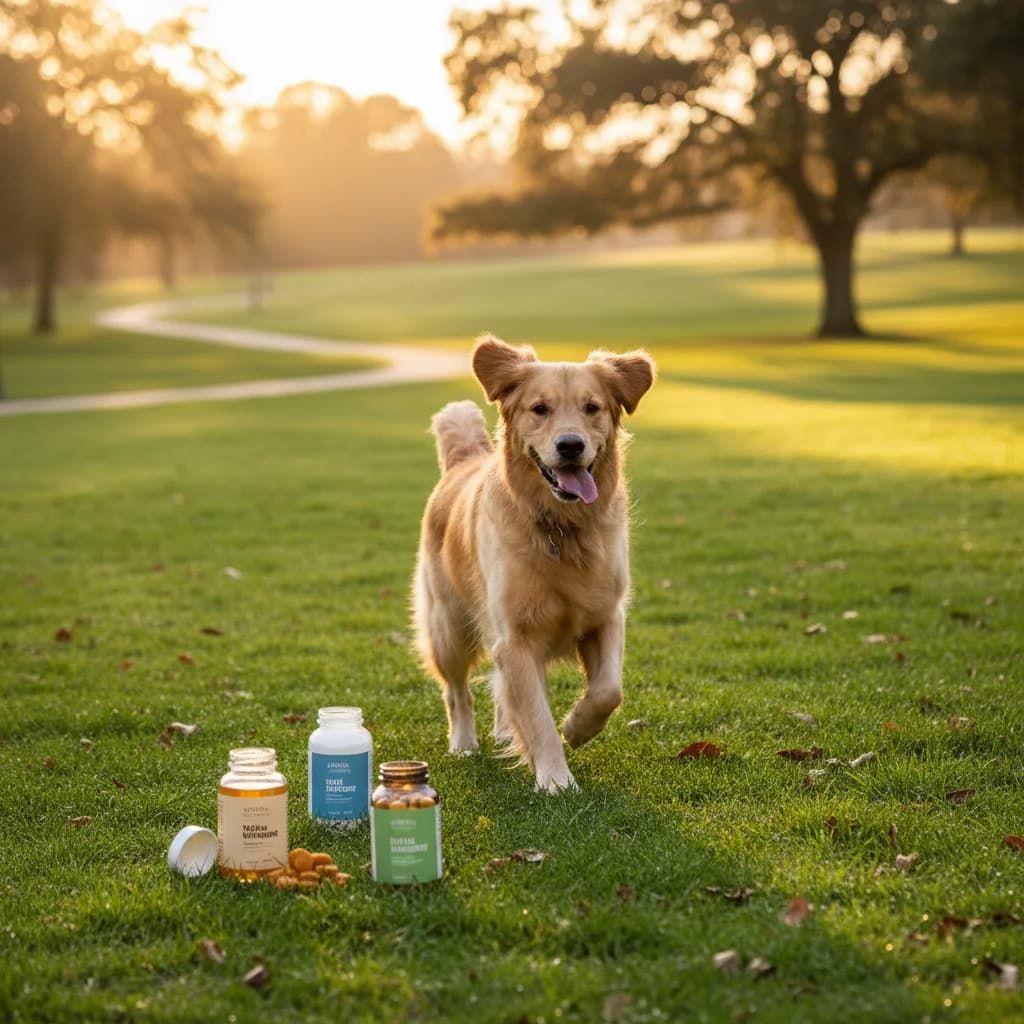
Does Your Puppy Actually Need DHA? The Science
Quick Answer
Yes, DHA matters for a puppy's brain and retinal development — but you don't need to buy it separately. Any food labeled complete and balanced for growth already meets AAFCO's minimum of 0.05% combined EPA + DHA. The science supports modest learning and trainability benefits from adequate dietary DHA; it does not support that adding a supplement on top of a quality puppy food makes a measurably smarter dog.
On this page6 sections
Our Verdict
DHA is a genuine structural nutrient for a puppy's developing brain and retina, with modest but real evidence for learning and trainability. But a complete-and-balanced puppy food already meets the AAFCO 0.05% EPA+DHA growth minimum — no separate supplement is needed, and no study shows extra DHA makes a smarter dog.

How PawBench is paid: we earn an Amazon Associates commission on qualifying purchases. We don’t accept sponsored placements, paid reviews, or free products in exchange for coverage. Picks are ranked on documented owner outcomes and primary-source research, never on commission rate. Read the full methodology.
Walk down the puppy-food aisle and you'll see "DHA for brain development" stamped on nearly every premium bag. Unlike a lot of pet-food buzzwords, this one is grounded in real science — DHA genuinely matters for a growing puppy. But the marketing wraps a kernel of solid research in a thick layer of overclaim, and that's where owners get separated from their money.
Here's the honest, sourced version: what DHA does, how much your puppy actually needs, where it should come from, and — just as important — what the research does not support.
Key Takeaways
- DHA is a structural building block of the brain and retina, actively deposited during a puppy's first few months. This is developmental biology, not a wellness fad.
- A complete-and-balanced puppy food already contains DHA. AAFCO sets a minimum of 0.05% combined EPA + DHA (dry-matter basis) in its Growth and Reproduction profile. If the bag says "complete and balanced for growth," the DHA is in there.
- The strongest evidence shows DHA improves learning and trainability — but the effect sizes are modest, and one controlled study found the benefit in basic learning, not in more complex reversal tasks.
- What the research does NOT support: that adding a DHA supplement on top of a complete puppy food makes a measurably smarter dog. No study shows extra benefit from megadosing beyond what a quality growth diet delivers.
What DHA Is and Why a Puppy Needs It
DHA — docosahexaenoic acid — is a long-chain omega-3 polyunsaturated fatty acid, the same family as the fish-oil omega-3s humans take, alongside EPA (eicosapentaenoic acid).
What makes DHA special for a developing animal is structural. The brain is roughly 50% fat, and per the American Kennel Club's summary of the science, DHA makes up 10–20% of all the fat in the brain and more than 90% of the long-chain polyunsaturated fats found there. It's also a major component of the retina. DHA isn't a "boost" the brain optionally uses; it's part of the physical material the brain and eyes are built from.
The timing is what matters for puppies. A 2023 review in the journal Animals notes the canine brain keeps developing for roughly 60 days after birth and continues growing until adulthood — and during this window the brain incorporates DHA selectively and at higher concentrations than other fatty acids. The diet a puppy eats in those early months directly influences how much DHA ends up in brain tissue.
The Actual Science (and Its Limits)
Two lines of canine evidence anchor the DHA-for-trainability claim:
The headline study. Beagle puppies fed a diet fortified with higher DHA from weaning to one year performed significantly better on learning, visual-contrast discrimination, and psychomotor tasks — T-mazes, object-displacement puzzles, memory tests — than puppies on low- or moderate-DHA diets. (Journal of the American Veterinary Medical Association, Heinemann et al., 2012)
That's a real, peer-reviewed result, and the basis for most "DHA aids trainability" marketing.
But more recent data tells a more nuanced story. In the 2023 Animals study, twelve 3-month-old puppies were split into a control group and a group supplemented with DHA-concentrated fish oil (about 40 mg DHA per kg of body weight per day). On the normal stage of an object-discrimination test, the supplemented puppies scored significantly higher — 70.1% correct versus 62.7% for controls (p = 0.0039).
Here's the part the marketing leaves out: on the reverse stage — the harder cognitive-flexibility task — there was no statistically significant difference between groups. DHA helped with straightforward learning, not with the more demanding reversal challenge. The effect is real but bounded.
| What the evidence shows | Strength | What it does NOT show |
|---|---|---|
| DHA is structurally essential to brain + retina | Strong, mechanistic | That more is always better |
| Higher-DHA diets improve basic learning/trainability | Moderate (small controlled studies) | A large, reliable IQ jump |
| Benefit appears in simple learning tasks (p ≈ 0.004) | Demonstrated | Benefit in complex reversal tasks (not significant) |
| Adequate DHA comes from complete puppy food | Established by AAFCO profile | That topping up with supplements adds measurable benefit |
What AAFCO Actually Requires
This is where most of the confusion lives. The Association of American Feed Control Officials (AAFCO) publishes the nutrient profiles "complete and balanced" foods must meet. In the Dog Food Nutrient Profile for Growth and Reproduction, the minimum for combined EPA + DHA is 0.05% on a dry-matter basis (with a minimum of 0.08% alpha-linolenic acid).
The practical translation: if a label says it is "formulated to meet the AAFCO Dog Food Nutrient Profiles for growth," it already contains a baseline of DHA. You're not choosing between "DHA food" and "no-DHA food" — you're choosing between foods that meet the minimum and foods that exceed it.
One widespread myth worth killing: the special large- and giant-breed puppy designation is not about DHA. Since 2016, per Tufts University's Petfoodology, AAFCO requires growth foods to state whether they suit large-breed puppies (expected to exceed 70 lbs as adults) — and that distinction is about a narrower calcium range to protect developing bones, not omega-3s. For a large-breed pup, the label phrase to look for is "including growth of large-size dogs (70 lbs or more as an adult)." Don't let a "DHA for big brains" pitch distract you from the calcium spec that actually matters for a Great Dane or Lab.
Food Sources of DHA
DHA comes from marine sources, not plants. The AKC lists the best dietary sources as coldwater fish — sardines, anchovies, salmon, mackerel, trout, and herring — plus algae (the original source fish get it from). Algal oil delivers DHA directly without fish.
A common mistake: assuming a "rich in omega-3s" or "contains flaxseed" claim equals DHA. Flaxseed and other plant oils provide alpha-linolenic acid (ALA), a short-chain omega-3 that dogs convert to DHA only inefficiently. For reliable DHA, the source needs to be fish, fish oil, or algal oil — check the ingredient panel for those, not a generic "omega-3" splash on the front of the bag.
If you're comparing growth diets, our best puppy food for dogs under 1 year and DHA-rich puppy food picks walk through specific options and what to read on the label.
So Should You Supplement?
For the vast majority of puppies eating a quality complete-and-balanced growth food: no separate DHA supplement is needed. The food is formulated to deliver adequate DHA, and there's no evidence that stacking a fish-oil capsule on top produces a smarter or more trainable dog. The supplemented-group studies measured modest learning gains on controlled diets; none show that exceeding a complete diet's DHA adds benefit.
A veterinarian might recommend omega-3 supplementation for skin and coat issues, inflammatory conditions, or a homemade diet not formulated by a board-certified veterinary nutritionist. Those are clinical decisions, not brain-enhancement plays. And DHA isn't risk-free in excess: as a highly unsaturated fat, too much can contribute to lipid oxidation, which is why the 2023 study specifically tracked antioxidant capacity. More is not a free upgrade.
The honest bottom line: DHA earns its place in puppy food — a genuine structural nutrient with real, if modest, cognitive evidence behind it. But "complete and balanced for growth" already covers it. Spend your decision-making energy on choosing a reputable, properly formulated diet (and the right calcium spec if your pup is a large breed), not on chasing a DHA number or buying supplements your puppy doesn't need.
If you want to go deeper on supplements generally, see our guide to dog health supplements, which covers when omega-3s are and aren't worth it.
Research Sources
- Boosting Puppy Brains for Trainability With Omega-3 Fatty Acids — American Kennel Club
- Evaluation of cognitive learning, memory, psychomotor, immunologic, and retinal responses in DHA-fortified puppies — Journal of the American Veterinary Medical Association
- The Supplementation of Docosahexaenoic Acid-Concentrated Fish Oil Enhances Cognitive Function in Puppies — Animals (NCBI PMC)
- AAFCO Dog Food Nutrient Profiles (Growth and Reproduction) — AAFCO
- Confused About What to Feed Your Large Breed Puppy? New Rules May Help! — Tufts University Petfoodology

PawBench Editorial
Published by Hilly Shore LabsPawBench’s editorial team researches dog products from primary veterinary sources, manufacturer specifications and aggregated buyer sentiment, alongside the lived ownership of Maggie, an Australian Labradoodle. We do not run hands-on product tests.
254 dog products scored · 1,160,091 buyer review-aspect mentions aggregated · cites AVMA, FDA, AAFCO, Cornell, WSAVA, AKC, ASPCA.
Recommendations are based on published veterinary guidelines, manufacturer specifications, and verified customer feedback. See our editorial standards.