Dog Anxiety: What Actually Works (and What Doesn't)
Quick Answer
Combine management tools (covered crate, calming treats, white noise) with gradual desensitization training. No single product fixes anxiety -- it requires a systematic behavioral approach.
On this page9 sections
Our Verdict
Combine a covered crate, calming treats, and white noise for immediate management, then work with a trainer on gradual desensitization. No single product cures anxiety -- it requires a systematic behavioral approach.
How PawBench is paid: we earn an Amazon Associates commission on qualifying purchases. We don’t accept sponsored placements, paid reviews, or free products in exchange for coverage. Picks are ranked on documented owner outcomes and primary-source research, never on commission rate. Read the full methodology.
An estimated 70% of dogs display anxiety-related behaviors at some point in their lives. That statistic surprises most people, but if you have ever come home to shredded blinds, a urine-soaked crate, or a dog that trembles during thunderstorms, you know exactly how real it is. The problem is not a lack of products claiming to fix anxiety. The problem is that most of them do not work -- and the ones that do require more effort than a quick purchase.
I have spent years sorting the evidence-backed solutions from the marketing noise. Here is what actually moves the needle.
Understanding the Three Types of Dog Anxiety
Before you can fix it, you need to identify it. Most dog anxiety falls into one of three categories, and the treatment approach differs significantly for each.
- Separation anxiety: is the most common and the most destructive. Dogs with separation anxiety panic when left alone. Symptoms include destructive behavior (targeting doors, windows, and owner belongings), excessive vocalization, house soiling despite being fully housebroken, and escape attempts that can result in injury. This is not your dog being "bad." This is a genuine panic response.
- Noise anxiety: is triggered by specific sounds -- fireworks, thunderstorms, construction, vacuum cleaners. Dogs with noise anxiety may tremble, hide, pant excessively, or become destructive during noise events. The Fourth of July is the single busiest day for animal shelters in the United States because noise-anxious dogs escape and run.
- Generalized anxiety: is the hardest to pin down. These dogs seem nervous or hypervigilant much of the time, startling easily, avoiding new situations, and struggling to settle. It is the canine equivalent of a chronic anxiety disorder and often requires the most intensive intervention.
Behavior Modification: The Foundation of Everything
No product, supplement, or medication is a substitute for behavior modification. This is the single most important point in this entire article. Desensitization and counterconditioning are the evidence-based gold standard for treating all three types of anxiety, and they work.
- For separation anxiety: The protocol involves practicing departures at a level the dog can tolerate without panicking, then gradually increasing duration. Start by picking up your keys without leaving. Then step outside for 5 seconds and return. Then 10 seconds. Then 30. It is painfully slow work -- many cases take 6-12 weeks of daily practice -- but the success rate for dogs that complete the protocol is above 70%.
- For noise anxiety: Play recordings of the triggering sound at extremely low volume while feeding high-value treats. Over weeks, gradually increase the volume. Pair every noise exposure with something your dog loves -- a frozen KONG stuffed with peanut butter is the classic pairing because it provides 20-30 minutes of focused engagement.
- For generalized anxiety: Teach a reliable "settle" command on a mat. Reward calm behavior heavily. Establish predictable routines. Avoid flooding -- do not force an anxious dog into overwhelming situations hoping they will "get over it."
ThunderShirt: The Data Is Surprisingly Solid
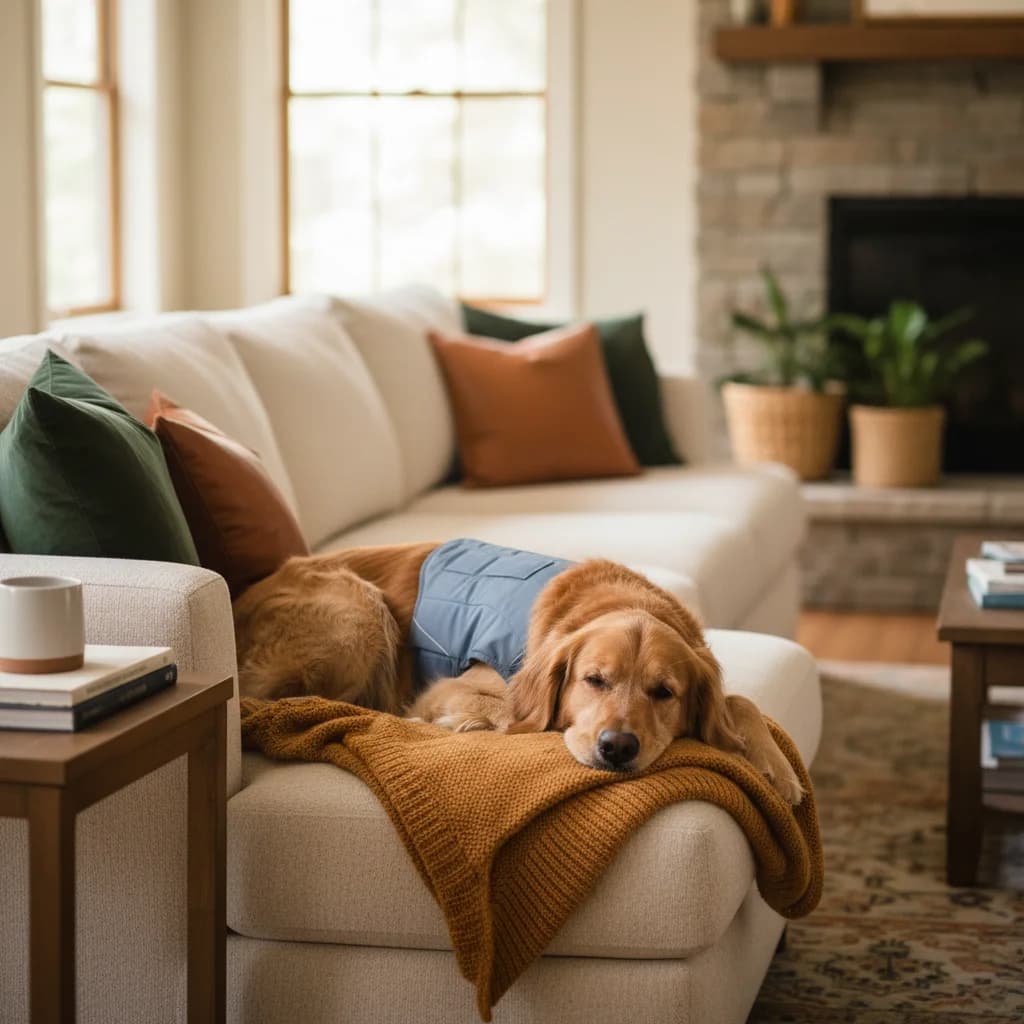
I expected the ThunderShirt ($45) to be pure gimmick. It is not. The concept -- applying constant, gentle pressure to the torso to calm the nervous system -- has roots in Temple Grandin's research on deep pressure therapy. Multiple studies have found measurable reductions in heart rate and cortisol levels in dogs wearing pressure wraps during stressful events.
- The numbers: ThunderShirt's own owner survey reports improvement in about 80% of dogs. That is a maker claim, not a controlled trial, so treat the wrap as something to try alongside training rather than a fix.
- My recommendation: At $45, it is worth trying for noise anxiety specifically. Put it on 15-20 minutes before the triggering event, not during. If your dog shows no improvement after three trials, it is probably not going to work for them.
Medication: The Most Underused Tool
Here is an unpopular opinion: veterinary behaviorists consider medication the most underutilized treatment for canine anxiety. There is a persistent stigma among dog owners that medicating a dog for anxiety is somehow "giving up." That attitude causes unnecessary suffering.
- Daily medications: like fluoxetine (Reconcile) and sertraline are selective serotonin reuptake inhibitors (SSRIs) that reduce baseline anxiety levels over 4-8 weeks. They do not sedate your dog or change their personality. They lower the anxiety floor so that behavior modification can actually work.
- Situational medications: like trazodone and alprazolam are used for predictable events -- vet visits, fireworks, travel. They work within 1-2 hours and are appropriate for dogs whose anxiety is intense but infrequent.
- The key point: Medication works best in combination with behavior modification, not as a replacement. Think of it as turning down the volume on anxiety so your dog can actually learn. If your dog's anxiety is severe enough to cause self-injury, house destruction, or chronic distress, talk to your vet. A board-certified veterinary behaviorist is the gold standard referral.
CBD: What the Evidence Actually Shows
The CBD pet product market is projected to exceed $600 million by 2027, and the marketing claims are aggressive. Here is the reality check.
- What the research shows: There are a small number of published studies on CBD and canine anxiety. A 2023 study in the Journal of the American Veterinary Medical Association found that CBD reduced stress behaviors in dogs during car travel. A Cornell study found some benefits for osteoarthritis pain. The evidence is preliminary and limited.
- What the research does not show: That CBD is a reliable standalone treatment for separation anxiety, noise anxiety, or generalized anxiety. The studies that exist use pharmaceutical-grade CBD at specific dosages -- not the treats you find at the pet store with unverified concentrations.
- My take: If you want to try CBD, use a product with a third-party certificate of analysis (COA), discuss the dosage with your vet, and do not expect miracles. It may take the edge off for mild cases. It is not a substitute for behavior modification or prescription medication for moderate-to-severe anxiety.
Environmental Enrichment: The Preventive Approach
Many dogs develop anxiety partly because they are bored and understimulated. A dog that spends 10 hours alone in an empty apartment with nothing to do is a candidate for anxiety, full stop.
What actually helps:
- Puzzle feeders -- Ditch the bowl entirely. Feed every meal through a KONG Wobbler, snuffle mat, or scatter feeding in the yard
- Rotation toys -- Keep 3-4 toys out at a time and rotate weekly to maintain novelty
- Window access -- A perch by a window provides hours of visual stimulation
- Background noise -- Leave a radio or TV on. Studies show dogs prefer classical music or audiobooks over silence
- Midday breaks -- If you cannot come home — common for owners working 12-hour shifts — a dog walker provides a critical break in the isolation. Even 20 minutes makes a difference
If you are crate training a puppy, getting enrichment right from the start builds resilience against anxiety developing later. A crate should be a positive, enriching space -- never a barren box.
For owners who work long hours, a pet camera with treat-tossing capability lets you interact with your dog during the day. It is not a replacement for physical presence, but it can interrupt anxiety spirals and provide a moment of connection.
What Does NOT Work
Let me be direct about the approaches that waste your money and your dog's time:
- Punishment. Punishing an anxious dog for destructive behavior makes the anxiety dramatically worse. They are not being "bad." They are panicking.
- Flooding. Forcing a noise-anxious dog to endure fireworks at close range does not toughen them up. It traumatizes them.
- Essential oils and diffusers. Lavender oil diffusers are marketed aggressively for dog anxiety. The evidence is effectively zero, and some essential oils are toxic to dogs.
- Homeopathic remedies. Bach's Rescue Remedy and similar products have no mechanism of action and no clinical evidence of efficacy in dogs.
The Bottom Line
Dog anxiety is treatable, but there are no shortcuts. Start with behavior modification -- it is the foundation. Add a ThunderShirt for noise anxiety specifically. Talk to your vet about medication if the anxiety is moderate to severe. Enrich your dog's environment aggressively. Skip the CBD treats and essential oils unless your vet specifically recommends them. Your anxious dog is not broken. They need patience, structure, and the right support.
🏆 Bottom Line: Most dog anxiety responds best to a combination approach: behavioral modification (desensitization + counter-conditioning), environmental management (safe space, predictable routine), and tools like ThunderShirts as supplements. Calming treats work for mild situational anxiety. For severe separation anxiety or generalized anxiety, a veterinary behaviorist consultation is worth the investment.
Related Reading
- Dog Health — Calming supplements and anxiety products
- Training — Behavior modification techniques
- Dog Beds — Calming beds for anxious dogs
Research Sources
- Separation Anxiety in Dogs — ASPCA, 2023
- Anxious Behavior: How to Help Your Dog Cope with Unsettling Situations — Cornell University College of Veterinary Medicine, 2023
- Fearful Dogs — Cornell University College of Veterinary Medicine, 2023
- AVSAB Position Statements on Humane Dog Training — American Veterinary Society of Animal Behavior, 2021
- Fear of Fireworks and Thunderstorms — Cornell University College of Veterinary Medicine, 2023

PawBench Editorial
Published by Hilly Shore LabsPawBench’s editorial team researches dog products from primary veterinary sources, manufacturer specifications and aggregated buyer sentiment, alongside the lived ownership of Maggie, an Australian Labradoodle. We do not run hands-on product tests.
331 dog products scored · 1,222,724 buyer review-aspect mentions aggregated · cites AVMA, FDA, AAFCO, Cornell, WSAVA, AKC, ASPCA.
Recommendations are based on published veterinary guidelines, manufacturer specifications, and verified customer feedback. See our editorial standards.