How Many Calories Does My Dog Need? The RER Formula
Quick Answer
Daily calories come from a two-step formula, not the cup printed on the bag. First find Resting Energy Requirement: RER = 70 x (target weight in kg) raised to the 0.75 power, or use the shortcut (30 x kg) + 70 for dogs roughly 2 to 45 kg. Then multiply RER by a life-stage factor to get the Daily Energy Requirement: about 1.4 to 1.6 for a neutered adult, 1.0 for weight loss, and 2.0 to 3.0 for growing puppies. A 20 kg neutered adult works out to roughly 990 calories a day. Always use target weight, not current weight, and treat the result as a starting ration that you verify against body condition over the next few weeks, since real needs can vary by as much as 50 percent from the calculated number.
On this page7 sections
Our Verdict
Daily calories = RER (70 x target-kg^0.75) times a life-stage factor (about 1.4 to 1.6 for a neutered adult, 1.0 for weight loss, 2.0 to 3.0 for puppies). Use target weight, then verify against body condition over a few weeks, since real needs can vary up to 50 percent from the math.
Starting Daily Calories by Weight (Neutered Adult)
RER = 70 x kg^0.75, then a 1.4 to 1.6 neutered-adult factor. Read as a starting range for an average neutered adult, then adjust to target weight, life stage, and body condition.
| Product | Target Weight | RER (rest) | Daily Range (kcal) | ~Cups @ 360 kcal/cup |
|---|---|---|---|---|
| 10 lb / 4.5 kg | Small | ~220 | 305 - 350 | 0.8 - 1.0 |
| 20 lb / 9 kg | Small | ~365 | 510 - 585 | 1.4 - 1.6 |
| 40 lb / 18 kg | Medium | ~615 | 860 - 985 | 2.4 - 2.7 |
| 60 lb / 27 kg | Large | ~835 | 1,170 - 1,335 | 3.3 - 3.7 |
| 80 lb / 36 kg | Large | ~1,035 | 1,450 - 1,655 | 4.0 - 4.6 |
How PawBench is paid: we earn an Amazon Associates commission on qualifying purchases. We don’t accept sponsored placements, paid reviews, or free products in exchange for coverage. Picks are ranked on documented owner outcomes and primary-source research, never on commission rate. Read the full methodology.
The feeding guide on the bag is a starting point, not a prescription. The number your vet actually uses is a two-step calculation built on your dog's metabolic body size, and you can run it at home with a calculator and one number: your dog's target weight in kilograms.
This is the math behind every "vet calorie calculator" you've searched for, written out so you can see exactly what each step does and where the common mistakes hide.
Key takeaways
- Calories come from a formula, not a cup. Daily calories = RER (resting energy) × a life-stage factor. The bag's "cups per day" is a rough average across all dogs of that weight.
- Use target weight, not current weight. If your dog is overweight, calculating from today's weight just feeds the extra weight. Always plug in the ideal/target weight.
- The factor is where most people go wrong. A neutered, indoor adult uses a much lower multiplier than a working dog or a growing puppy. Picking the wrong one can be off by 100% or more.
- The result is an estimate, not a guarantee. Individual dogs vary by as much as 50% from the calculated number. The calculation gives you a starting ration; body condition over the next month tells you whether it was right.
Step 1: Resting Energy Requirement (RER)
RER is the calories a dog burns at rest just to stay alive — breathing, circulation, organ function. It scales with metabolic body size, not linear body weight, which is why a dog twice as heavy does not need twice the calories.
The formula: RER = 70 × (body weight in kg)^0.75
A 20 kg (44 lb) dog: 70 × 20^0.75 ≈ 662 kcal/day at rest.
If exponents are not your thing, there is a linear shortcut that veterinary references use for dogs between roughly 2 and 45 kg:
Linear shortcut: RER ≈ (30 × body weight in kg) + 70
Same 20 kg dog: (30 × 20) + 70 = 670 kcal/day.
The two methods land within ~1% for mid-sized dogs. For very small (under ~2 kg) or very large (over ~45 kg) dogs, the linear version drifts, so use the exponent formula at the extremes.
Step 2: Multiply by the life-stage factor (DER)
RER is the floor. To get the Daily Energy Requirement (DER) — what your dog actually needs to eat in a normal day — you multiply RER by a factor that reflects life stage, neuter status, and activity.
The widely-used veterinary factor ranges:
| Dog's situation | Factor × RER |
|---|---|
| Weight loss (target) | 1.0 |
| Overweight, prone to gain | 1.0 – 1.2 |
| Inactive / indoor adult | 1.0 – 1.4 |
| Neutered adult | 1.4 – 1.6 |
| Intact adult | 1.6 – 1.8 |
| Light activity / working | 2.0 – 5.0 |
| Puppy, ~4 months to adult | 2.0 |
| Puppy, weaning to 4 months | 3.0 |
So a neutered 20 kg adult is roughly 662 × 1.5 ≈ 990 kcal/day. The same dog as a young puppy would need closer to 2,000 kcal — which is why puppy and adult feeding amounts look so different.
A worked daily-calorie chart
The starting-calories table at the top of this page runs the full calculation for common weights: RER = 70 × kg^0.75, then a 1.4–1.6 neutered-adult factor, with cups based on a typical 360 kcal/cup food. Read each row as a starting range for an average neutered adult at that target weight, then adjust for your own dog.
Find the calories on the bag, then divide
Once you have a target DER in kcal/day, the last step is simple: find the kcal/cup (called "metabolizable energy" or ME) printed on your food's bag or the brand's website, then:
Cups per day = DER ÷ kcal per cup
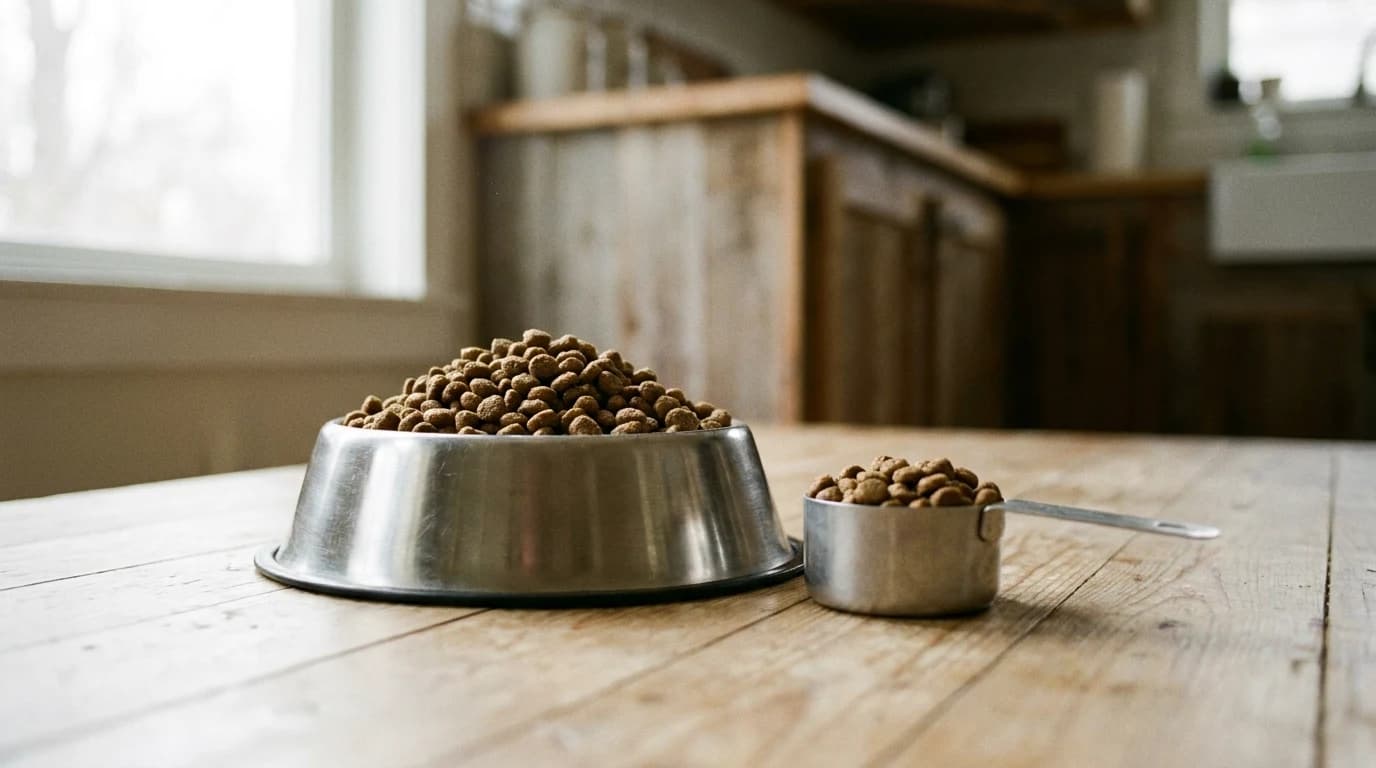
A 990 kcal/day dog on a food with 360 kcal/cup needs 990 ÷ 360 ≈ 2.75 cups/day, split across meals. Two foods can differ by 150+ kcal/cup, so "two cups" of one food is not the same as "two cups" of another — always check the ME, not the cup.
And do not forget treats. Treats should stay under 10% of daily calories; the other 90% comes from a complete-and-balanced food. A handful of high-value training treats can quietly add 100+ kcal, which is a fifth of a small dog's entire day.
What most people get wrong
They calculate from current weight. If a dog needs to slim down, feeding the DER for today's heavier weight maintains the problem. Run the formula on the target weight, then use the 1.0 weight-loss factor.
They treat the result as exact. The Ohio State University veterinary nutrition service is blunt about this: individual energy needs can vary by as much as 50% from the calculated value. Two same-weight dogs of different breeds, temperaments, or coat types can have genuinely different needs. The formula gives you a defensible starting ration — not a final answer.
They never check the work. The calculation is step one. Step two is feeding that amount for 2–4 weeks and re-checking body condition by hand. If the ribs are getting harder to feel and the waist is disappearing, the number was too high; trim 10% and recheck. Body condition is the feedback loop the formula cannot replace.
They forget that "active" is a wide band. A leashed-walk pet and a hard-working sled dog are not the same animal. The working/active multiplier runs from 2.0 all the way to 5.0, so do not casually upgrade a normal pet dog to a working factor because it "seems energetic."
The honest bottom line
The RER × factor calculation is the right tool to start a feeding plan — it is more rigorous than the bag's averages and it forces you to think about target weight and life stage. But it is a starting estimate, not a measurement. Run the math, feed the result, then let your dog's body condition over the following weeks be the real verdict.
If you want to skip the arithmetic, check your dog's body condition score first — it tells you whether your current feeding is already working — and use the complete feeding guide by weight and age for portion ranges once you have a calorie target.
Research Sources
- Veterinary RER & MER Calorie Calculator for Dogs and Cats — Association for Pet Obesity Prevention (APOP)
- Calculate the Perfect Portions for Pets — dvm360
- Companion Animal Nutrition Support Service — Ohio State University College of Veterinary Medicine
- How Much Should I Feed My Dog? — American Kennel Club
- 2021 AAHA Nutrition and Weight Management Guidelines — American Animal Hospital Association

PawBench Editorial
Published by Hilly Shore LabsPawBench’s editorial team researches dog products from primary veterinary sources, manufacturer specifications and aggregated buyer sentiment, alongside the lived ownership of Maggie, an Australian Labradoodle. We do not run hands-on product tests.
331 dog products scored · 1,222,724 buyer review-aspect mentions aggregated · cites AVMA, FDA, AAFCO, Cornell, WSAVA, AKC, ASPCA.
Recommendations are based on published veterinary guidelines, manufacturer specifications, and verified customer feedback. See our editorial standards.