How Much Should I Feed My Dog? Complete Feeding Guide by Weight and Age
Quick Answer
Start with the feeding guide on your dog food bag based on target weight, then adjust by 10% up or down based on body condition score. Most dogs are overfed by 20-30%.
On this page10 sections
Our Verdict
Use the bag's feeding guide as a starting point based on your dog's target weight, then adjust by 10% based on body condition. Most dogs are overfed by 20-30%.

How PawBench is paid: we earn an Amazon Associates commission on qualifying purchases. We don’t accept sponsored placements, paid reviews, or free products in exchange for coverage. Picks are ranked on documented owner outcomes and primary-source research, never on commission rate. Read the full methodology.
"How much should I feed my dog?" is one of the most common questions veterinarians hear — and one of the most commonly answered incorrectly by dog food bags. The feeding guidelines printed on kibble packaging are starting estimates, not precise prescriptions. They're designed to work for the "average" dog, but your dog's ideal portion depends on their age, weight, breed, activity level, metabolism, and whether they need to gain, lose, or maintain weight.
This guide gives you a research-based framework for determining the right amount, then adjusting based on real-world results.
The Basic Formula: Calories, Not Cups
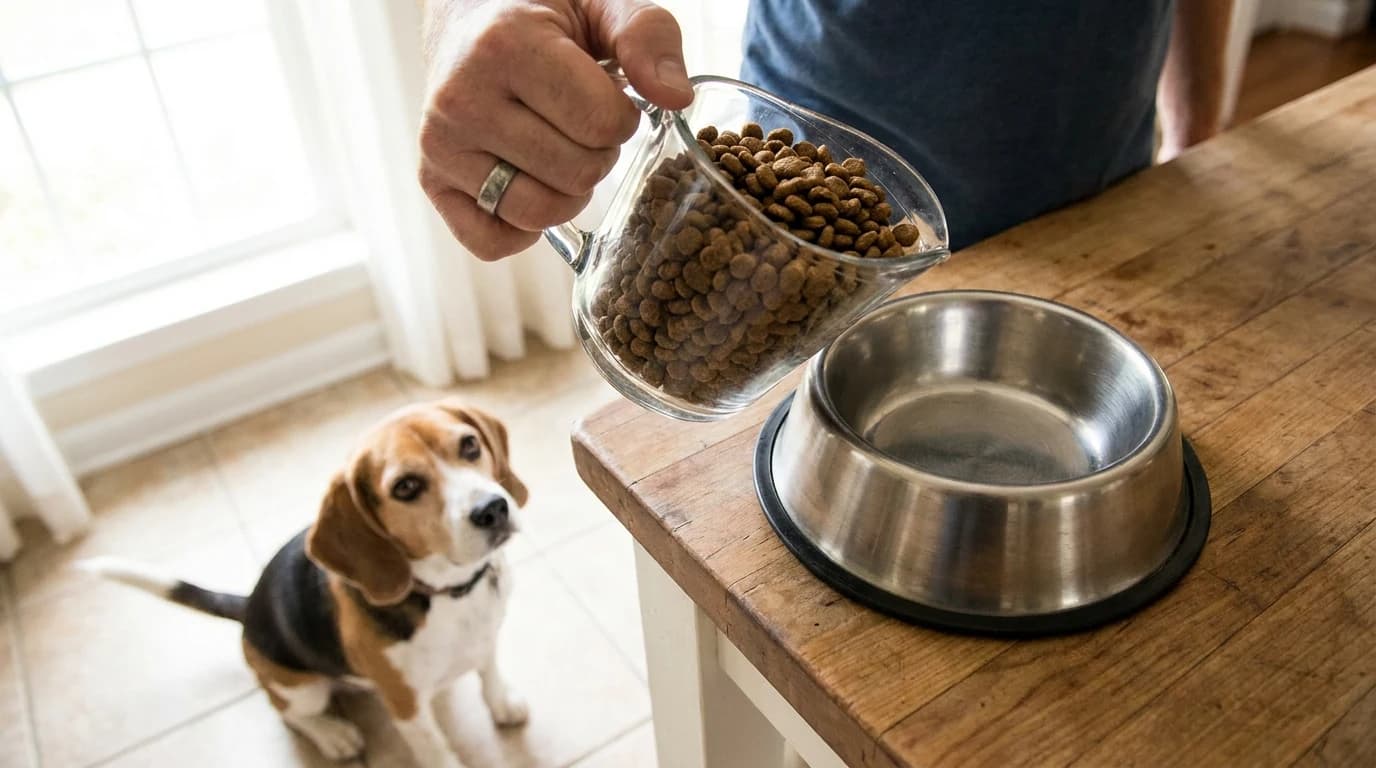
Dog food brands list feeding amounts in cups, but cups vary wildly in calorie content between brands. A cup of one kibble might be 300 calories; a cup of another might be 500. That's why calories are the better unit of measurement.
Resting Energy Requirement (RER) is the baseline calories your dog needs to maintain basic body functions:
RER = 70 × (body weight in kg)^0.75
Then multiply by an activity factor:
| Life Stage / Activity | Multiply RER by |
|---|---|
| Neutered adult, normal activity | 1.6 |
| Intact adult, normal activity | 1.8 |
| Light activity / senior | 1.2-1.4 |
| Moderate activity (1+ hr daily exercise) | 2.0-3.0 |
| High activity (working/sport dogs) | 3.0-6.0 |
| Weight loss | 1.0 |
| Puppy (4-12 months) | 2.0-3.0 |
| Puppy (under 4 months) | 3.0 |
Example: A 30-kg (66-lb) neutered adult dog with normal activity:
- RER = 70 × 30^0.75 = 70 × 12.8 = 897 calories
- Daily needs = 897 × 1.6 = 1,435 calories per day
Then check the calorie content of your dog's food (listed on the bag as kcal/cup or kcal/kg) and divide accordingly. Our step-by-step RER formula guide covers the common mistakes, like calculating from current rather than target weight.
Quick Reference: Daily Feeding by Weight
For owners who want a simpler starting point, here are general daily feeding ranges for adult dogs of moderate activity eating standard kibble (~350-400 kcal/cup):
| Dog Weight | Daily Amount (cups) | Daily Calories (approx.) |
|---|---|---|
| 5 lbs (2.3 kg) | 1/3 - 1/2 cup | 200-275 |
| 10 lbs (4.5 kg) | 1/2 - 3/4 cup | 275-400 |
| 20 lbs (9 kg) | 3/4 - 1.5 cups | 400-700 |
| 30 lbs (14 kg) | 1.5 - 2 cups | 700-900 |
| 50 lbs (23 kg) | 2 - 2.5 cups | 900-1,200 |
| 70 lbs (32 kg) | 2.5 - 3.5 cups | 1,200-1,600 |
| 90 lbs (41 kg) | 3.5 - 4.5 cups | 1,600-2,000 |
| 100+ lbs (45+ kg) | 4.5+ cups | 2,000+ |
These are starting points. Adjust based on body condition (see below).
How Many Meals Per Day?
| Age | Meals Per Day |
|---|---|
| Under 4 months | 3-4 |
| 4-12 months | 2-3 |
| Adults (1+ year) | 2 |
| Seniors (7+ years) | 2-3 (smaller meals) |
Two meals per day is the standard recommendation for adult dogs. It's more satisfying than one large meal, reduces the risk of bloat (particularly in deep-chested breeds), and provides more stable blood sugar levels throughout the day.
For dogs prone to bloat, also consider a slow feeder bowl to further reduce risk.
The Body Condition Score: Your Best Feedback Tool
Forget the scale — the Body Condition Score (BCS) is how veterinarians actually assess whether your dog is at a healthy weight. It's a 1-9 scale, and it's something you assess with your hands and your eyes rather than a number readout.
| Score | What you feel and see |
|---|---|
| 1-3 (Underweight) | Ribs, spine, and hip bones clearly visible; no palpable body fat; obvious abdominal tuck and waist |
| 4-5 (Ideal) | Ribs easily felt with slight fat covering (not visible); clear waist when viewed from above; abdominal tuck visible from the side; slight fat pad over the ribcage |
| 6-7 (Overweight) | Ribs difficult to feel under fat layer; waist barely distinguishable; abdomen may appear rounded from the side |
| 8-9 (Obese) | Ribs can't be felt under thick fat; no waist visible; obvious abdominal distension; fat deposits on neck, limbs, and tail base |
The goal is a BCS of 4-5. If your dog scores higher, reduce portions by 10-15% and reassess in 2 weeks. If lower, increase by the same margin. Small, gradual adjustments are more sustainable (and safer) than dramatic changes.
Special Circumstances
Puppies
Puppies need more calories per pound than adults. Feed a puppy-specific formula and follow the elevated feeding frequency schedule above. Large breed puppies should eat large-breed-specific puppy food with controlled calcium levels.
Senior Dogs
Senior dogs (7+ years) typically need 20-30% fewer calories than young adults due to decreased activity and slower metabolism. But protein requirements may actually increase to maintain muscle mass. A senior-specific food with moderate calories and higher protein is ideal. See our senior dog food guide for recommendations.
Pregnant/Nursing Dogs
Nutritional needs increase dramatically — up to 2-3x normal caloric intake during peak lactation. Work with your vet for specific feeding plans during pregnancy and nursing.
Weight Loss
A safe weight loss rate for dogs is 1-2% of body weight per week. Reduce daily calories to 1.0x RER (the resting energy requirement without an activity multiplier). This creates a caloric deficit while still meeting basic nutritional needs. Always consult your vet before putting your dog on a diet — underlying conditions like hypothyroidism can cause weight gain that won't respond to simple calorie restriction.
Active and Working Dogs
Dogs with high daily activity — hiking partners, agility competitors, herding breeds in active work — may need 2-3x the calories of a sedentary pet. Increase portions or switch to a higher-calorie performance food.
Treats Count Too
This is where most feeding plans fall apart.
Rule of thumb: treats should make up no more than 10% of daily calories, and dental chews come out of the same budget.
A single large Milk-Bone is about 40 calories. Three per day is 120 calories — which is significant for a small dog whose total daily budget might be 400 calories. A Greenies Regular is about 70 calories; see our dental chew comparison for calorie counts by brand.
When using treats for training, adjust meal portions down to compensate. Or use pieces of your dog's regular kibble as training rewards — most dogs don't care that it's the same food; the ritual of receiving it is the reward.
Signs You're Feeding Too Much (or Too Little)
Too much:
- Weight gain over time
- Visible fat deposits
- Decreased energy and reluctance to exercise
- Loose stool (over-feeding is a common cause)
Too little:
- Visible ribs and spine
- Low energy and lethargy
- Coat appears dull or dry
- Constant food-seeking behavior
- For more on detecting diet issues, see signs your dog's food isn't working
The Bottom Line
Start with the feeding guidelines on your dog's food bag, then adjust based on body condition, not the number on the scale. Check your dog's BCS monthly. If they're gaining weight, reduce portions by 10-15%. If they're losing weight, increase by the same amount. Factor in treats and dental chews as part of the daily calorie budget.
The right amount to feed your dog is the amount that keeps them at a healthy body condition — and that number will change over their lifetime as activity levels, metabolism, and health status evolve.
Note: Links to Amazon may earn us an affiliate commission at no extra cost to you.
🏆 Bottom Line: Start with the feeding guide on your dog's food package as a baseline, then adjust based on your dog's body condition score — not their enthusiasm for food. Measure cups rather than estimating, weigh your dog monthly, and reduce by 10% at the first sign of weight gain.
If the problem is how fast the bowl empties rather than how much goes into it, a slow feeder fixes the pace without changing the portion — our pick there is the Outward Hound Fun Feeder Slo Bowl, in best slow feeder dog bowls.
Related Reading
- Dog Food — Complete food rankings and reviews
- Best Dog Food for Puppies 2026 — Puppy-specific nutrition guide
- Why Is My Dog a Picky Eater? — Solving food refusal
Sources
- AAFCO — Calorie and portion guidance standards for adult dog foods. aafco.org.
- Tufts University Clinical Nutrition Service — "How Much Should I Feed My Dog?" 2023.
- American Kennel Club (AKC) — "Dog Feeding Chart: How Much to Feed a Dog by Weight." akc.org.
- Association for Pet Obesity Prevention (APOP) — Canine obesity statistics and feeding recommendations. petobesityprevention.org.
- National Research Council (NRC) — Energy requirements for dogs by body weight and activity. National Academies Press, 2006.
Research Sources
- How Much Should I Feed My Dog? — American Kennel Club
- 2021 AAHA Nutrition and Weight Management Guidelines for Dogs and Cats — American Animal Hospital Association, 2021
- WSAVA Body Condition Score Chart for Dogs — World Small Animal Veterinary Association
- Daily Maintenance Energy Requirements for Dogs and Cats — Merck Veterinary Manual
- Feeding Practices in Small Animals — Merck Veterinary Manual
- How Often Should Dogs Eat and How Much Should You Feed Them? — American Kennel Club
What changed in this review(1 entry)
- Body copy
Added one contextual line bridging portion control to the slow feeder roundup and its named pick.

PawBench Editorial
Published by Hilly Shore LabsPawBench’s editorial team researches dog products from primary veterinary sources, manufacturer specifications and aggregated buyer sentiment, alongside the lived ownership of Maggie, an Australian Labradoodle. We do not run hands-on product tests.
254 dog products scored · 1,160,091 buyer review-aspect mentions aggregated · cites AVMA, FDA, AAFCO, Cornell, WSAVA, AKC, ASPCA.
Recommendations are based on published veterinary guidelines, manufacturer specifications, and verified customer feedback. See our editorial standards.