Best Cooling Mats for Dogs (2026): Gel vs. Water vs. Elevated
Our #1 Pick
- Lowest price for a pressure-activated gel mat in this subcategory
- No water, power or refrigeration; folds flat for travel
- Recharges on its own between uses
Pressure-activated gel needs no water, power, or freezing — best for calm adults and seniors. Chewers should go water-fill or elevated instead.
Our analysis of 3,704 buyer mentions on Green Pet Shop Chillz Gel Mat: buyers consistently praised quality, functionality, with some flagging durability, leakage.
On this page6 sections
Our Verdict
For calm adults and seniors, a pressure-activated gel mat like the Green Pet Shop Chillz is the easy default. For chewers, go water-fill (K&H Cool Bed III) or an elevated cot. Whatever you pick, size it so your dog lies flat, and remember a mat is comfort, not heatstroke protection.
Green Pet Shop Chillz Gel Mat Owner rating3.8 Best default gel mat for calm dogs — pressure-activated, self-recharging, four sizes. | K&H Cool Bed III Owner rating4 Best water-fill pick — no gel to chew into and no recharge window. | Arf Pets Self-Cooling Solid Gel Mat Owner rating4.3 Best gel mat for big dogs — a solid gel core rather than a liquid one, at 35 x 55 inches. | |
|---|---|---|---|
| Price | $23.99Buy on Amazon | $38.54Buy on Amazon | $49.99Buy on Amazon |
| Buyer sentiment | Quality Functionality Durability Leakage Value for money Buyers praise quality and functionality. Some flag durability and leakage. Based on 3,704 user mentions | Cooling Quality Functionality Temperature Durability Leakage Weight Buyers praise cooling, quality, functionality and temperature. Some flag durability and leakage. Based on 597 user mentions | Cooling Quality Pet Preference Functionality Durability Buyers praise cooling, quality, pet preference and functionality. Mixed feedback on value for money and fit. Some flag durability. Based on 5,516 user mentions |
| Pros |
|
|
|
| Cons |
|
|
|
| Type | Pressure-activated gel | Water-fill | Pressure-activated solid gel |
| Sizes | S, M, L, XL | — | — |
| Activation | No power or water needed | — | No power or water needed |
| Fill | — | Tap water | — |
| Best use | — | Chewers / low-fuss | — |
| Size | — | — | 35 x 55 inches |
| Best for | — | — | Dogs over 80 lbs |
* Prices are approximate and may vary. Please check the latest price on Amazon.
Cooling-mat technology decision matrix
Match the type to your dog first — brand is a distant third. All three cool; they fail in different ways.
| Product | Gel (pressure-activated) | Water-fill | Elevated / airflow |
|---|---|---|---|
| How it cools | Gel absorbs body heat on contact; recharges off it in 15–20 min | Tap water in a chamber draws heat away by conduction | Mesh lifts dog off the floor so air moves underneath |
| Best for | Calm adults and seniors who lie still | Chewers; owners who want the simplest refillable option | Outdoor dogs, patios, heavy chewers |
| Maintenance | None — self-recharges; no power or water | Top up with tap water; needs shade to shed heat | None; can't be punctured or run down |
| Main weakness | Punctures on chewers; loses effect in extreme heat | Heavier, less portable | Cools by ventilation, so needs airflow/outdoors |
| Our pick | Green Pet Shop Chillz ($23.99, 3.8★) | K&H Cool Bed III ($38.54, 4.0★) | Coolaroo elevated cot ($28.34, 4.5★) |
How PawBench is paid: we earn an Amazon Associates commission on qualifying purchases. We don’t accept sponsored placements, paid reviews, or free products in exchange for coverage. Picks are ranked on documented owner outcomes and primary-source research, never on commission rate. Read the full methodology.
A cooling mat is the one piece of hot-weather gear most owners get wrong — not because they buy a bad mat, but because they buy the wrong type for their dog. The pressure-activated gel pad that a calm senior loves is the same pad a teething puppy will shred in an afternoon. Below is how the three real cooling technologies differ, which dog each one actually suits, and the honest limits every mat shares.
One thing to be clear about first: a cooling mat is a comfort tool, not a safety device. The AVMA is blunt that the non-negotiables in heat are unlimited fresh water, real shade, and never leaving a dog in a parked car. A mat lowers the temperature of the surface a dog rests on by a few degrees — useful, but it does nothing about a stuffy room or a missed water bowl. Treat it as the last 10%, not the plan. For the current ranked list with prices, see our cooling mats and pads page.
The three cooling technologies (they are not interchangeable)
Every "cooling mat" on the market is one of three designs, and the difference is the whole buying decision. Cool-touch fabric mats, like the heavily advertised Pelsbarn ice-silk mat, feel cool on contact but are not a cooling technology in the same sense.
Gel (pressure-activated): A gel layer under a thin cover absorbs body heat when the dog lies down, then "recharges" on its own after 15–20 minutes off it. No water, no power, no freezer. Per the AKC, most stay cool for a few hours of contact before needing that reset. Best for calm adults and seniors who lie still.
Water-fill: You fill a chamber with tap water; it cools by drawing heat into the water mass. Cheap to run, easy to top up, and there's no chemical gel to worry about if a chewer gets into it. Slightly heavier and less portable. Best for dogs who chew, and for owners who want the simplest, most refillable option.
Elevated / airflow (not a mat at all): A taut mesh cot lifts the dog off the hot floor so air moves underneath. It never needs recharging and can't be punctured, but it cools by ventilation, not conduction — so it works best outdoors or in a breeze. Best for outdoor dogs, patios, and heavy chewers who destroy everything else.
Comparison: the three picks we rank
Here is how the specific products break down. Prices and ratings were verified live before publishing; Amazon pricing shifts, so confirm before you buy.
The Green Pet Shop Chillz Gel Mat is the default gel pad — pressure-activated, self-recharging, and available in four sizes. It carries a 3.8-star average across roughly 12,800 ratings, and that spread is honest: owners of calm dogs love it, owners of chewers report punctures. Buy it for the dog, not despite the dog.
The K&H Cool Bed III is the water-fill pick (4.0 stars, ~1,200 ratings). You fill it with tap water, so there's no gel to chew into and no recharge window — it just needs a shady spot to shed heat. It's the pragmatic choice for a household with a mouthy dog.
The Arf Pets Self-Cooling Solid Gel Mat is the gel mat for dogs the other pads do not fit: 35 by 55 inches, rated by the maker for dogs over 80 pounds, and big enough that two housemates will share it. Two things separate it from the budget pads. The gel core is solid rather than liquid, so a nicked cover does not drain the mat the way a punctured liquid-gel pad does — that is a failure-mode difference, not a chew-proofing claim, and a determined chewer should still be on water-fill or a cot. And it folds, which makes it the one mat here that travels to a crate or a car without a fight. It holds a 4.3-star average across roughly 8,800 ratings; the recurring complaint is durability over a full season, and it is the priciest pick in this guide. Buy it for the footprint.
And the honest curveball: for many outdoor dogs, an elevated cot like the Coolaroo (4.5 stars, 80,000-plus ratings) beats every gel mat. It can't be punctured, never needs recharging, and moves air under the dog all day. If your dog lives on a patio, start here, not with gel.
Does a cooling mat work without A/C?
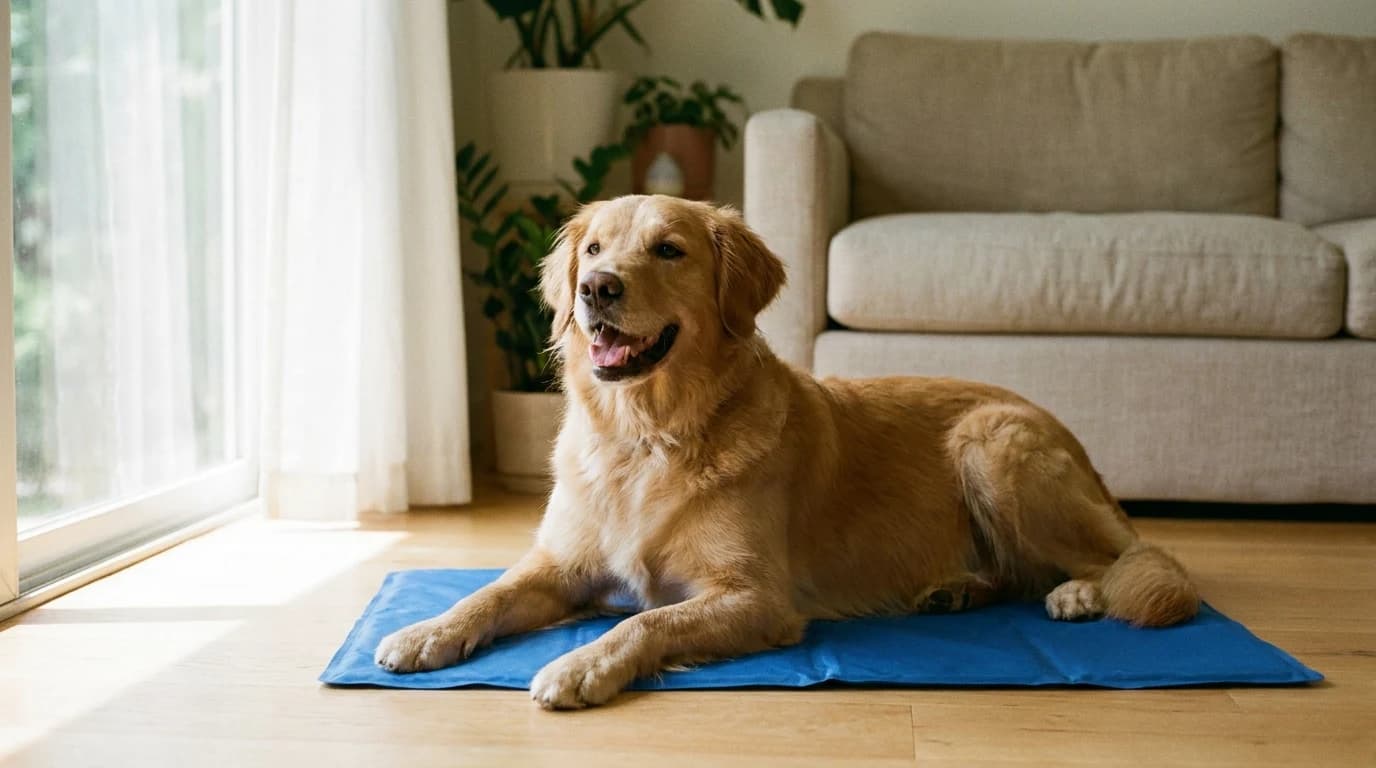
Partly, and it helps to know why. An unpowered mat doesn't make cold. It starts at the temperature of the room, then pulls heat out of the dog faster than a fabric bed would, until it has warmed up to match. How much it can do depends on the gap between the mat and the dog.
- In an air-conditioned room that gap is big, and a gel pad feels cool for a good while.
- In a hot flat without A/C the mat starts warm. A gel pad at 85°F is still cooler than a dog's skin, so it still helps, but it saturates sooner and needs longer off-duty to shed that heat into air that is already hot.
- The one controlled study we found used a chilled mat. In a 2019 trial, nine conditioned dogs were exercised in an 86°F chamber and then cooled three ways. A cooling mat held at about 39°F brought them back to 102.2°F in 36 minutes, against 48 minutes with no help; partial immersion in water at room temperature did it in 16. A gel pad sitting on a warm floor is nowhere near 39°F.
What that means without air conditioning:
- Put the mat on tile or concrete, out of the sun. The floor underneath is the mat's heat sink; carpet insulates it.
- Prefer water-fill. Owners in a recent r/dogs thread on cooling mats report emptying and refilling water-fill mats with cold tap water on the hottest days, which a sealed gel pad can't do.
- Add moving air. A fan over an elevated cot cools by airflow, which keeps working after any mat has warmed through.
- Wet the dog, not only the bed. The same study found water beat the mat even at room temperature. A damp coat plus a fan is the strongest thing you can do without A/C.
- Some dogs just won't lie on one. Owners in r/dogs regularly report dogs who ignore the gel feel and choose a bare hard floor instead; one thread from January puts it down to the individual dog. Try the cheapest option first.
If the dog is panting hard and can't settle, a mat is the wrong tool. That's the overheating picture in the next section.
Sizing: get one your dog can lie down flat on
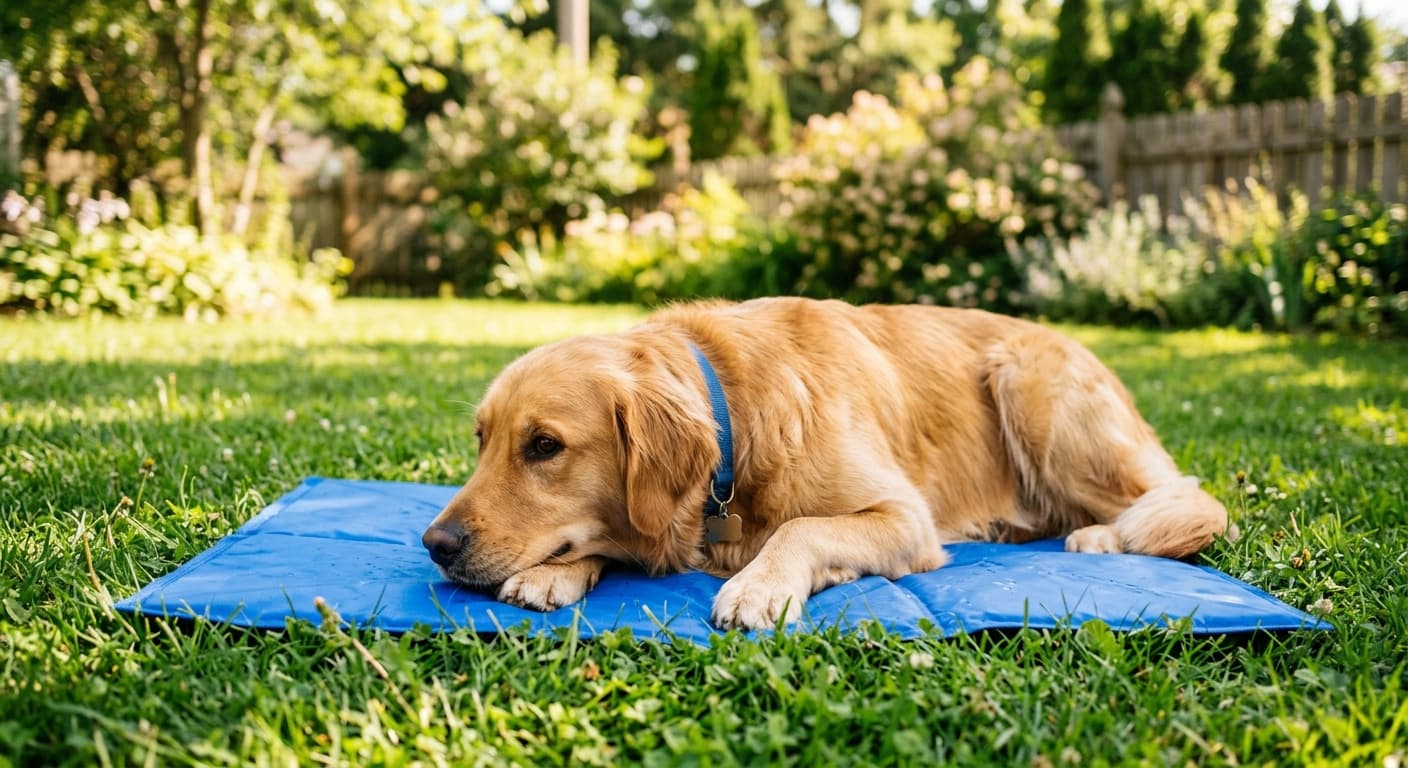
The most common complaint in every cooling-mat review is "too small." Dogs cool through the belly and inner thighs, so the mat has to fit the dog lying fully stretched out on its side — not curled up. Measure your dog nose-to-tail-base while it's sprawled, and add a few inches. A mat the dog only half-fits on is a mat the dog abandons.
The safety line most guides skip: the chew risk is real
This is the part that matters and gets glossed over. The gel inside pressure-activated mats is generally marketed as non-toxic, and the AKC notes that even so, a punctured mat is "a big mess to clean up" — and any gulped gel plus the plastic film is a foreign-body risk worth a vet call. Their guidance is concrete: for a dog that chews, choose a durable material (nylon or a water-fill design) that resists punctures, and supervise the first several uses. If your dog treats new objects as chew toys, skip gel entirely and go water-fill or elevated.
What a mat does not do
Here's the falsifiable claim to hold onto: a cooling mat cannot prevent heatstroke, and treating it like it can is the actual danger. The ASPCA lists the real overheating signs — heavy panting or labored breathing, drooling, weakness, collapse, and a body temperature over 104°F — and none of them are things a resting pad addresses. A mat cools a surface; it doesn't cool a dog that's already overheating, and it doesn't replace shade, water, or getting indoors. If you see those signs, that's an emergency, not a "put him on the mat" situation. (See our guides on heatstroke signs and what to do and hot-pavement paw safety.)
For a wider look at vests, bandanas, and cooling bowls alongside mats, see our best dog cooling products roundup. If you just want the mat decision, the table above is the whole answer: match the type to your dog first, size second, brand a distant third.
Frequently Asked Questions
- What is the best type of cooling mat for a dog that chews?
- Skip pressure-activated gel mats — a chewer can puncture them and swallow the gel and plastic film, which the AKC flags as a mess and a potential foreign-body risk. Choose a water-fill design (nothing but tap water inside) or an elevated mesh cot that can't be punctured at all, and supervise the first several uses.
- Do cooling mats actually work, or do they need power?
- Gel mats work with no power, water, or freezing — the dog's own weight activates the gel, which cools for a few hours of contact and then recharges on its own in 15–20 minutes off it, per the AKC. Water-fill mats use plain tap water. Only some frozen-insert designs need a freezer.
- Can a cooling mat prevent heatstroke?
- No. A mat cools the surface a dog rests on by a few degrees — it does not cool a dog that is already overheating and it does not replace shade, fresh water, or getting indoors. The ASPCA lists real overheating signs (heavy panting, drooling, weakness, collapse, body temp over 104°F) as an emergency; a mat does nothing for those. Treat it as comfort, not protection.
- What size cooling mat should I buy?
- Big enough for your dog to lie fully stretched out on its side, since dogs cool through the belly and inner thighs. Measure your dog sprawled out, nose to tail-base, and add a few inches. 'Too small' is the single most common complaint in cooling-mat reviews — a mat the dog half-fits on gets abandoned.
- Does a cooling mat work without air conditioning?
- It helps, but less. An unpowered mat starts at room temperature and draws heat from the dog until it warms up, so in a hot room it saturates sooner and recharges slower. In the one controlled study we found, the mat was chilled to about 39°F, far colder than a pad on a warm floor. Without A/C, put a water-fill mat on tile out of the sun, refresh it with cold water, add a fan, and dampen the dog's coat.
Research Sources
- Warm Weather Pet Safety — American Veterinary Medical Association
- Cooling Mats for Dogs — American Kennel Club
- Hot Weather Safety Tips — ASPCA
- Comparison of Postexercise Cooling Methods in Working Dogs (Davis et al., J Spec Oper Med 2019) — Journal of Special Operations Medicine
What changed in this review(3 entries)
- Body copyfaq
Added a section on whether a cooling mat works without air conditioning, using a published cooling trial and owner discussion, with a matching FAQ. No pick or price changed; the Chillz, K&H and Arf Pets picks stay.
- Body copyPicks
Replaced the Canada Pooch Chill Seeker mat, whose Amazon listing no longer has a buy box, with the Arf Pets Self-Cooling Solid Gel Mat (verified purchaseable 2026-09-16). Comparison table row and body section rewritten for the new pick; no other pick or price changed.
- Body copy
Added a link to the new Cooling Mats & Pads subcategory page, where the same mats are ranked with current prices. No pick or price changed.

PawBench Editorial
Published by Hilly Shore LabsPawBench’s editorial team researches dog products from primary veterinary sources, manufacturer specifications and aggregated buyer sentiment, alongside the lived ownership of Maggie, an Australian Labradoodle. We do not run hands-on product tests.
254 dog products scored · 1,160,091 buyer review-aspect mentions aggregated · cites AVMA, FDA, AAFCO, Cornell, WSAVA, AKC, ASPCA.
Recommendations are based on published veterinary guidelines, manufacturer specifications, and verified customer feedback. See our editorial standards.