Best Indoor Dog Potty Solutions 2026: Grass Pads, Trays, and More
Our #1 Pick
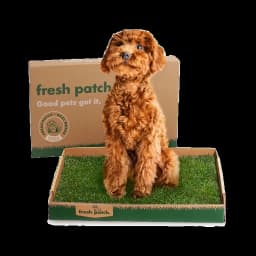
- Real grass, so grass-trained dogs use it with little or no retraining
- Fully disposable — no rinsing, no tray, no odor build-up between changes
- Absorbs liquid and odor better than artificial turf
Buy this if you want the fastest transition for a small or medium dog: it is real grass, so a grass-trained dog recognises it without retraining.
Our analysis of 3,700 buyer mentions on Fresh Patch Real Grass Patch (Small–Medium, under 15 lb): buyers consistently praised quality, durability, grass quality, with some flagging value for money, color.
Also Great
Reusable turf: HQ4US 4LEGS Large Grass Pad with Tray (34x23in) ($69.99) — Washable artificial turf on a raised drainage tray, sized for a medium or large dog
On this page6 sections
Our Verdict
Fresh Patch real grass is the easiest transition for a small or medium dog, because a grass-trained dog needs no retraining to use it. For a medium or large dog, the HQ4US 4LEGS tray at 34 by 23 inches is the reusable alternative with room to turn around. Pair any indoor potty with crate training for the fastest results.
Fresh Patch Real Grass Patch (Small–Medium, under 15 lb) Owner rating3.9 Best real-grass option | Powools 3-Layer Grass Pad with Tray Owner rating3.7 The budget way in. A three-layer tray separates liquid from the surface, which is the whole difference between a grass pad that works and one that becomes the smell. | HQ4US 4LEGS Large Grass Pad with Tray (34x23in) Owner rating4.2 Best for large dogs. At 34 by 23 inches it gives a medium or large dog somewhere to actually turn around, which the small trays do not. | Artificial Grass Puppy Pad with Tray (16x20in) Owner rating4.2 The smallest and cheapest here, which makes it the sensible puppy-training buy — the size a puppy needs is not the size it will need in a year. | LOOBANI Large Grass Pad with Tray (35x23in) Owner rating4.3 The balcony-specific pick. Same large format as the HQ4US, positioned for apartment balconies where a drainage tray that does not leak onto a neighbour matters more than anywhere else. | BLUETREE Dog Doorbells (Potty Training Bells) Owner rating4.6 Best for teaching the ask | |
|---|---|---|---|---|---|---|
| Price | $34.95Buy on Amazon | $29.98Buy on Amazon | $69.99Buy on Amazon | See price on AmazonSee buying options | $75.99Buy on Amazon | $6.99Buy on Amazon |
| Buyer sentiment | Quality Durability Grass quality Odor Value for money Color Buyers praise quality, durability, grass quality and odor. Some flag value for money and color. Based on 3,700 user mentions | Quality Functionality Ease Of Cleaning Buyers praise quality, functionality and ease of cleaning. Based on 25 user mentions | Functionality Sanitary Size Included Accessories Durability Buyers praise functionality, sanitary, size and included accessories. Mixed feedback on value for money and odor reduction. Some flag durability. Based on 192 user mentions | — | — | Quality Potty Training Loudness Durability Buyers praise quality, potty training, loudness and durability. Mixed feedback on whistle. Based on 6,701 user mentions |
| Pros |
|
|
|
|
|
|
| Cons |
|
|
|
|
|
|
| Grass | Hydroponically grown, California grown | — | — | — | — | — |
| Sized for | Small and medium pets under 15 lb | — | — | — | — | — |
| Reusable | No - disposable, replaced every 1-3 weeks | — | — | — | — | — |
| Tray required | No | — | — | — | — | — |
| Type | — | Artificial grass with tray | — | Artificial grass with tray | Artificial grass with tray | — |
| Layers | — | 3 | — | — | — | — |
| Position | — | Budget | — | — | — | — |
| Size | — | — | 34 x 23 inches | 16 x 20 inches | 35 x 23 inches | — |
| Feature | — | — | Raised legs | — | — | — |
| Dog size | — | — | Medium to large | — | — | — |
| Best for | — | — | — | Puppies, toy breeds | Balcony / apartment | — |
* Prices are approximate and may vary. Please check the latest price on Amazon.
How PawBench is paid: we earn an Amazon Associates commission on qualifying purchases. We don’t accept sponsored placements, paid reviews, or free products in exchange for coverage. Picks are ranked on documented owner outcomes and primary-source research, never on commission rate. Read the full methodology.
Not every dog can wait for a leash walk every time they need to relieve themselves. High-rise apartment dwellers, harsh winter climates, senior dogs with reduced bladder control, and puppies in training all benefit from a reliable indoor potty option. Done right, indoor potty solutions complement outdoor training — they don't undermine it. If your dog has a yard but not always a person to open the door, a dog door may be the simpler fix.
Here's what works, what doesn't, and how to choose. Every product below is also ranked, with current prices, on our indoor dog potties and grass pads page.
Who Needs an Indoor Dog Potty
- Apartment dwellers without immediate yard access — elevator rides take time
- Puppies under 6 months who can't hold their bladder longer than 2–3 hours
- Senior dogs with age-related bladder control issues
- Small breeds that struggle in extreme cold or heat
- Dogs recovering from surgery with restricted outdoor mobility
Types of Indoor Potty Solutions
| Type | Strongest for | Main drawback |
|---|---|---|
| Artificial grass pads | Medium-large dogs; closest to the outdoor experience | Needs regular cleaning or odor builds fast |
| Real grass delivery | Dogs already grass-trained | Ongoing cost; not available in all areas |
| Pee pad trays | Puppies and the tightest budgets | Some dogs mouth or shred the pads |
Artificial Grass Pads
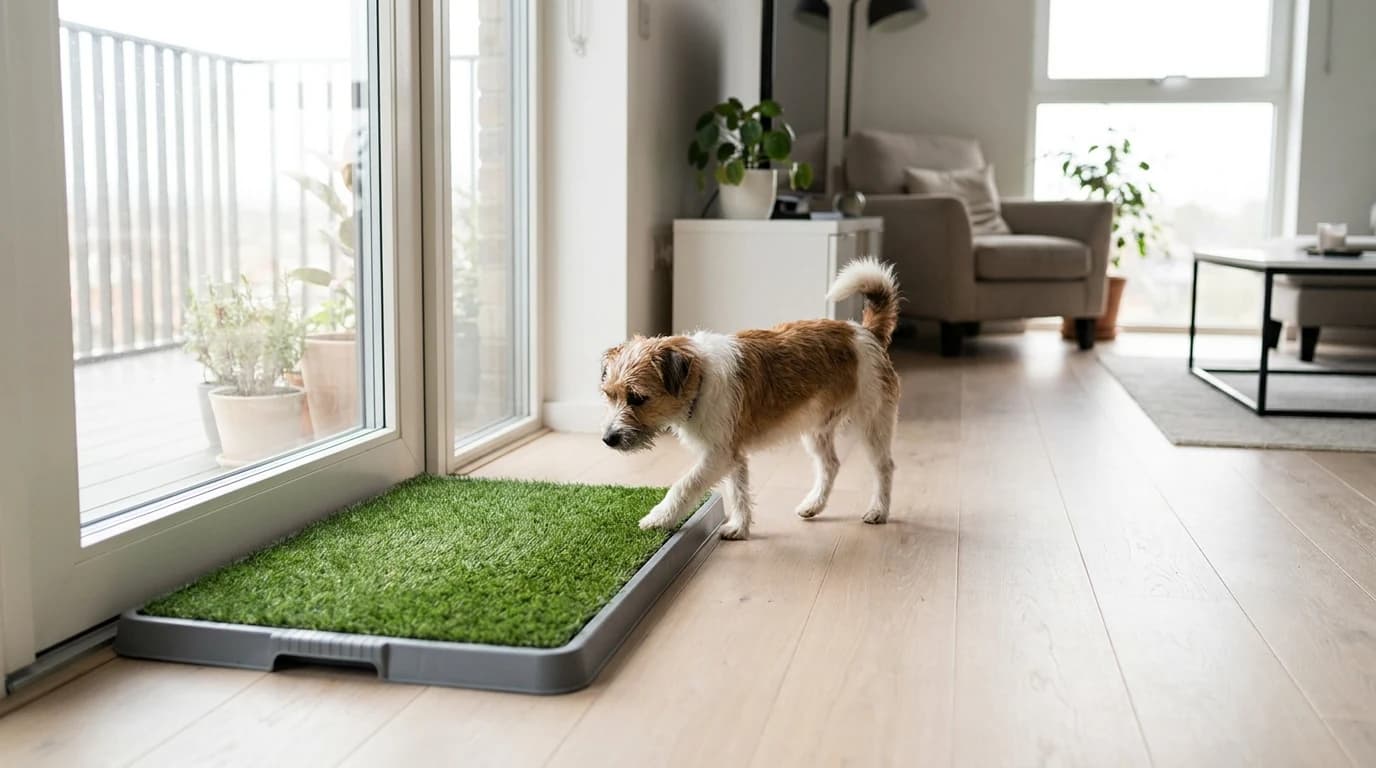
The most popular option. An artificial turf surface sits over a drainage tray — the dog uses it like grass, liquid drains through, and the tray is emptied periodically. Better models have antimicrobial treatment on the turf to reduce odor. Expect transition training for dogs accustomed to outdoor grass.
Real Grass Delivery (Subscription)
Services like Fresh Patch deliver boxes of real hydroponically-grown grass every 1–4 weeks. You can also buy single patches on Amazon without a subscription, which is the cheaper way to test whether your dog takes to real grass before committing to a delivery schedule. Fresh Patch sizes the patch by dog weight, so check the listing you order: the small-medium patch is rated to 15 lb and there is a separate extra-large patch for dogs of 30 lb and over. The natural grass smell is a powerful potty cue for dogs that are grass-trained, making transition significantly easier than artificial alternatives — and there's nothing to clean, because you replace the box.
Pee Pad Trays/Holders
A hard plastic tray holds pee pads in place (preventing the dog from shredding them) with a raised lip to prevent overflow. The most economical option, familiar to most puppies, though it doesn't simulate the outdoor experience well for adult dogs. Amazon Basics pee pads in the regular 22 x 22 inch size, 100 count (~$18.99), are the standard refill for one of these trays.
Our Top Picks
#1 Best Overall: Fresh Patch Real Grass Patch (Small–Medium, under 15 lb) — $34.95
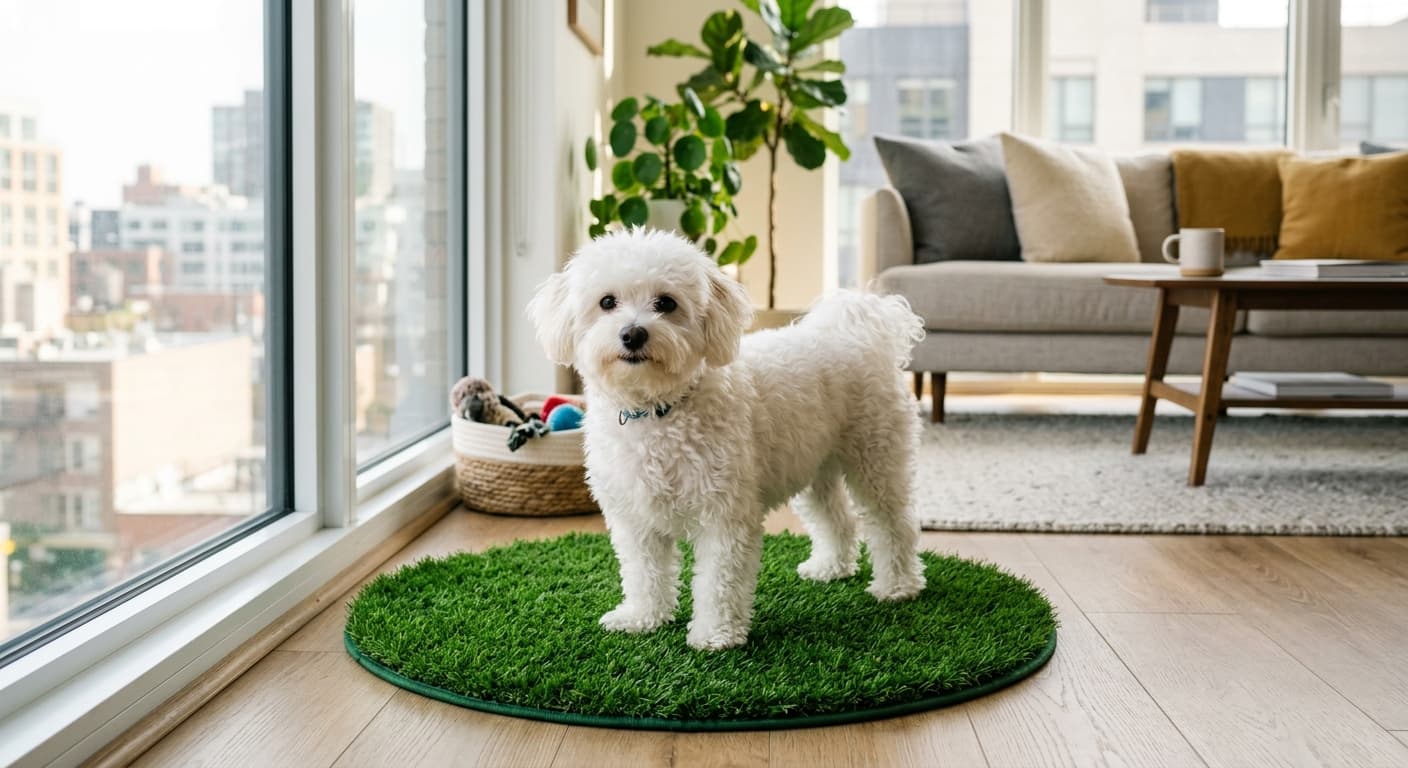
Buy on Amazon · $34.95 →Real grass is the only indoor surface a grass-trained dog already recognizes, which is why it needs the least transition work of anything here. There is no tray to scrub and nothing to rinse — when the patch wilts you bin the whole box. Fresh Patch states the grass absorbs liquid rather than holding it on the surface, which is what keeps the smell down between replacements. This is the small-medium patch, rated for pets under 15 lb.
Best for: Small and medium dogs, apartments, owners who will not commit to daily tray cleaning
Pros: Strongest possible potty cue, nothing to clean, no tray needed
Cons: A recurring cost — a replacement patch every 1–3 weeks — and this size does not fit a large dog
#2 Best for Large Dogs: HQ4US 4LEGS Large Grass Pad with Tray (34x23in) — $69.99
Buy on Amazon · $69.99 →At 34 by 23 inches, this is the one pad here that gives a medium or large dog room to turn around before it goes — the thing small trays get wrong. The turf sits on raised legs over a drainage tray, so liquid leaves the surface instead of pooling under the dog's paws. It is reusable, so there is no per-week cost, but it does have to be rinsed.
Best for: Medium and large dogs, owners who want no recurring cost
Pros: Genuinely large-dog sized, raised drainage tray, reusable
Cons: Takes real floor space, and heavier to carry to a balcony or bath to rinse
#3 Best Budget: Powools 3-Layer Grass Pad with Tray ($29.98)
Buy on Amazon · $29.98 →The cheapest complete tray-and-pad system in this roundup. The three-layer construction is the part that matters: it separates liquid from the surface, which is the difference between an artificial grass pad that works and one that becomes the smell in the room. The footprint suits toy and small breeds only, and the turf needs regular rinsing.
Best for: Toy and small breeds, first-time indoor-potty buyers, the tightest budgets
Pros: Cheapest complete system here, three-layer drainage, no recurring pad cost
Cons: Too small for a medium or large dog, and artificial grass needs regular rinsing
Transition Training: Getting Your Dog to Use Indoor Potty
Most adult dogs won't automatically use an indoor potty. The transition requires training:
Week 1: Place the potty in the spot you want it permanently (near a door, in a bathroom, or on a balcony). Bring your dog to the potty on leash every 2 hours and after meals. Use a consistent cue word ("go potty," "do your business").
Week 2: When the dog sniffs the potty, use your cue word and wait. The first successful use gets a jackpot reward — their favorite treat, enthusiastic praise, a game. Make it the best thing that ever happened.
Week 3+: Gradually extend time between supervised trips as the dog reliably uses the potty.
What speeds the transition up:
- The permanent spot, chosen on day one
- Leash trips on a schedule, rather than hoping the dog finds it
- A jackpot reward — not a routine treat — for the first success
What sets it back:
- Moving the potty around to see where it "works better"
- Unsupervised time extended before the dog is reliably using it
Important: do not punish accidents near but not on the potty. Simply clean up without comment and increase supervision.
For puppies learning any potty system, our crate training guide covers the full house-training protocol that pairs with any indoor potty solution.
Odor Management
The biggest complaint with indoor potties is smell. These practices minimize it:
- Clean the tray daily — liquid sitting 24+ hours creates ammonia that's nearly impossible to eliminate from the turf
- Use an enzyme cleaner (not bleach) — enzyme cleaners break down urea at the molecular level; bleach just masks it
- Replace artificial turf every 3–6 months — no amount of cleaning eliminates deep-embedded odor from old turf
- Real grass subscriptions: swap every 2 weeks in summer, 3–4 weeks in winter when decomposition is slower
🏆 Bottom Line: For a grass-trained small or medium dog, the Fresh Patch real grass patch is the easiest transition — nothing to clean, and a replacement patch every 1–3 weeks. For a medium or large dog, or for anyone who does not want a recurring cost, the HQ4US 4LEGS tray is the reusable answer, and the Powools tray is the cheapest way in. Pee pad trays work fine for puppies but shouldn't be a long-term adult dog solution.
Sources
- American Kennel Club — Indoor housetraining and potty training alternatives. akc.org.
- Horwitz DF, Neilson JC — Blackwell's Five-Minute Veterinary Consult Clinical Companion: Canine and Feline Behavior. Wiley-Blackwell, 2007.
- DoggieLawn — Hydroponics grass growth specifications. doggielawn.com.
- Association of Professional Dog Trainers (APDT) — Housetraining guidelines. apdt.com.
- ASPCA — Basic housetraining for adult dogs. aspca.org.
What each option costs to run
Every figure below is an editable scenario, not a measured lifetime — we have not tested how long a patch or a turf mat lasts in your home. Prices are the ones on this page; change any number to your own and the comparison updates.
Real grass
Fresh Patch Real Grass Patch (Small–Medium, under 15 lb)
$75.72 /month
$908.70 over 12 months · 26 patches
That is the single-patch price on this page. A delivery subscription is priced separately by the seller — put its per-patch price in the box to cost that instead. Two weeks is the summer figure; this guide notes winter swaps stretch to three or four.
- Cleaning:
- Nothing to rinse or scrub — you bin the whole box and open the next one.
- Space:
- One box, no tray to store, but you have to reorder before the current patch wilts.
- Odour:
- Fresh Patch states the grass absorbs liquid rather than holding it on the surface.
Washable turf tray
Powools 3-Layer Grass Pad with Tray
$15.50 /month
$185.94 over 12 months · 3 trays
The cleaner budget is our assumption, not a price from this page — set it to 0 if you already own one. Replacements are priced as the whole tray-and-turf unit; a bare replacement mat usually costs less.
- Cleaning:
- Rinse the turf regularly and empty the tray daily — liquid left 24h+ turns to ammonia.
- Space:
- Small footprint, which is also the limit: this size suits toy and small breeds only.
- Odour:
- Enzyme cleaner, not bleach. Turf gets replaced every 3-6 months because cleaning eventually stops working.
Disposable pads
Amazon Basics pee pads
$11.55 /month
$151.92 over 12 months · 8 packs
Pads only. The plastic holder tray is a one-off this page does not price, so it is not counted here.
- Cleaning:
- Swap the pad and wipe the tray. No rinsing, no drying time.
- Space:
- Smallest footprint of the three; the tray's raised lip is what stops overflow.
- Odour:
- A fresh surface at every change, but some dogs mouth or shred the pads.
Show the maths behind these numbers
A month is 4.333 weeks and 30.42 days, not four weeks — over a year that difference is about 8%. /month is the long-run average with fractional units; over 12 months counts the whole patches, trays or packs you actually buy inside the first year, so the two differ when an interval does not divide cleanly into a year.
- Real grass = price x (52 ÷ 12) ÷ weeks between patches → $34.95 x 4.333 ÷ 2 = $75.72/month. First year = 26 patches x $34.95 = $908.70.
- Washable turf = tray price ÷ months between turf replacements, plus the cleaner budget → $29.98 ÷ 4 + $8.00 = $15.50/month. First year = 3 x $29.98 + 12 x $8.00 = $185.94.
- Disposable pads = (pack price ÷ pads per pack) x pads per day x (365 ÷ 12) → ($18.99 ÷ 100) x 2 x 30.42 = $11.55/month. First year = 8 whole packs x $18.99 = $151.92.
The replacement intervals seeded here are the ones this article states (a real-grass patch every 1-3 weeks, artificial turf every 3-6 months). They are ranges owners report and manufacturers publish, not a lifetime we measured, and your dog’s size, water intake and how fast you clean will move all three columns.
Research Sources
- How to Potty Train a Dog When You Live in an Apartment — American Kennel Club
- How to Potty Train a Puppy on Pads: Indoor House Training for Puppies — American Kennel Club
- Housetraining Dogs: Puppy Potty Pad and Paper Training — American Kennel Club
- House Training Your Dog or Puppy — ASPCA
- AAHA Canine Life Stage Guidelines: New Puppy Checklist — American Animal Hospital Association
What changed in this review(3 entries)
- Body copy
Added a link to the new Indoor Dog Potties & Grass Pads subcategory page, where the same products are ranked with current prices. No pick or price changed.
- PicksBody copy
Renumbered the three Our Top Picks headings into the site’s "#N Best X: <product>" form and matched each heading to the exact product named in the comparison table, so every pick now carries the inline Buy on Amazon button at the point the reader decides instead of only in the table and the top card. Order is unchanged: Fresh Patch real grass stays the #1 pick.
- PicksLinksBody copyPrices
Reviewed every recommendation module against the comparison table: the #1 pick is now the Fresh Patch small-medium patch (B005G7S6UI) on the card, in the table and in the body, the three products named under Our Top Picks that appeared in no other module were replaced with products this page actually ranks, a malformed Amazon pee-pad link was replaced with the live 100-count listing, and the table row was re-priced to the $34.95 of the listing it links.
Your next step
Living with an indoor potty means living with the cleanup — that's the half nobody plans for.

PawBench Editorial
Published by Hilly Shore LabsPawBench’s editorial team researches dog products from primary veterinary sources, manufacturer specifications and aggregated buyer sentiment, alongside the lived ownership of Maggie, an Australian Labradoodle. We do not run hands-on product tests.
254 dog products scored · 1,160,091 buyer review-aspect mentions aggregated · cites AVMA, FDA, AAFCO, Cornell, WSAVA, AKC, ASPCA.
Recommendations are based on published veterinary guidelines, manufacturer specifications, and verified customer feedback. See our editorial standards.