Best Pet Carriers for Travel 2026: Airline-Approved and Car-Tested
Our #1 Pick
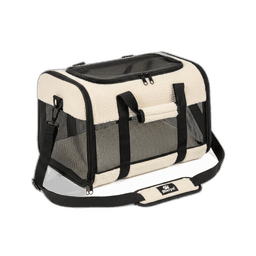
- Meets most airline under-seat requirements
- Adjustable strap system for stability
- Mesh windows on three sides
Guaranteed on Board airline program eliminates gate-check anxiety and fits under virtually every seat.
Our analysis of 1,169 owner mentions on Sherpa Original Deluxe: buyers consistently praised quality, fit, comfort, with some flagging zipper durability.
Also Great
Crash Safety: Sleepypod Mobile Pet Bed ($190) — Only soft carrier with 5-star CPS crash test rating
Hiking: Kurgo G-Train Backpack ($140) — Airline-approved and doubles as a functional hiking pack
Our Verdict
For airline travel, the Sherpa Original Deluxe is the safest bet with its Guaranteed on Board program. For car safety, the Sleepypod Mobile Pet Bed is the only 5-star CPS-rated soft carrier.
Key Takeaways
For airline travel, the Sherpa Original Deluxe is the safest bet with its Guaranteed on Board program. For car safety, the Sleepypod Mobile Pet Bed is the only 5-star CPS-rated soft carrier.
Sherpa Original Deluxe 4.6 Best airline carrier with Guaranteed on Board program acceptance | Sleepypod Mobile Pet Bed 4.5 Only soft carrier with 5-star CPS crash test rating -- doubles as a bed | Kurgo G-Train Dog Carrier Backpack 4.4 Best backpack carrier for hiking that also works as airline cabin carry-on | Diggs Revol Collapsible Travel Crate 4.9 Most crash-safe hard carrier on the market, used by military K-9 units | PetAmi Deluxe Pet Carrier Backpack 4.6 Best budget backpack carrier with solid ventilation and safety tether | |
|---|---|---|---|---|---|
| Price | $46.04Buy on Amazon | $224.99Buy on Amazon | $112.22Buy on Amazon | $399Buy on Amazon | $46.99Buy on Amazon |
| Buyer sentiment | Quality Fit Comfort Travel-Friendly Zipper Durability Buyers praise quality, fit, comfort and travel-friendly. Mixed feedback on durability and size. Some flag zipper durability. Based on 1,169 user mentions | Construction Size Portability Comfort Buyers praise construction, size, portability and comfort. Mixed feedback on value for money and zipper durability. Based on 286 user mentions | Quality Comfort Capacity Sturdiness Weight Distribution Buyers praise quality, comfort, capacity and sturdiness. Some flag weight distribution. Based on 213 user mentions | — | Quality Comfort Portability Spacious Buyers praise quality, comfort, portability and spacious. Mixed feedback on size and durability. Based on 273 user mentions |
| Pros |
|
|
|
|
|
| Cons |
|
|
|
|
|
| Type | Soft-sided airline carrier | Soft carrier + bed | Backpack carrier | Hard-sided kennel | Backpack carrier |
| Weight Limit | 22 lbs | 15 lbs | 25 lbs | — | 18 lbs |
| Dimensions | 18x11x11 in | — | — | — | — |
| Crash Rating | — | 5-star CPS | — | 5-star | — |
| Airline Approved | — | — | Yes | — | — |
| Material | — | — | — | Roto-molded plastic | — |
| Price Range | — | — | — | — | Budget |
* Prices are approximate and may vary. Please check the latest price on Amazon.
Carrier format, weight limit, and travel safety
Carrier type, manufacturer weight limit, crash-test standing, and airline compatibility — the four specs that decide whether a carrier is right for your travel.
| Product | Type | Weight Limit | Crash Rating | Airline-Cabin Compatible | Outer Dimensions |
|---|---|---|---|---|---|
| Sherpa Original Deluxe | Soft-sided airline carrier | 22 lbs | — | Yes (Sherpa Guaranteed On Board program) | 18 × 11 × 11 in |
| Sleepypod Mobile Pet Bed | Soft carrier convertible to bed + car seat | 15 lbs | Center for Pet Safety 5-star certified | Yes (carrier mode) | 17 in diameter (open) |
| Kurgo G-Train Dog Carrier Backpack | Backpack carrier | 25 lbs | — | Yes (carry-on per airline policy) | — |
| Gunner Kennels G1 | Hard-sided roto-molded kennel | — | Center for Pet Safety 5-star certified | Cargo only (IATA-compliant); not cabin | Varies by size (S/M/L/XL) |
| PetAmi Deluxe Pet Carrier Backpack | Backpack carrier (budget) | 18 lbs | — | Generally yes (verify with airline before flight) | — |
Crash ratings reference Center for Pet Safety third-party testing. Airline compatibility varies by carrier and aircraft; always confirm dimensions with your airline before booking.
How PawBench is paid: we earn an Amazon Associates commission on qualifying purchases. We don’t accept sponsored placements, paid reviews, or free products in exchange for coverage. Picks are ranked on documented owner outcomes and primary-source research, never on commission rate. Read the full methodology.
Traveling with your dog should not feel like a gamble. But every year, thousands of pet owners show up at the airport gate with a carrier that is the wrong size, the wrong material, or flat-out banned by their airline. Others toss their dog in the backseat with zero restraint and hope for the best. Both scenarios are avoidable if you do your homework before you buy.
I have tested over a dozen carriers across flights, road trips, and hiking trails. Here is what actually works, what the airlines really require, and where most people waste their money.
Airline Rules: Know Before You Book
Every airline has different pet carrier requirements, and they enforce them inconsistently. That is the frustrating reality. But here are the current specifications you need to know.
Delta: Soft-sided carriers only for in-cabin. Maximum dimensions 18" x 11" x 11" (L x W x H). The carrier must fit entirely under the seat in front of you. Pet fee is $125 each way for domestic flights. Delta is one of the stricter airlines about checking carrier dimensions at the gate.
United: Maximum dimensions 18" x 11" x 11" for hard-sided carriers, 18" x 11" x 11" for soft-sided. United charges $125 each way domestically. They require the pet to remain in the carrier for the entire flight with no exceptions. United also restricts snub-nosed breeds from cargo travel year-round.
Southwest: Maximum dimensions 18.5" x 8.5" x 13.5". Pet fare is $125 each way. Southwest only allows small dogs and cats in-cabin, limited to one pet carrier per passenger. No cargo pet travel is available on Southwest.
American Airlines: Soft or hard carriers allowed, 19" x 13" x 9" max for hard-sided, and the soft-sided carrier must fit under the seat. The $125 fee applies domestically.
The universal rule: your dog must be able to stand up, turn around, and lie down comfortably inside the carrier. If the dog cannot do this, the carrier is too small regardless of what the airline allows.
How to Measure Your Dog for a Carrier
This is where most people mess up. You cannot eyeball this.
- Length: Measure from the tip of the nose to the base of the tail (not the tip). Add 2-3 inches.
- Height: Measure from the floor to the top of the head while standing. Add 2-3 inches for clearance.
- Width: Measure the widest point of the shoulders or hips. Add 2 inches.
Write these numbers down and compare them directly to the carrier's interior dimensions, not the exterior dimensions listed on the product page. A carrier that is 18" on the outside might only be 16.5" on the inside after accounting for walls, padding, and frame.
Soft-Sided vs Hard-Sided: The Real Trade-offs
Soft-sided carriers are the better choice for airline travel, full stop. They compress slightly to fit under seats with tight clearances, they are lighter to carry, and most dogs find them more comfortable because the fabric walls give a little when the dog shifts position. The Sherpa Original Deluxe ($55-$70) remains the gold standard here. The spring-wire frame is the key innovation -- it allows the carrier to flex just enough to squeeze under a tight airplane seat without collapsing on your dog. Sherpa also offers a "Guaranteed on Board" program where participating airlines pre-approve the carrier's dimensions.
Hard-sided carriers are better for car travel and cargo flights. They provide superior crash protection, they are easier to clean after accidents, and they stack securely in a vehicle. The Petmate Sky Kennel ($50-$90 depending on size) meets IATA requirements for cargo travel and is the most commonly accepted hard-sided carrier for international flights.
My recommendation: own one of each if you travel regularly. Sherpa for cabin flights, Petmate for car trips and cargo.
Car Safety: What the Crash Test Data Shows
Here is the uncomfortable truth that most pet product companies do not want you to think about: an unrestrained 60-pound dog in a 35 mph crash becomes a 2,700-pound projectile. That is not marketing hype; that is basic physics.
The Center for Pet Safety (CPS) is the only independent organization conducting crash tests on pet travel products, and their results are sobering. Most carriers, crates, and restraints that claim to be "crash-tested" have never been subjected to a standardized crash test. CPS has tested dozens of products, and the failure rate is disturbingly high.
The carriers and restraints that have actually passed CPS testing:
- Sleepypod Mobile Pet Bed ($190-$220) -- The only soft carrier to earn a 5-star CPS rating. It doubles as a bed at home, which means your dog is already comfortable in it before travel day. The integrated seatbelt loop secures it firmly to the vehicle's LATCH system or seatbelt.
- Diggs Revol Collapsible Travel Crate ($300-$400) -- A premium collapsible travel crate that sets up one-handed in under 60 seconds and folds flat for storage. The diamond-mesh design and reinforced frame make it secure for car travel, and the built-in wheels and handle make it the most convenient hard-sided option to move. The sturdy construction holds up at levels that destroy standard wire crates.
- PetSafe Happy Ride Deluxe Booster Seat ($30-$45) -- For small dogs under 18 pounds, this elevated booster with a tether attachment keeps them visible and restrained. Not crash-tested to CPS standards, but better than nothing.
If you are serious about car safety, skip the Amazon bargain bin carriers and read our complete travel gear guide for more detail on crash-tested options.
Backpack Carriers for Hiking
Backpack carriers have exploded in popularity, and for good reason. If you have a small dog, a senior dog with limited stamina, or a puppy that is not yet conditioned for long trails, a backpack carrier lets them join the adventure without overexertion.
Best Overall: Kurgo G-Train Dog Carrier Backpack ($140). Airline-approved as a cabin carrier AND a functional hiking pack. The waterproof bottom protects against accidents, the ventilation mesh keeps airflow moving, and the padded waist belt distributes weight properly so your back does not suffer on longer hikes. Holds dogs up to 25 pounds comfortably.
Best Budget: PetAmi Deluxe Pet Carrier Backpack ($40-$50). The ventilation is good, the safety tether inside prevents jumping out, and the ergonomic straps are surprisingly comfortable for the price. The build quality is not on par with Kurgo, but for occasional use it is a solid value.
Best for Larger Dogs: K9 Sport Sack AIR 2 ($110-$130). Designed for dogs up to 40 pounds, this forward-facing backpack carrier is engineered for even weight distribution. The padded leg openings prevent chafing on longer outings.
A word of caution: do not hike with a loaded backpack carrier until you have tested it on a short walk first. The weight distribution changes significantly when a 20-pound dog shifts their body weight, and you need to know how your balance is affected before hitting a real trail.
For budget-conscious shoppers, check out our pet gear budget guide to see where carriers fall on the save-vs-splurge spectrum. And if you need a harness that works with your carrier's tether system, our harness roundup covers compatible options.
The Bottom Line
For airline cabin travel, the Sherpa Original Deluxe ($55-$70) is the safest bet -- it fits under virtually every seat and the Guaranteed on Board program eliminates gate-check anxiety. For car travel, the Sleepypod ($190-$220) is the only soft carrier with genuine crash-test credentials. For hiking, the Kurgo G-Train ($140) justifies its price with dual airline/trail functionality. Stop guessing at dimensions, stop assuming your airline allows your carrier, and stop driving with an unrestrained dog. The right carrier is not optional gear -- it is safety equipment.
🏆 Bottom Line: For airline travel, the Sherpa Original Deluxe is the most universally accepted carrier across major airlines. For car travel, prioritize crash-tested options. Always check your specific airline's current size restrictions before purchasing — these change without notice.
Related Reading
- Travel & Carriers — Airline-approved carriers and travel gear
- Leashes & Collars — Travel-safe harnesses and leashes
- Dog Health — Calming products for travel anxiety
Sources
- IATA — In-cabin pet carrier dimension standards (LAR). iata.org.
- Center for Pet Safety — Carrier crashworthiness testing results. centerforpetsafety.org.
- American Kennel Club (AKC) — "Best Pet Carriers for Travel." akc.org.
- Sherpa — Airline-approved carrier testing and airline compliance documentation. sherpapet.com.
- U.S. Department of Transportation — Airline pet travel rules and size restrictions. transportation.gov.
Frequently Asked Questions
- What size pet carrier fits under an airplane seat?
- Most airlines require carriers no larger than 18 x 11 x 11 inches (L x W x H), though dimensions vary slightly by airline. Always check your specific airline's requirements before flying, as enforcement can be inconsistent. Soft-sided carriers are preferred because they flex slightly to fit under tighter seats.
- Are hard or soft pet carriers better?
- Soft-sided carriers are better for airline cabin travel because they compress to fit under seats and are lighter to carry. Hard-sided carriers are better for car travel and cargo flights because they provide superior crash protection, are easier to clean, and stack securely in a vehicle.
- How do I measure my dog for a pet carrier?
- Measure your dog's length from nose to base of tail (add 2-3 inches), height from floor to top of head while standing (add 2-3 inches), and width at the widest point of shoulders or hips (add 2 inches). Compare these to the carrier's interior dimensions, not the exterior measurements.
- Are pet carriers crash tested?
- Most pet carriers on the market have never been independently crash tested, despite marketing claims. The Center for Pet Safety (CPS) is the only organization conducting standardized crash tests. The Sleepypod Mobile Pet Bed is the only soft carrier with a 5-star CPS rating, and the Gunner Kennels G1 is the top hard carrier.
Research Sources
- Traveling with Your Pet — American Veterinary Medical Association
- Tips for Air Travel With Your Dog — American Kennel Club
- Travel Safety Tips — ASPCA
- Traveling With Pets: IATA Guidance — International Air Transport Association

Hilly Shore Labs
Editorial teamIndependent product research team behind PawBench. Reviews are grounded in primary veterinary sources, aggregated buyer sentiment, and the lived ownership of Maggie, an Australian Labradoodle.
150+ dog products researched · 800,000+ owner mentions analyzed · cites AVMA, FDA, AAFCO, Cornell, WSAVA, AKC, ASPCA.
All product reviews are independently researched. Recommendations are based on published veterinary guidelines, manufacturer specifications, and verified customer feedback. See our editorial standards.