How to Introduce Your Dog to a New Baby: Step-by-Step Guide
Quick Answer
Start preparing months before the baby arrives: desensitize to baby sounds, establish new boundaries, and bring home a blanket with baby's scent before the first meeting. Never leave dog and baby unsupervised.
On this page7 sections
Our Verdict
Start prep 2–3 months out. Refresh training, transition routines gradually, introduce baby scent before the homecoming, and use management (gates, leash, 'place') rather than trust for the first 8 weeks.
How PawBench is paid: we earn an Amazon Associates commission on qualifying purchases. We don’t accept sponsored placements, paid reviews, or free products in exchange for coverage. Picks are ranked on documented owner outcomes and primary-source research, never on commission rate. Read the full methodology.
The arrival of a baby is one of the most disruptive events in a dog's life. Their routine changes, their access to spaces is restricted, the people they love are suddenly distracted and sleep-deprived, and there's a small screaming creature that smells strange and moves unpredictably. Dogs that were perfectly behaved before a baby can develop anxiety, attention-seeking behavior, or redirected aggression if the transition is managed poorly.
The good news: with preparation that starts before the birth — not the day you bring the baby home — almost all dogs adapt well.
Before the Baby Arrives: 2–3 Months Out
Update Training Now
If your dog pulls on leash, jumps on people, or resource-guards, address these behaviors before the baby arrives. A dog that jumps on you when you're holding a newborn is dangerous. Enroll in a refresher obedience class or work with a certified trainer (CCPDT or KPA certified).
Specifically train:
- "Leave it" — critical for when the baby drops a toy and the dog goes for it
- "Go to place" — send the dog to a mat/bed on cue; essential for managing the dog during feeding, diaper changes, and moments when you can't supervise
- "Off" — reliable no-jumping response
Adjust Routines Gradually
Identify what's going to change after the baby arrives (walk times, feeding times, where the dog sleeps, which rooms they access) and start those changes now. Don't abruptly change the dog's entire routine the day you bring the baby home.
If the dog currently sleeps in the bedroom but won't after the baby arrives, transition them to their new sleeping spot 6–8 weeks before the due date.
Set Up Baby Spaces Early
Install baby gates, set up the nursery, and establish which areas will be dog-free zones before the baby arrives. Allow the dog to sniff the nursery furniture, baby items, and equipment while they're empty and neutral. They'll be less reactive to the new smells and objects when the baby is present if they've already been desensitized.
Use baby lotions, powders, and detergents on stuffed animals so the dog can investigate those scents in a low-pressure context.
At the Hospital: The Scent Introduction
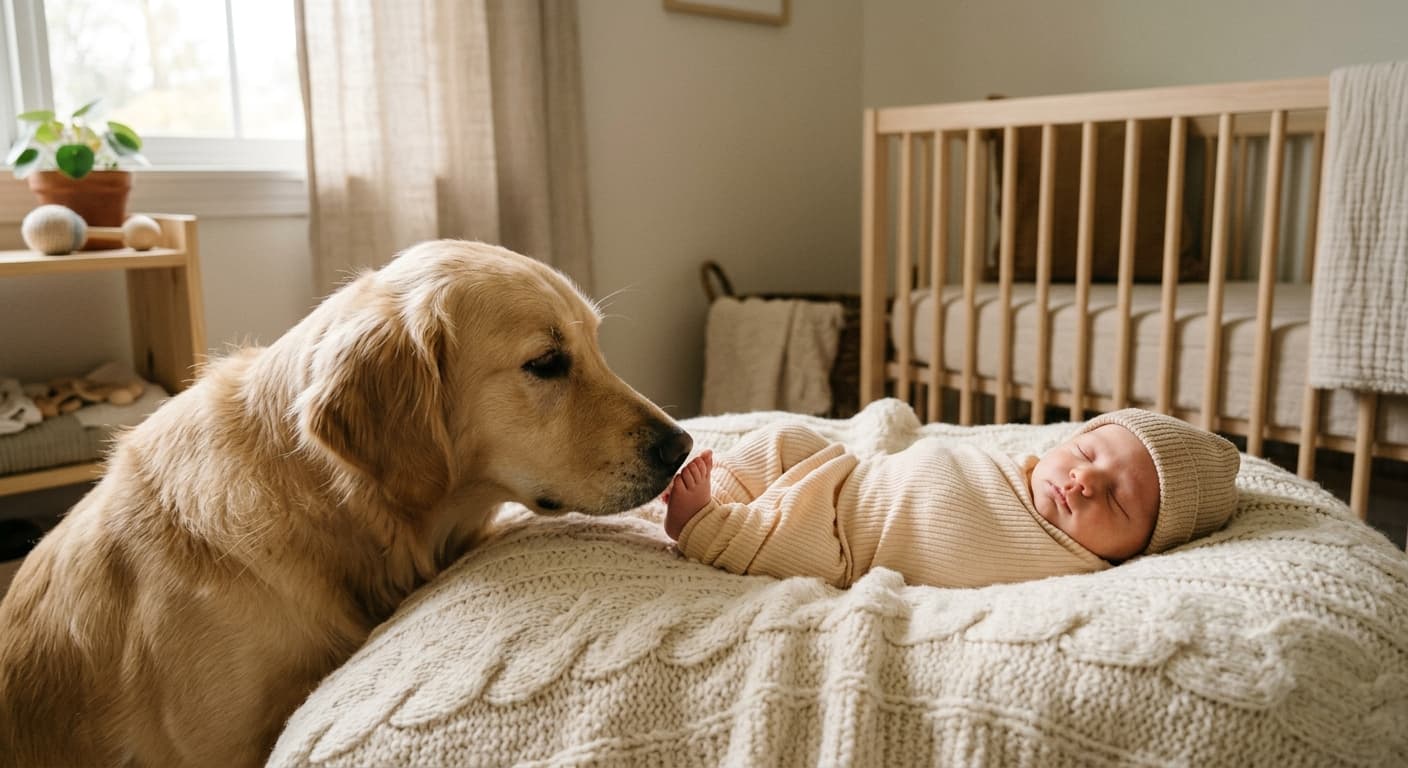
Before you bring the baby home, have someone bring a worn hospital blanket or onesie home to the dog. Let the dog sniff it calmly — not wrestle with it or mouth it — while being praised quietly. This is the dog's first neutral introduction to the baby's scent, without the stress of the actual homecoming.
The First Meeting: Coming Home
- Parent enters first, without the baby: Give the dog a calm, normal greeting. Let them settle — don't ramp them up with excited hellos and then expect calm when you bring the baby in.
- Second parent enters holding the baby: The holding parent stays calm and confident — dogs read anxiety and tension. Have the other parent manage the dog with leash or "sit-stay."
- Controlled sniff, not a free-for-all: Allow the dog to approach and sniff the baby's feet while in a sit or down position. Keep the initial introduction to 30–60 seconds. Reward calm behavior heavily with treats. End the session before the dog gets overstimulated.
- Never force the introduction: If the dog seems anxious, stressed, or overly fixated, give them space and try again in a few hours.
The First Weeks: Management Over Trust
For the first 4–8 weeks, manage the environment rather than relying on trust. Dogs and babies are never left alone together — even a dog that has been perfectly reliable with adults can be unpredictable with an infant whose movements and sounds are novel.
Practical management tools:
- Baby gates to create dog-free zones around play areas
- A "place" mat in the room where you're nursing/feeding — the dog can be present but not crowding
- Baby monitors to keep remote awareness of the baby when you leave the room briefly
- Exercise the dog before high-stress periods (newborn screaming, feeding sessions)
Maintaining the Dog's Bond
The most important thing you can do to prevent behavior problems is to ensure the dog still gets individual positive attention. Not massive amounts — just reliable, predictable positive interaction every day.
Even 5–10 minutes of training, play, or one-on-one attention maintains the dog's sense of security in the relationship. Dogs that feel displaced become anxious or attention-seek in disruptive ways.
Warning Signs to Take Seriously
These behaviors require immediate professional intervention (CCPDT or veterinary behaviorist):
- Stiff body, hard stare, or growling toward the baby
- Snapping when the baby cries
- Resource guarding behavior that escalates near baby items
- Anxiety behaviors (destructive behavior, house soiling) that don't resolve within 2–3 weeks
Growling is communication — never punish it. A dog that stops growling because you punished it hasn't become safer; it's just removed its warning. Address the underlying anxiety with a professional.
For dogs already showing anxiety symptoms, address those before the baby arrives.
🏆 Bottom Line: Start preparation 2–3 months before the birth: refresh training, gradually change routines, set up baby spaces with dog boundaries, and do a scent introduction from the hospital. The transition is almost always smooth when the groundwork is done in advance.
Sources
- American Veterinary Society of Animal Behavior (AVSAB) — Position statement on dog-child interactions and supervision. avsab.org.
- American Kennel Club — Preparing your dog for a new baby. akc.org.
- Certified Council of Professional Dog Trainers (CCPDT) — Finding qualified trainers. ccpdt.org.
- Overall KL — Manual of Clinical Behavioral Medicine for Dogs and Cats. Elsevier, 2013.
- Stop the 77 Campaign (AVMA) — Dog bite prevention around children. avma.org/stop77.
Research Sources

PawBench Editorial
Published by Hilly Shore LabsPawBench’s editorial team researches dog products from primary veterinary sources, manufacturer specifications and aggregated buyer sentiment, alongside the lived ownership of Maggie, an Australian Labradoodle. We do not run hands-on product tests.
254 dog products scored · 1,160,091 buyer review-aspect mentions aggregated · cites AVMA, FDA, AAFCO, Cornell, WSAVA, AKC, ASPCA.
Recommendations are based on published veterinary guidelines, manufacturer specifications, and verified customer feedback. See our editorial standards.