How to Potty Train a Puppy: Step-by-Step House Training Guide
Quick Answer
Take your puppy outside every 2 hours, immediately after meals, naps, and play. Reward instantly when they go outside. Never punish accidents -- clean with enzymatic cleaner. Most puppies are reliable by 6 months.
On this page13 sections
Our Verdict
Take your puppy out every 2 hours, after meals, after naps, and after play. Reward immediately when they go outside. Most puppies are reliably trained by 6 months with consistency.
How PawBench is paid: we earn an Amazon Associates commission on qualifying purchases. We don’t accept sponsored placements, paid reviews, or free products in exchange for coverage. Picks are ranked on documented owner outcomes and primary-source research, never on commission rate. Read the full methodology.
Potty training is the first major training milestone for every puppy — and for most new owners, the most stressful. The good news: with a consistent routine and realistic expectations, most puppies can be reliably house trained in 4-8 weeks. Some breeds pick it up faster, others take longer, but the process is the same.
This guide covers everything you need to know, step by step.
The Golden Rule: Management, Not Punishment
Before we get into the specifics, understand this: punishment does not work for potty training. Rubbing a puppy's nose in an accident, yelling, or any form of negative correction teaches your puppy exactly one thing — to be afraid of you. It does not teach them where to go.
Successful potty training is about management (preventing accidents) and reinforcement (rewarding success). Every time your puppy goes in the right spot, they learn. Every accident they have indoors is a missed training opportunity — your failure to supervise, not their failure to learn.
Gear we would buy for this: a Fresh Patch Real Grass Patch. Real grass is a far stronger potty cue than a turf pad or paper, and it covers the night-time and bad-weather gaps in the schedule below. Our full comparison is in best indoor dog potty solutions.
What You'll Need
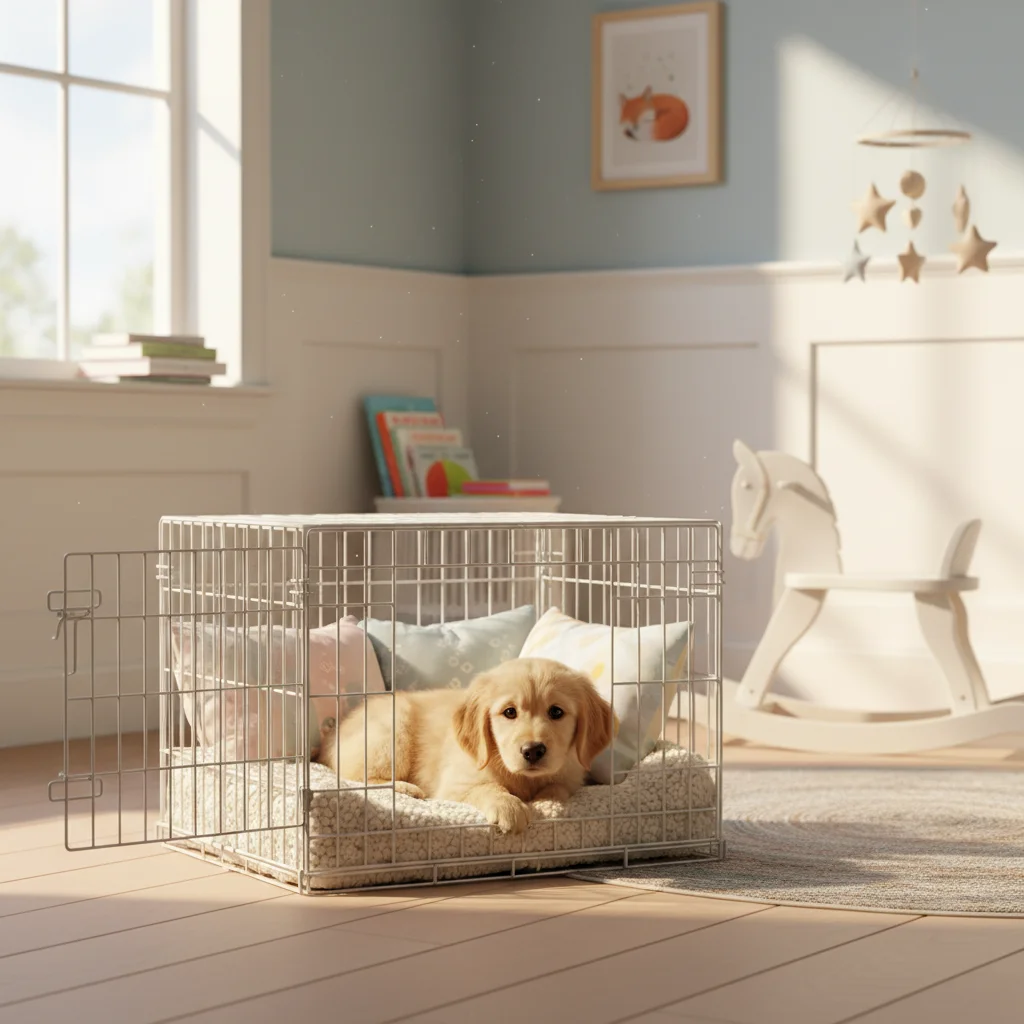
- A properly sized crate — just big enough for the puppy to stand, turn around, and lie down
- An enzymatic cleaner (Nature's Miracle or similar) — regular cleaners don't eliminate the scent that draws dogs back to the same spot
- High-value training treats — small, soft, and irresistible
- A leash — even for backyard trips
- A consistent schedule — this is the most important item on the list
Step 1: Establish a Schedule
Puppies have tiny bladders and fast metabolisms. A good rule of thumb: a puppy can hold it for roughly one hour per month of age, plus one. So a 3-month-old puppy can hold it for about 4 hours maximum — during the day. At night, they can usually go longer because their metabolism slows during sleep.
Take your puppy out at these times, every single day:
- Immediately after waking up (morning and naps)
- Within 10-15 minutes after every meal
- After every play session
- After every training session
- After drinking water
- Before bed
- Every 1-2 hours between these events (for young puppies)
Yes, that's a lot of trips outside. That's the reality of potty training. The frequency decreases as the puppy matures and gains bladder control.
Step 2: Choose a Potty Spot
Pick one specific area in your yard and take your puppy there every time. The accumulated scent will cue them to go. Stand quietly and give your puppy 3-5 minutes. Don't play, don't talk much — this is business time.
When they go, immediately mark it ("Yes!" or a clicker) and reward with a treat. The timing matters: you have about 1-2 seconds after the behavior to connect the reward to the action. Reward while they're still in the potty spot, not after you've walked back inside.
Once they've eliminated, then they earn freedom — a few minutes of yard play or off-leash time inside.
Step 3: Supervise or Confine — No Exceptions
This is where most potty training fails. When your puppy is inside and not in a crate, they must be under direct, active supervision. That means eyes on the puppy. Not "in the same room while you scroll your phone." Actually watching.
Signs your puppy needs to go:
- Sniffing the ground in circles
- Whining or barking at the door
- Suddenly stopping play to wander away
- Squatting (this means you're already too late — scoop them up and rush outside)
When you can't actively supervise — cooking, showering, sleeping, working — the puppy goes in the crate. Dogs have a natural instinct to keep their sleeping area clean, which makes the crate your most powerful potty training tool. A properly sized crate (just big enough to lie down and turn around) activates this instinct. If the crate is too large, the puppy will use one end as a bathroom.
Step 4: Handle Accidents Correctly
Accidents will happen. When they do:
If you catch them in the act: Interrupt with a gentle "Oops!" or clap, then immediately pick them up and carry them outside to the potty spot. If they finish outside, reward. Don't yell or punish.
If you find it after the fact: Clean it up silently with enzymatic cleaner. You missed your supervision window. The puppy has no idea what happened — they can't connect your displeasure to something they did 30 seconds ago, let alone 30 minutes ago.
Use enzymatic cleaner every time. Regular household cleaners leave trace odors that human noses can't detect but dog noses absolutely can. If the spot still smells like a bathroom, it will be used as one.
Step 5: Gradually Increase Freedom
As your puppy goes several days without accidents:
- Increase supervised free time inside
- Gradually expand the area they have access to (start with one room, add rooms as they prove reliable)
- Begin extending the time between potty breaks
- Phase out treats for outdoor elimination (replace with verbal praise)
A puppy who hasn't had an accident in 4+ weeks in a given area is probably reliable in that area. But keep expectations reasonable — most puppies aren't fully house trained until 6-8 months, and some breeds take up to a year.
Apartment and Indoor Potty Training
If you live in an apartment without quick yard access, puppy pads or an indoor grass patch can bridge the gap:
- Puppy pads: Place them in a consistent location, far from the puppy's food and bed. Use the same reward system as outdoor training. The downside: some puppies generalize "soft surface = bathroom" and start targeting rugs and carpets.
- Indoor grass patches (real or synthetic): Better than pads because the grass texture doesn't generalize to carpets. Products like Fresh Patch or DoggieLawn work well.
The goal is to eventually transition to outdoor-only, so start taking your puppy outside as frequently as possible even if you're using indoor options. Gradually move the pad/grass patch closer to the door, then outside.
Breed-Specific Considerations
Some breeds are notoriously harder to potty train:
- Small breeds (Chihuahuas, Dachshunds, Yorkies) have tiny bladders and often get a "pass" on indoor accidents due to small mess size — which actually slows training. Hold them to the same standard as large breeds.
- Hound breeds (Beagles, Bassets) can be more independent-minded about training. Extra patience and higher-value treats help.
- Brachycephalic breeds (French Bulldogs, Pugs) may resist going outside in extreme weather. Have a backup indoor option for very hot or cold days.
Common Mistakes That Slow Progress
- Giving too much freedom too soon. Freedom is earned, room by room, week by week.
- Inconsistent schedule. Everyone in the household must follow the same routine.
- Not cleaning accidents properly. Enzymatic cleaner is non-negotiable.
- Punishing accidents. This creates a dog who hides to eliminate, not one who goes outside.
- Relying only on puppy pads. Pads should be a bridge, not a permanent solution.
The Bottom Line
Potty training is simple (take them out frequently, reward success, prevent accidents) but demanding of your time and consistency. The investment pays off enormously — a reliably house-trained dog is the foundation of a happy life together. Most puppies "get it" within 4-8 weeks if you're consistent.
Be patient. Your puppy isn't being defiant when they have an accident — they're being a baby animal with a tiny bladder and an incomplete understanding of human expectations. Stay consistent, keep rewarding, and it will click.
For more on setting up your puppy for success, check out our guides on crate training and puppy essentials.
🏆 Bottom Line: Consistent schedule + immediate outdoor access + massive praise for outdoor elimination = housetraining success. Accidents indoors are almost always owner supervision failures, not puppy stubbornness. At 8 weeks, puppies can only hold their bladder for about 1 hour. Plan accordingly.
Related Reading
- Training — Guides and tools for better behavior
- How to Crate Train a Puppy — Step-by-step crate training guide
- Best Dog Crates for Puppies — Top crate picks for young dogs
Sources
- American Veterinary Medical Association (AVMA) — Puppy training and socialization recommendations. avma.org.
- American Kennel Club (AKC) — "Puppy Potty Training: A Step-by-Step Guide." akc.org.
- Association of Professional Dog Trainers (APDT) — Force-free housetraining methodology. apdt.com.
- Dunbar I — Before and After Getting Your Puppy. New World Library, 2004.
- Scott JP, Fuller JL — Genetics and the Social Behavior of the Dog. University of Chicago Press, 1965 (foundational puppy development research).
Research Sources
- Potty Training a Puppy: How to House Train a Dog — American Kennel Club
- Puppy Potty Training Schedule: A Timeline for Housebreaking Your Puppy — American Kennel Club
- AVSAB Position Statement on Humane Dog Training — American Veterinary Society of Animal Behavior, 2021
- House Training Your Dog or Puppy — ASPCA
- 2022 AAHA Canine Vaccination Guidelines — American Animal Hospital Association, 2022

Hilly Shore Labs
Editorial teamIndependent product research team behind PawBench. Reviews are grounded in primary veterinary sources, aggregated buyer sentiment, and the lived ownership of Maggie, an Australian Labradoodle.
200+ dog products researched · 1.1M+ Amazon review-aspect mentions analyzed · cites AVMA, FDA, AAFCO, Cornell, WSAVA, AKC, ASPCA.
All product reviews are independently researched. Recommendations are based on published veterinary guidelines, manufacturer specifications, and verified customer feedback. See our editorial standards.