Best Dog Crates for Puppies: Safe First Crates Ranked
MidWest iCrate Double Door Crate is the best first crate for most puppies, because its divider panel lets you buy for the adult size and shrink the space while the puppy is small. Petmate Sky Kennel is the pick for anxious puppies, and the AmazonBasics Double-Door Folding Metal Crate is the budget choice.
Our #1 Pick
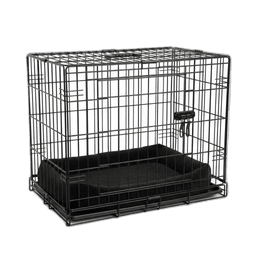
- Two doors (front and side) for flexible placement
- Includes free divider panel for growing puppies
- Folds completely flat for storage and transport
Divider panel lets you buy once for the adult size, two doors for flexible room placement.
Our analysis of 25,872 buyer mentions on MidWest iCrate Double Door: buyers consistently praised quality, size, value for money.
Also Great
Small-Breed Alternative: Diggs Evolv Dog Crate (Small) ($239.20) — Furniture-grade mesh crate sized for dogs that will stay small (no divider)
Potty companion: Fresh Patch Real Grass Patch ($44.95) — Real grass for the overnight and rainy-day gaps while the crate schedule settles
On this page10 sections
Our Verdict
The MidWest iCrate with divider panel is the best first crate for most puppies — it grows with your dog, folds flat for travel, and costs less than most alternatives. Size it for the adult dog, use the divider now.
Pick by situation
| If your situation is… | Pick | Why |
|---|---|---|
| Standard wire crate with grow-with divider | MidWest iCrate Double Door | Adjustable divider lets one crate cover puppy through adult; the most-recommended crate in trainer communities. |
| Travel / car / vet-visit crate | Petmate Sky Kennel | IATA airline-approved hard plastic kennel; the standard for car travel and the only style most airlines accept. |
| Working-line dog or escape artist | Impact Case Collapsible Dog Crate | Aluminum heavy-duty crate built for high-drive working dogs; the upgrade pick when standard wire crates are getting bent. |
| Small breed in a small-footprint home | Diggs Evolv Dog Crate (Small) | Slim diamond-mesh crate with repositionable doors; the right fit for small breeds in apartments where aesthetics matter. No divider, so buy it for the adult size. |
Each pick is one of the products ranked below — this row is for shortcutting based on your situation, not a separate recommendation.
MidWest iCrate Double Door Crate Owner rating4.7 Best overall — divider panel grows with the puppy | MidWest iCrate Double Door Owner rating4.8 Best overall | Petmate Sky Kennel Owner rating4.4 Best for anxious puppies | Impact Case Collapsible Dog Crate Owner rating4.6 Best heavy-duty | Diggs Evolv Dog Crate (Small) Owner rating4.2 Best for small breeds | AmazonBasics Double-Door Folding Metal Crate Owner rating4.7 Best budget | Fresh Patch Real Grass Patch Owner rating4.4 The potty companion to crate training | |
|---|---|---|---|---|---|---|---|
| Price | $84.99Buy on Amazon | See price on AmazonSee buying options | $107.95Buy on Amazon | $631.80Buy on Amazon | $239.20Buy on Amazon | $44.36Buy on Amazon | $44.95Buy on Amazon |
| Buyer sentiment | Quality Size Value for money Assembly Buyers praise quality, size, value for money and assembly. Mixed feedback on durability and ease of use. Based on 25,872 user mentions | — | Quality Durability Size Assembly Locking mechanism Buyers praise quality, durability, size and assembly. Some flag locking mechanism. Based on 4,001 user mentions | Quality Stability Durability Portability Value for money Buyers praise quality, stability, durability and portability. Some flag value for money. Based on 85 user mentions | — | Quality Sturdiness Assembly Ease of use Durability Buyers praise quality, sturdiness, assembly and ease of use. Some flag durability. Based on 2,083 user mentions | Effectiveness Quality Ease Of Use Value for money Buyers praise effectiveness, quality and ease of use. Mixed feedback on durability and grass quality. Some flag value for money. Based on 4,751 user mentions |
| Pros |
|
|
|
|
|
|
|
| Cons |
|
|
|
|
|
|
|
| Size linked | 42-inch double door (71–90 lb adult) | — | — | — | — | — | — |
| Divider | Included | — | — | — | — | — | — |
| Folds | Yes | — | — | — | — | — | — |
| Type | — | — | — | — | Modular indoor crate | — | — |
| Material | — | — | — | — | Mesh | — | — |
| Dimensions (Small) | — | — | — | — | 25.9 x 19.4 x 20 in | — | — |
| Doors | — | — | — | — | 2 included, up to 4 positions | — | — |
| Grass | — | — | — | — | — | — | Hydroponically grown, California grown |
| Size | — | — | — | — | — | — | 24" x 24" (Extra Large) |
| Reusable | — | — | — | — | — | — | No - disposable, replaced every 1-3 weeks |
| Tray required | — | — | — | — | — | — | No |
* Prices are approximate and may vary. Please check the latest price on Amazon.
How PawBench is paid: we earn an Amazon Associates commission on qualifying purchases. We don’t accept sponsored placements, paid reviews, or free products in exchange for coverage. Picks are ranked on documented owner outcomes and primary-source research, never on commission rate. Read the full methodology.
Crate training is one of the most effective tools in puppy ownership. A properly introduced crate becomes your puppy's den — a safe, quiet space they voluntarily retreat to when overwhelmed, tired, or in need of comfort. It also makes housetraining dramatically easier, prevents destructive behavior when you can't supervise, and keeps your puppy safe from household hazards like electrical cords and cleaning products.
But not every crate works for every puppy.
- The wrong size creates anxiety.
- The wrong material gets destroyed.
- The wrong design makes cleaning a nightmare.
We evaluated crates across every major type and brand to find the ones that work best for the unique demands of puppyhood.
Why Crate Training Works
Dogs are den animals by instinct. In the wild, canines seek out enclosed spaces for rest and security. A crate replicates this instinct in a domestic setting. When introduced properly — gradually, positively, never as punishment — a crate becomes the place your puppy chooses to be.
The housetraining benefit is biological: dogs are instinctively reluctant to soil their sleeping area. A properly sized crate leverages this instinct by limiting the puppy's space to just enough for standing, turning, and lying down.
Why divider panels are essential: if the puppy can retreat to one corner to sleep and use the opposite corner as a bathroom, the crate is too large.
Critical rule: A crate is not a storage container for your puppy. Puppies under 6 months should not be crated for more than 3-4 hours at a stretch (except overnight). Their bladders simply can't hold longer than that. Excessive crating causes anxiety, not comfort.
What to Look For in a Puppy Crate
Divider Panel
This is non-negotiable for puppy crates. A divider panel lets you buy a crate sized for your dog's adult dimensions while restricting the usable space to match your puppy's current size. As the puppy grows, you move the divider back. Without a divider, you're either buying a crate that's too large for housetraining or buying multiple crates as the puppy grows.
Appropriate Material
- Wire crates: Best for most puppies. Maximum ventilation, visibility, and the puppy can see and hear you. Easy to clean (pull out the tray, wipe down). Compatible with crate covers for creating a darker, more den-like environment.
- Plastic crates (airline-style): More enclosed and den-like from the start. Better for anxious puppies who are overwhelmed by visual stimulation. Required for airline travel. Less ventilation in warm climates.
- Soft-sided crates: Not recommended for puppies. A determined puppy will chew through mesh panels in minutes. Save these for adult dogs who are already crate-trained.
- Heavy-duty crates: Necessary only for puppies showing extreme escape behavior. Most puppies don't need them — if your puppy is desperate to escape, the crating approach needs adjustment, not a stronger crate.
Easy Tray Access
Puppies have accidents. A slide-out plastic tray at the bottom of a wire crate makes cleanup a 30-second task instead of a 10-minute ordeal. Ensure the tray slides out smoothly without requiring you to move the crate or remove the dog first.
Secure Latches
Puppies are remarkably good at figuring out latch mechanisms. Double-latch doors (latching at both top and bottom) are significantly more escape-resistant than single-latch designs.
Test the latch before you trust it: push on the door from the inside — if it flexes more than half an inch, a determined puppy will eventually pop it open.
Two-Door Design
A crate with both a front and side door gives you flexibility in placement. The side door is particularly useful when the crate is positioned against a wall — you can still open the door without rearranging furniture.
The puppy starter basket
Most people who buy a crate buy the rest of the setup in the same sitting, so here is the version that doesn't need a second order: the MidWest iCrate 42-inch (with its divider, so one crate lasts from 8 weeks to adult), a Furhaven orthopedic sofa bed cut to fit inside, a non-skid stainless bowl for the crate's water, a KONG Classic stuffed and frozen for the first closed-door sessions, and a Nylabone puppy chew for teeth. That's the whole kit; everything else can wait a month.
The 5 Best Dog Crates for Puppies
#1 Best Overall: MidWest iCrate Double Door (~$45 for 36")
See buying optionsWhy it wins: The MidWest iCrate checks every box for puppy ownership at a price that undercuts most competitors. The included divider panel adjusts as your puppy grows. The double-door design (front and side) provides placement flexibility. The slide-out plastic tray makes cleanup effortless. And the fold-flat design means you can collapse it for travel or storage in under 30 seconds.
The wire construction provides excellent ventilation and allows your puppy to see you from inside the crate — reducing anxiety during the adjustment period. The dog-safe coating resists rust and is easy to wipe clean. The dual slide-bolt latches on each door are secure enough to resist most escape attempts.
Available in sizes from 18" to 48", you can buy the adult-appropriate size immediately and use the divider throughout puppyhood.
-
For a 70-lb adult Lab, buy the 42" model.
-
For a 25-lb adult Cocker Spaniel, the 30" is appropriate.
-
Key specs: Wire, double door, divider included, fold-flat, slide-out tray, dual latches
-
Best for: Most puppies of any breed. The default recommendation.
#2 Best for Anxious Puppies: Petmate Sky Kennel ($107.95 for 32")
Buy on Amazon · $107.95 →Why anxious puppies prefer it: The enclosed plastic design naturally creates the dark, den-like environment that calms anxious puppies. Unlike wire crates where the puppy can see (and react to) every movement in the room, the Petmate Sky Kennel limits visual stimulation to the ventilation slots and wire door.
This is also the crate to buy if you'll ever need to fly with your dog — it's IATA-compliant for airline cargo and meets most airline requirements for in-cabin travel in smaller sizes. The shell is sturdy enough to prevent escape but lightweight enough for one person to carry.
The trade-off is ventilation. In warm climates or poorly air-conditioned homes, the enclosed design can trap heat. It also doesn't include a divider panel (sold separately), so you'll need to purchase one or stuff the back with a box or rolled towel to reduce the usable space during housetraining.
- Key specs: Plastic shell, airline-approved, enclosed den design, ventilation slots, sturdy latches
- Best for: Anxious puppies, future airline travelers, dogs overwhelmed by stimulation
#3 Best Heavy-Duty: Impact Case Collapsible Dog Crate ($648 for 37")
Buy on Amazon · $631.80 →Why some puppies need reinforcement: Most puppies don't need a heavy-duty crate. But puppies with severe separation anxiety, extreme escape drive, or destructive tendencies can bend wire crate bars, pop standard latches, and injure themselves in the process. The Impact Case uses aluminum construction with slam-latch door mechanisms that are genuinely escape-proof.
The rounded interior corners eliminate pinch points where a panicking dog could catch a paw or jaw. The removable floor tray is aluminum (not plastic), so it won't crack under stress. And despite the heavy-duty construction, it folds flat for transport.
At $350+, this is a significant investment. But it's cheaper than an emergency vet visit for a dog that's injured itself escaping a standard crate — or replacing the furniture, drywall, and door frames that a free-roaming anxious puppy destroys.
- Key specs: Aluminum, slam-latch doors, rounded corners, collapsible, removable aluminum tray
- Best for: Puppies with severe anxiety or escape behavior (after consulting a veterinary behaviorist)
#4 Best for Small Breeds: Diggs Evolv Dog Crate ($239.20 for the Small)
Why it's worth the premium for small dogs: The Evolv is the Apple product of dog crates — beautifully designed, genuinely furniture-like, and expensive. The diamond-pattern mesh panels are puppy-paw-safe (no gaps wide enough to catch a small paw), the doors lock with a dual latch Diggs describes as finger-friendly for owners, and the modular design lets you reposition doors as the crate moves around the house.
For small-breed puppies — Yorkies, Chihuahuas, Miniature Poodles — the safety features justify the cost. Small-breed puppies have delicate legs that can slip between standard wire crate bars, and the mesh pattern eliminates this risk entirely.
Two things to be clear about before you spend $299. The Small ships with the crate only — no divider — so buy it for the adult size of a dog that will stay small, not as a crate your puppy grows into. And it is a rigid modular crate, not a folding one: it belongs in a room, not in a car trunk. Diggs discontinued the collapsible Revol we previously recommended here, and nothing in that line is still available, which is why this pick changed.
- Key specs: Mesh panels, dual-lock doors, up to 4 door positions, no divider included, puppy-paw-safe
- Best for: Small-breed puppies whose adult size is known, safety-conscious owners
#5 Best Budget: AmazonBasics Double-Door Folding Metal Crate ($41.90 for 36")
Buy on Amazon · $44.36 →Why it works on a budget: The AmazonBasics crate is functionally similar to the MidWest iCrate at a slightly lower price point. Double doors, divider panel, slide-out tray, fold-flat design — the essential features are all present. The construction quality is slightly lower (thinner gauge wire, less smooth tray slides), but for most puppies it's perfectly adequate.
The latches are the main compromise — the single slide-bolt per door is less secure than the MidWest's dual-latch system. For calm puppies or puppies crated only for short periods, this isn't an issue. For escape artists, upgrade to the MidWest.
- Key specs: Wire, double door, divider included, fold-flat, slide-out tray, single latches
- Best for: Budget-conscious owners with non-escape-prone puppies
Comparison Table
| Crate | Price (36") | Material | Divider | Doors | Best For |
|---|---|---|---|---|---|
| MidWest iCrate | ~$45 | Wire | Included | 2 | Most puppies |
| Petmate Sky Kennel | $107.95 | Plastic | Sold separately | 1 | Anxious puppies |
| Impact Case | ~$350 | Aluminum | Included | 1 | Escape artists |
| Diggs Evolv (Small) | $239.20 | Mesh | Not included | 2 (repositionable) | Small breeds |
| AmazonBasics | ~$35 | Wire | Included | 2 | Budget pick |
Crate Sizing Guide by Expected Adult Weight
Buy the crate for your dog's expected adult size, not their current puppy size. Use the divider to adjust. Not sure how big your puppy will get? The puppy weight predictor estimates adult weight from breed, age and current weight.
| Expected Adult Weight | Recommended Crate Length |
|---|---|
| Under 10 lbs | 18-22" |
| 10-25 lbs | 24-30" |
| 25-40 lbs | 30-36" |
| 40-70 lbs | 36-42" |
| 70-90 lbs | 42-46" |
| 90+ lbs | 48"+ |
The fit test: your dog should be able to stand without crouching, turn around completely, and lie down with legs extended in the crate at adult size. If they can do significantly more than that, the crate is too large for housetraining purposes (use the divider).
How to Introduce the Crate
Week 1: Positive Association
Place the crate in a common area with the door open. Toss treats inside. Let the puppy enter and exit freely. Never close the door during this phase. Feed meals inside the crate with the door open.
Week 2: Brief Closures
After the puppy is voluntarily entering the crate, close the door for 30 seconds while you sit next to it. Gradually increase to 5 minutes. If the puppy whines, wait for a brief pause in whining before opening — never open the door while the puppy is actively whining, or you'll reinforce the behavior.
Week 3: Increasing Duration
Build up to 30-minute crate sessions while you're in the room, then while you're in another room. Always provide a safe chew toy (Kong, Nylabone) for occupation. Make the crate a positive destination, not a punishment.
Week 4 and Beyond
By now, most puppies accept the crate as their space. Establish a routine: crate during your absence, crate at bedtime, freedom during supervised periods. Always exercise the puppy before crating — a tired puppy settles much faster.
Never use the crate as punishment. The moment a puppy associates the crate with negative experiences, crate training fails. If you need a time-out space, use a separate pen or room.
Frequently Asked Questions
How long can a puppy stay in a crate?
As a general rule: the puppy's age in months plus one equals the maximum hours of crating. A 2-month-old can hold it for about 3 hours, a 4-month-old for about 5 hours. Overnight is an exception — most puppies can sleep through the night (6-8 hours) by 4 months of age, since metabolism slows during sleep.
Should I cover the crate at night?
For most puppies, yes. A crate cover (or a blanket draped over the top and sides, leaving the front partially open) reduces visual stimulation and creates a darker, more den-like environment. This helps many puppies settle faster at night. Ensure adequate ventilation — never cover all sides completely.
My puppy cries in the crate. What should I do?
First, rule out physical needs: does the puppy need to potty, is it too hot or cold, has the puppy been crated too long? If needs are met, brief whining during the adjustment period is normal. Don't open the door while the puppy is whining. Wait for even a 2-second pause, then open it and reward the quiet. If crying is persistent (more than 15-20 minutes) or escalating, you may be progressing too quickly — go back to shorter durations.
Should I put bedding in the puppy's crate?
During housetraining, use only a thin, washable pad — not a plush bed. Thick bedding absorbs accidents, which allows the puppy to soil the crate and still sleep comfortably. This undermines the biological instinct that makes crate-based housetraining work. Once the puppy is fully housetrained, you can add a proper bed.
When can I stop using the crate?
Many dogs use crates voluntarily their entire lives — with the door open, it remains their preferred rest spot. For housetraining purposes, most puppies can be trusted with supervised freedom by 6-8 months and unsupervised freedom by 12-18 months, depending on breed and temperament. Transition gradually by leaving the crate open during supervised periods and monitoring for destructive behavior.
The Bottom Line
A crate is a training tool, not a containment device. Used correctly — the right size, the right introduction, the right duration — it's one of the most effective investments in your puppy's first year. The MidWest iCrate is our default recommendation because it's well-built, appropriately priced, and includes every feature a puppy crate needs. Buy it for your dog's adult size, use the divider now, and let the crate become the safe space every puppy deserves.
🏆 Bottom Line: Buy the adult-size crate your puppy will grow into and use a divider panel to size it correctly for now. MidWest Homes for Pets single-door crates are the best value for first-time puppy owners — durable, easy to assemble, and widely available with divider panels included.
Related Reading
-
Puppy Essentials — Complete first-year gear guide
-
Dog Beds — Upgrade from crate pad to proper bed
-
Dog Health — Puppy vaccination and wellness schedules
-
Dog Anxiety Solutions — Crates as part of an anxiety management plan
-
How to Choose the Right Dog Crate Size — Get the sizing right the first time
-
Best Dog Beds 2026 — Add a bed insert for crate comfort
Research Sources
- How to Crate Train Your Dog in Nine Easy Steps — American Kennel Club
- Crate Training a Puppy: How to Housetrain a Dog — American Kennel Club
- An Owner's Manual: Crate Training — American Kennel Club
- Lifestyle and Safety Assessment (Canine Life Stage Guidelines) — American Animal Hospital Association
- AVSAB Position Statement on Humane Dog Training — American Veterinary Society of Animal Behavior, 2021

PawBench Editorial
Published by Hilly Shore LabsPawBench’s editorial team researches dog products from primary veterinary sources, manufacturer specifications and aggregated buyer sentiment, alongside the lived ownership of Maggie, an Australian Labradoodle. We do not run hands-on product tests.
331 dog products scored · 1,222,724 buyer review-aspect mentions aggregated · cites AVMA, FDA, AAFCO, Cornell, WSAVA, AKC, ASPCA.
Recommendations are based on published veterinary guidelines, manufacturer specifications, and verified customer feedback. See our editorial standards.