When to Throw Away a Dog Toy: Wear Signs That Are a Hazard
Quick Answer
Throw a dog toy away as soon as a piece can come off and be swallowed, not when it finally falls apart. Retire it at the first frayed rope strand or unraveling seam, a loose or missing squeaker, a soft spot or crack near a seam, exposed stuffing, or any size that has shrunk relative to a growing dog. The most dangerous wear is a frayed rope or plush string: veterinary surgeons class these as linear foreign bodies that can saw through the intestine and cause perforation, peritonitis, and sepsis. Inspect every toy by hand once a week, act on the worst thing you find rather than the average condition, and if a chunk, squeaker, or strand goes missing, watch for vomiting, loss of appetite, or lethargy and treat any of those as a same-day veterinary emergency.
On this page7 sections
Our Verdict
A dog toy is a consumable, not a permanent object. Inspect every toy weekly, retire it at the first fray, loose squeaker, or missing piece, buy a size too big to swallow whole, and treat vomiting, appetite loss, or lethargy after a missing toy piece as a same-day emergency. Frayed ropes and plush strings are the most dangerous wear because they are linear foreign bodies that can perforate the intestine.
Dog Toy Wear-Stage Inspection Chart
Run your hands over each toy weekly. Match what you find to the worst stage present, and act on that — not on the average condition of the toy.
| Product | What you see / feel | Risk | Action |
|---|---|---|---|
| Intact | No fraying, no cracks, squeakers in place, correct size | Low | Keep, recheck weekly |
| Surface wear | Light tooth marks, faded color, minor surface scuffing | Low | Keep, watch closely |
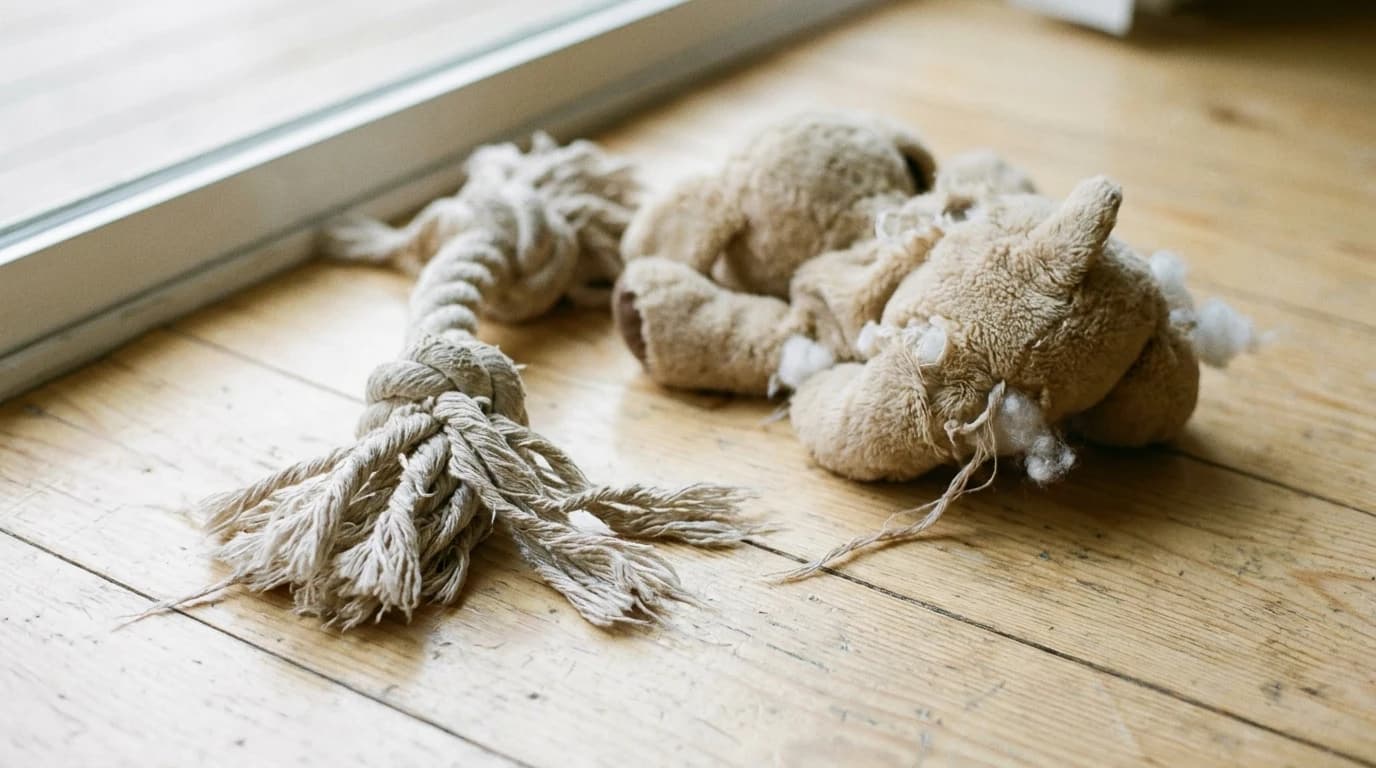
| Frayed rope / loose seam | Rope strands pulling loose, plush seam starting to open | High (linear foreign body) | Retire now |
| Soft spot / crack | Squishy spot near a seam, crack opening up, squeaker loosened | High | Retire now |
| Missing piece | Squeaker, knot, stuffing, or chunk gone and unaccounted for | Critical (possible swallow) | Bin it, watch the dog |
| Too small now | Fits fully inside the mouth (dog outgrew it or it shrank) | High (choking) | Size up, retire old toy |
Linear foreign bodies (string, rope, ribbon, plush strands) carry the highest risk per Cornell and the ACVS. A swallowed piece that lodges in the stomach or intestine usually requires surgery. This chart is general guidance, not a substitute for veterinary advice.
How PawBench is paid: we earn an Amazon Associates commission on qualifying purchases. We don’t accept sponsored placements, paid reviews, or free products in exchange for coverage. Picks are ranked on documented owner outcomes and primary-source research, never on commission rate. Read the full methodology.
Most toy-safety advice stops at the checkout: pick the right size, avoid hard bones, watch for choking. But the toy you bought safely six months ago is not the same object today. Chewing degrades it. A plush that was harmless when whole becomes a swallowed squeaker. A rope that was fine fresh becomes a string your dog can ingest.
The danger is not the toy you buy. It is the toy you keep too long.
This is an inspection problem, not a shopping problem. Below is how to read a worn toy, when it crosses from "well-loved" to "throw it out tonight," and why the rope toy deserves its own rule.
Why a worn toy is a different risk than a hard one
A too-hard chew fractures a tooth while your dog is chewing it. A worn-out toy is a slower, scarier risk: pieces come off and get swallowed. Once a non-digestible chunk is in the gut and too big to pass, it becomes a gastrointestinal (GI) foreign body, which the Cornell Riney Canine Health Center describes as an emergency that often requires surgical removal. Toys are one of the most common foreign bodies veterinary surgeons pull out of dogs, alongside socks, bones, and rocks.
The American College of Veterinary Surgeons is blunt about where it goes wrong: a swallowed object that lodges in the stomach or intestine usually has to be removed surgically by opening the stomach (gastrotomy) or intestine (enterotomy). Some small, smooth items pass on their own. Many do not.
The wear-stage chart above is the quick version: run your hands over each toy weekly, map what you find to a stage, and act on the worst thing you see — not the average condition of the toy. The rest of this post is the reasoning behind it.
What most owners get wrong: the rope toy
Here is the part the bag never warns you about. A frayed rope, a ribbon, a strand of cloth from a torn plush — these are linear foreign bodies, and both Cornell and the ACVS single them out as the most dangerous category. A string does not just sit in the gut. It can saw through the intestinal wall and cause a perforation, spilling intestinal contents into the abdomen. That leads to peritonitis and sepsis, which are life-threatening.
That is why "the rope is just a little frayed" is not a small problem. The loose strands are the exact shape that does the worst damage.
Retire at the first fray: a rope toy that has started to unravel has reached the end of its life, full stop.
If you keep rope toys, supervise every session and retire them at the first fray — do not wait for the knot to come apart.
When "it's fine, it always passes" is the trap
The reassuring story owners tell themselves is that their dog eats weird things all the time and always passes them. Sometimes that is true: a small, smooth object can move through and come out the other end. But the research does not support treating that as the rule. Whether an item passes depends on its size, its shape, where it lodges, and how long it has been there — and you cannot judge any of that from the couch. A history of "it always passes" is exactly the history that ends in a surgery, because the dog that swallows toy pieces is the dog that eventually swallows the wrong one.
The honest rule is not "wait and see." It is "remove the toy before there is a piece to swallow."
Watch for these signs after a toy goes missing a piece
If a chunk, squeaker, or strand has disappeared and you cannot find it, assume it was swallowed and watch closely. Per Cornell, the common signs of a GI obstruction are:
Vomiting, loss of appetite, and lethargy — especially repeated vomiting or a dog that stops eating. With a linear foreign body, a string is sometimes visible wrapped under the tongue or coming from the rear. Any of these after a missing toy piece is an emergency, not a wait-until-morning.
Call your veterinarian or an emergency clinic the same day. Obstructions get worse, not better, and the best outcomes come from removing them early.
Buy to outlast the chewer, then still inspect
Inspection is the safety net, but the right purchase makes it easier. AAHA's guidance is practical:
- Bigger than your dog's snout and slightly wider than their mouth.
- For a power chewer, go one size above the labeled range — a toy too big to fit fully in the mouth is far harder to swallow whole or break apart.
- Watch coated or flavored chews. AAHA flags that some bully sticks and pig ears can carry bacteria such as Salmonella, which is a different reason to be choosy.
But size at purchase does not cancel the weekly check. The biggest, toughest toy still wears down. Match the toy to how your dog actually chews, then keep checking it.
The one-minute weekly toy audit
- Pick up every toy your dog has access to, one at a time.
- Squeeze and flex it. Loose squeaker, soft spot near a seam, or a crack that has opened up? Retire it.
- Look for missing pieces. Count squeakers and stuffing knots you know should be there; a gap means a swallow you may have missed.
- Check ropes and plush for strings. Any fray, loose strand, or unraveling seam is a linear-foreign-body risk — bin it now.
- Confirm size still fits the dog, not the puppy. Dogs grow; the toy that was "one size up" at four months may be a choking size at ten.
- When in doubt, throw it out. A replaced toy is cheaper than an enterotomy.
The bottom line
A dog toy is a consumable, not a permanent object. The risk is highest not on day one but on the day a piece comes loose and gets swallowed, and the worst version of that is a frayed rope or a strand of plush — a linear foreign body that can perforate the intestine. So:
- Inspect weekly.
- Retire at the first fray or missing piece.
- Buy a size that cannot be swallowed whole.
- Treat vomiting, appetite loss, or lethargy after a missing toy piece as a same-day emergency.
The cheapest insurance in the toy bin is the willingness to throw something away early.
Research Sources
- Don't Chew On This! — American Animal Hospital Association (AAHA)
- Gastrointestinal foreign body obstruction in dogs — Cornell Richard P. Riney Canine Health Center
- Gastrointestinal Foreign Bodies — American College of Veterinary Surgeons (ACVS)

PawBench Editorial
Published by Hilly Shore LabsPawBench’s editorial team researches dog products from primary veterinary sources, manufacturer specifications and aggregated buyer sentiment, alongside the lived ownership of Maggie, an Australian Labradoodle. We do not run hands-on product tests.
331 dog products scored · 1,222,724 buyer review-aspect mentions aggregated · cites AVMA, FDA, AAFCO, Cornell, WSAVA, AKC, ASPCA.
Recommendations are based on published veterinary guidelines, manufacturer specifications, and verified customer feedback. See our editorial standards.