Are Your Floor Cleaners Safe for Dogs? What Matters
Quick Answer
Most floor and household cleaners are safe around dogs as long as they're diluted per label, rinsed, and fully DRY before the dog returns — the ASPCA Animal Poison Control Center confirms this for bleach, vinegar, and enzyme cleaners alike. The real hazard isn't the chemical name; it's wet residue (dogs walk a freshly-mopped floor and lick it off their paws) and swallowed concentrate. About 8.3% of ASPCA poison calls involve household cleaning products (PetMD). So clean dogs out of the room, ventilate, let it dry, and keep concentrates and detergent pods locked away. 'Natural' is not automatically safe — undiluted vinegar irritates the stomach and concentrated essential oils (tea tree, pine, citrus) are genuinely toxic, especially to cats. Swallowed concentrate, pods, drain/oven cleaner, or pool chemicals, or any mouth burns — call your vet or ASPCA Poison Control at (888) 426-4435 right away.
On this page8 sections
Our Verdict
There is no single 'pet-safe' floor cleaner to go buy. Nearly any mainstream cleaner is safe around a dog when it's diluted to label, rinsed, and fully dry before the dog walks on it — and even a 'natural' product can cause a problem used wet or left within reach. The exposure route is almost always paw-then-lick on a still-wet floor, not drinking the bottle. Clean for the dry floor and the locked cabinet, not the brand name. Swallowed concentrate, detergent pods, drain/oven cleaner, or pool chemicals — or any mouth burns — are an emergency: call your vet or ASPCA Poison Control at (888) 426-4435.
Common Cleaner Ingredients, by Real-World Risk to Dogs
At normal household dilution most cleaners cause at-worst mild GI upset; serious injury comes from concentrate and extreme pH. Risk ratings paraphrased from ASPCApro's toxicology resource. None of this is a reason to fear a fully-dried floor — it's why concentrates stay locked up and dogs stay off wet floors.
| Product | At household dilution | As concentrate / spill |
|---|---|---|
| Chlorine bleach (sodium hypochlorite, 3-6%) | Mild mucosal irritation; safe once diluted, rinsed, dry | Mouth/esophagus/stomach burns; pool chlorine (10-12%) is far worse |
| Ammonia / glass cleaners | GI irritation; fume-sensitive in cats and birds | Corrosive injury, worse fumes — never mix with bleach |
| Cationic surfactants (fabric softener, sanitizers) | GI upset; cats notably sensitive | More likely than other surfactants to burn mouth and esophagus |
| Bases / alkalis (oven, drain, dishwasher pods) | GI irritation | pH >10 = corrosive burns; pods a top emergency |
| Vinegar / acids | Stomach upset; fine once diluted, rinsed, dry | Low-pH irritation; not a free pass for being 'natural' |
| Enzyme cleaners | Mild stomach upset — ensure fully dry before re-entry | Mild; same dry-first rule |
| Solvents / essential oils (pine, d-limonene, tea tree) | Usually mild, self-limiting GI upset | Genuinely toxic concentrated — cats most at risk |
How PawBench is paid: we earn an Amazon Associates commission on qualifying purchases. We don’t accept sponsored placements, paid reviews, or free products in exchange for coverage. Picks are ranked on documented owner outcomes and primary-source research, never on commission rate. Read the full methodology.
The question dog owners ask is "is this cleaner pet-safe?" — but that's the wrong question. The label on the bottle matters far less than how you use it. According to the ASPCA Animal Poison Control Center, most cleaning products are safe to use around dogs and cats as long as they are used per labeled directions — diluted correctly, rinsed, and allowed to dry before the pet comes back. The danger is wet residue, spilled concentrate, and fumes — not the existence of a chemical name you can't pronounce.
Household cleaners are not a rare problem. PetMD reports that 8.3% of ASPCA poison-control calls involve household cleaning products — pets walk across freshly mopped floors, lick residue off their paws, inhale fumes, or knock over a bottle. So the goal here isn't to find a magic non-toxic cleaner. It's to clean in a way where exposure never happens.
Key Takeaways
- "Used as directed and fully dry" is the real safety line — far more than which product you buy.
- Concentration is everything. Diluted bleach on a kennel is fine once dry; spilled concentrate or a swallowed pool chemical can burn the mouth and esophagus.
- The exposure route is paw-then-lick. Dogs don't usually drink the bottle — they walk the wet floor and groom it off.
- "Natural" is not automatically safe. Vinegar irritates the stomach undiluted; concentrated tea-tree and other essential oils are genuinely toxic, especially to cats.
How Pets Actually Get Exposed
There are four routes, and the floor is the most common one:
- Skin/paw contact, then grooming — walking across a still-wet floor, then licking the residue off the paws. This is why "let it dry" is the whole ballgame.
- Licking residue off mopped floors, counters, or crate surfaces.
- Inhaling fumes in an unventilated room — cats are especially fume-sensitive, and the ASPCA warns birds are extremely sensitive.
- Ingesting concentrate — knocking over the bottle or chewing a detergent pod.
The takeaway: a product can be perfectly safe once dry and still cause a vet visit if your dog walks the floor while it's wet.
The Ingredient Decode (What the Concentration Really Means)
The ASPCA's professional toxicology resource (ASPCApro) breaks the risk down by chemical class. The pattern is consistent: at normal household dilution, most cleaners cause at-worst mild stomach upset; the serious injuries come from concentrates and high/low pH.
Common Cleaner Ingredients, Ranked by Real-World Risk
The matrix below pairs each ingredient class with what actually happens at household concentration versus concentrate. None of this is a reason to panic about a properly-used, fully-dried floor — it's a reason to store concentrates out of reach and never let a dog onto a wet floor.
Safe Mopping in Five Steps
You don't need a special product. You need a routine that removes the residue and the wet window:
- Dilute exactly as the label says. Stronger is not cleaner — it just leaves more residue and raises the pH.
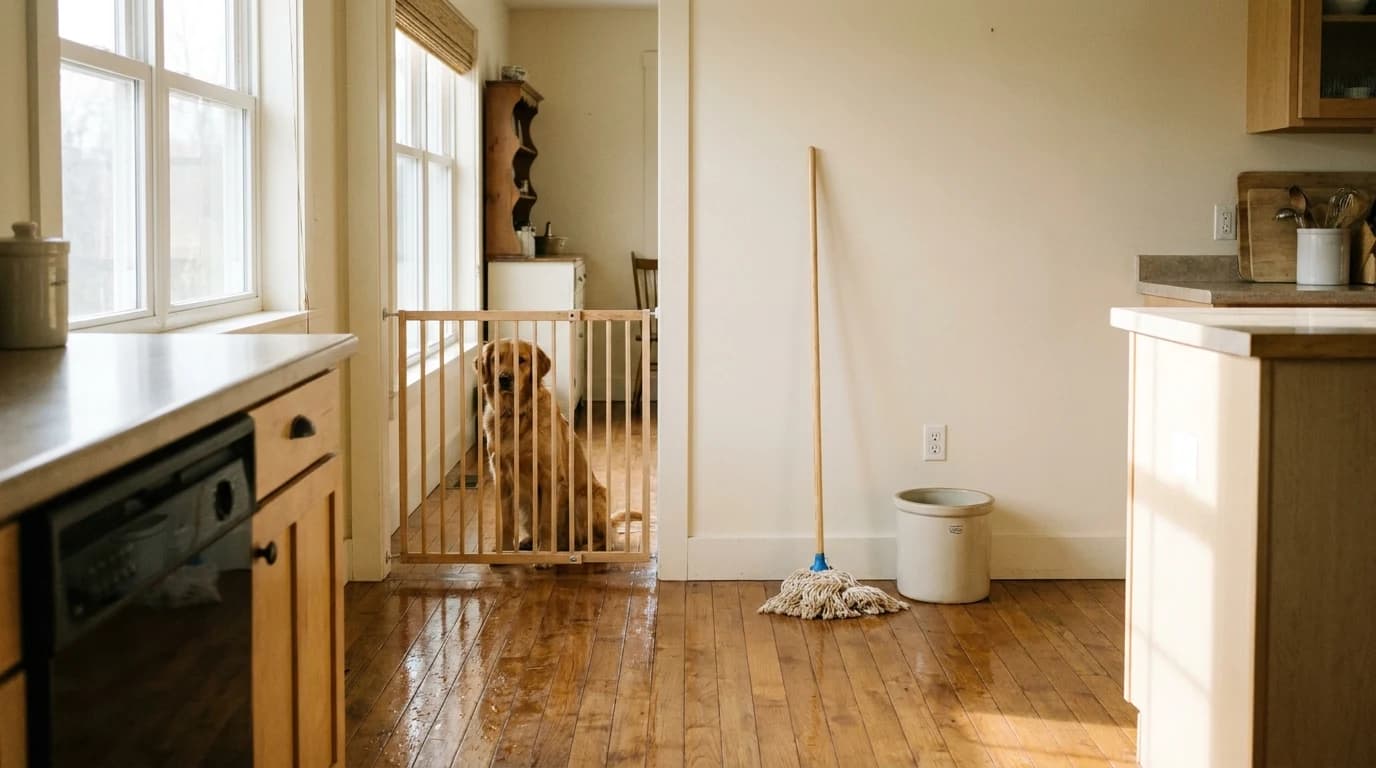
- Mop dogs out of the room. A baby gate or closed door for the duration is the single most effective safety step.
- Rinse if the label allows. A plain-water pass after cleaning removes the film a dog would otherwise lick off its paws.
- Ventilate. Open a window or run a fan, especially with anything chlorine- or ammonia-based, and especially if you have cats or birds.
- Wait for fully dry before re-entry. The ASPCA's guidance for vinegar, bleach, and enzyme cleaners all converge on the same instruction: let it dry first.
What Most People Get Wrong
"Natural means safe." This is the most common and most dangerous assumption. Undiluted vinegar is acidic enough to cause stomach upset and irritation — the ASPCA only calls it safe when diluted, rinsed, and dried. Essential oils are worse: concentrated tea-tree, pine, and citrus (d-limonene) oils show up in "green" cleaners and potpourri, and concentrated forms are genuinely toxic — cats, who can't efficiently metabolize them, are the most vulnerable. A bottle labeled "plant-based" earns no free pass; the same "dilute, rinse, dry, keep concentrate locked up" rules apply.
"Enzyme cleaners are pet products, so they're harmless." Most enzyme-based cleaners cause mild stomach upset if a dog licks them up, so the ASPCA's instruction is the same as everything else: make sure they're dry before the pet returns.
When to Call, Not Wait
Mild drooling or a single soft stool after a small lick of a properly-diluted cleaner is usually self-limiting. Treat these as an emergency and call your vet or ASPCA Animal Poison Control at (888) 426-4435:
- Swallowing concentrate, a detergent/dishwasher pod, a drain or oven cleaner, or pool chemicals (high-concentration sodium hypochlorite).
- Burns, ulcers, or blistering in or around the mouth, or refusing to eat/drink.
- Repeated vomiting, lethargy, tremors, or difficulty breathing (cats open-mouth breathing is an urgent sign).
Corrosive ingestions can cause esophageal burns, so do not induce vomiting unless a veterinarian tells you to — bringing a corrosive substance back up does a second round of damage.
The Bottom Line
There is no single "pet-safe" floor cleaner to go buy. Nearly any mainstream cleaner is safe around a dog when it's diluted to label, rinsed, and fully dry before the dog walks on it — and even a "natural" one can cause a problem if it's used wet or stored within reach. Clean for the dry floor and the locked cabinet, not for the brand name. That's the line the toxicology data actually draws.
Research Sources
- Poisonous Household Products — ASPCA Animal Poison Control Center
- Ingredients & Toxicities of Cleaning Products — ASPCApro
- Common Cleaning Products That Can Harm Your Pets — PetMD
Your next step
Picked a safe cleaner? Here's the full dog-household system.

Hilly Shore Labs
Editorial teamIndependent product research team behind PawBench. Reviews are grounded in primary veterinary sources, aggregated buyer sentiment, and the lived ownership of Maggie, an Australian Labradoodle.
200+ dog products researched · 1.1M+ Amazon review-aspect mentions analyzed · cites AVMA, FDA, AAFCO, Cornell, WSAVA, AKC, ASPCA.
All product reviews are independently researched. Recommendations are based on published veterinary guidelines, manufacturer specifications, and verified customer feedback. See our editorial standards.