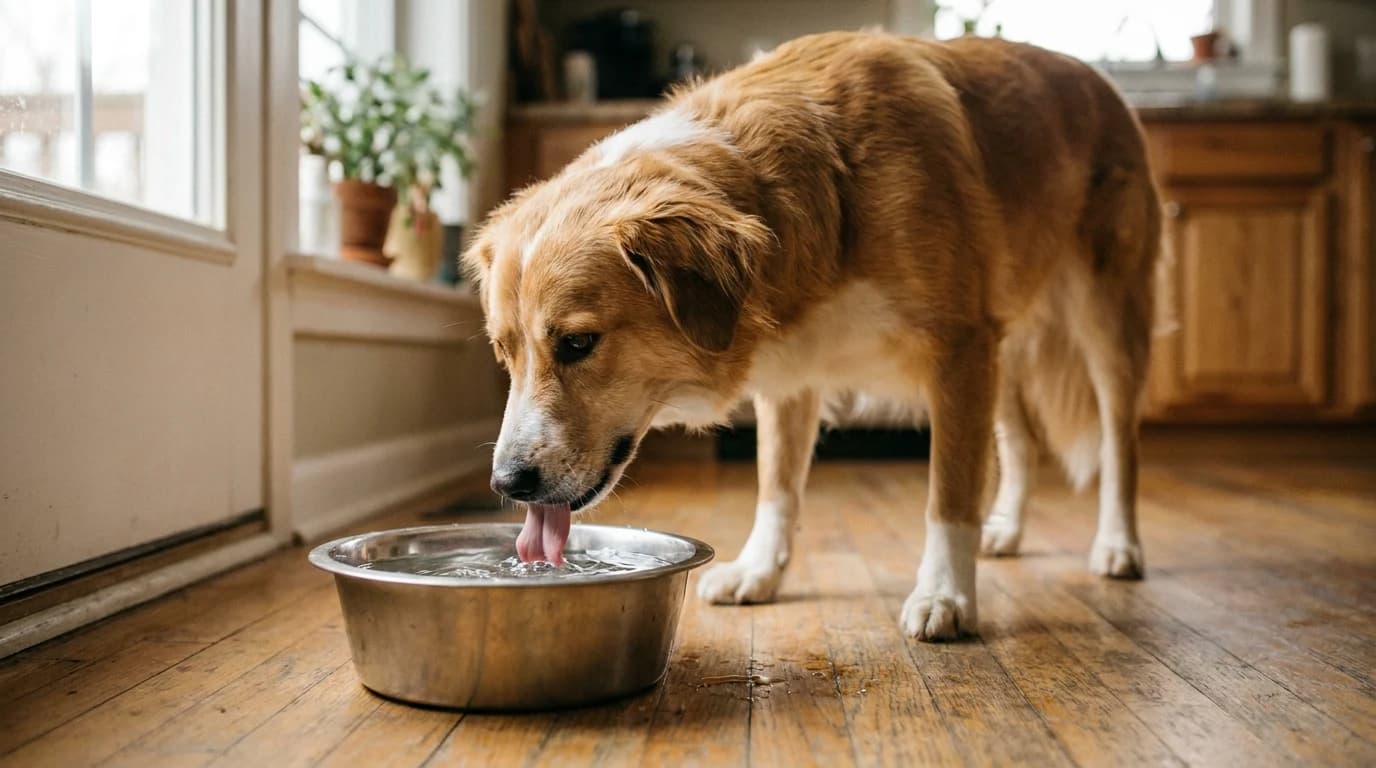
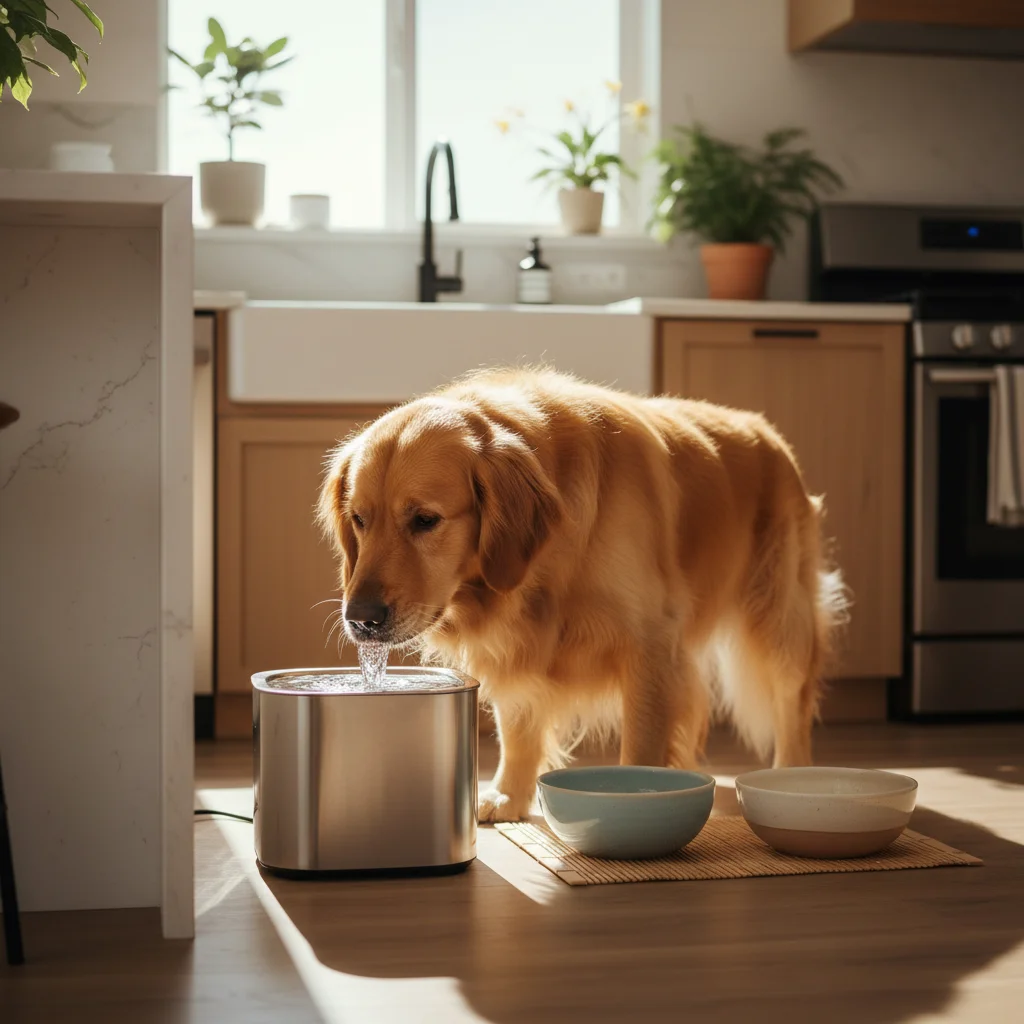
Dog Water Fountains: Do They Help or Just Cost More?
Quick Answer
A dog water fountain may make an individual dog drink more if that dog prefers cool, moving water, but there is no solid dog-specific evidence that fountains reliably raise intake. For a healthy dog already drinking normally, the fountain is mainly a convenience appliance. The honest decision is maintenance: daily food-and-water-surface cleaning, a pump teardown about every two weeks, recurring filters, and a backup bowl for outages or pump failure.
On this page8 sections
Our Verdict
For a healthy dog that already drinks normally, a fountain is a convenience purchase, not a health intervention. Buy one if your dog prefers moving water, several pets share a station, or easier refilling makes you more consistent. Skip it if you will resent daily bowl cleaning and biweekly pump disassembly. Any sudden increase or decrease in drinking belongs with a veterinarian, not a new appliance.
The two-year fountain cost model
A transparent example, not a market average: $40 fountain, $4 filter changed every four weeks, a 3-watt pump, electricity priced at your own local rate, and one $15 replacement pump in year two. Change any input to match the model you are considering.
| Product | Year 1 | Year 2 | What changes the number |
|---|---|---|---|
| Fountain hardware | $40 | $0 | Purchase price and warranty |
| Filters (13 × $4) | $52 | $52 | Filter price and 2–4 week cadence |
| Electricity (3 W continuous) | 26.3 kWh × local rate | 26.3 kWh × local rate | Pump wattage and utility rate |
| Replacement pump allowance | $0 | $15 | Pump life and parts availability |
| Total before electricity | $92 | $67 | Filters dominate after purchase |
How PawBench is paid: we earn an Amazon Associates commission on qualifying purchases. We don’t accept sponsored placements, paid reviews, or free products in exchange for coverage. Picks are ranked on documented owner outcomes and primary-source research, never on commission rate. Read the full methodology.
Quick answer
A fountain can make water more appealing to a dog who already likes moving or cool water. It is not proven to make healthy dogs drink more as a group. The most useful dog-specific veterinary view we found is blunt: a University of Pennsylvania veterinary behaviorist told the American Kennel Club he was unaware of evidence that dogs generally prefer running water.
So the buying question is not “Is moving water healthier?” It is “Will my dog choose it, and will I maintain it after the novelty wears off?”
Key takeaways
- Healthy normal drinker: a fountain is convenience, not treatment.
- Preference matters: a dog that seeks hoses, taps, or cool water may use it more.
- Maintenance is the real cost: filters are predictable; hidden pump slime and hair are what send fountains to the cupboard.
- Medical drinking changes need a vet: suddenly drinking much more or less can signal a health problem.
What the evidence actually says
There is not a clean dog trial showing “fountain equals more water.” That absence matters because product pages often promote the outcome as if it were settled. The same caution applies to star ratings: our Selene Doggy Fountain review found the brand's headline review count far larger than what can be independently checked.
The closest controlled evidence is in cats, not dogs, and it is hardly a fountain commercial. A small crossover study of 13 household cats found that a fountain did not substantially increase intake or dilute urine; after one diet-confounded cat was excluded, the intake difference was not significant. The full paper is available through PubMed Central. It cannot prove what dogs do, but it is a useful warning against turning an individual preference into a universal hydration claim.
A better experiment costs nothing: put a fountain beside the existing bowl for a week, measure what you add to each, and see which source your dog chooses. Keep food, weather, and exercise reasonably consistent. Do not remove the bowl to force a result.
If you are unsure whether the total amount is normal, use our dog water-intake guide as a baseline and call your veterinarian about a sudden change.
Who may actually get value
| Household | Fountain case | Why it may help | Better first move |
|---|---|---|---|
| Healthy dog, enthusiastic bowl drinker | Weak | There is no problem to solve | Keep the bowl clean and full |
| Dog that seeks taps or hoses | Reasonable trial | Moving/cool water may match a real preference | Offer fountain and bowl side by side |
| Multi-pet home | Reasonable | More capacity and another water station reduce access friction | Still place water in multiple locations |
| Picky or low-interest drinker | Possible, vet-aware | Novel movement may attract that individual dog | Rule out a medical cause first |
| CKD or urinary case | Only under vet guidance | Reliable fresh water matters; the appliance is not treatment | Follow the veterinary hydration plan |
VCA's guidance for dogs with chronic kidney disease emphasizes an unlimited supply of fresh, clean water every day. It does not prescribe a fountain. That is the right distinction: the health requirement is access to water; the appliance is one possible delivery method.
The year-one vs. year-two cost
The table above uses an explicit sample model instead of pretending there is one universal price: $40 up front, a $4 filter every four weeks, a 3-watt pump, and a $15 replacement-pump allowance in year two.
The arithmetic is the useful part. Thirteen filters a year cost $52, so the consumables overtake the initial hardware quickly. A 3-watt pump running continuously uses 26.3 kilowatt-hours per year: 0.003 kW × 24 × 365. Multiply that by the electricity rate on your bill.
Before buying, replace the sample inputs with three numbers from the exact fountain: filter-pack cost divided by filter count, stated change interval, and replacement-pump price. If the maker does not sell the pump separately, treat the entire fountain as the replacement part.
The cleaning reality check
A fountain is not self-cleaning because the water moves through a filter. Your dog still adds saliva, food crumbs, hair, and dust. The FDA says to wash water bowls daily, and the CDC's pet-supply schedule likewise says daily for water bowls. The fountain's drinking tray is a water bowl with extra plumbing.
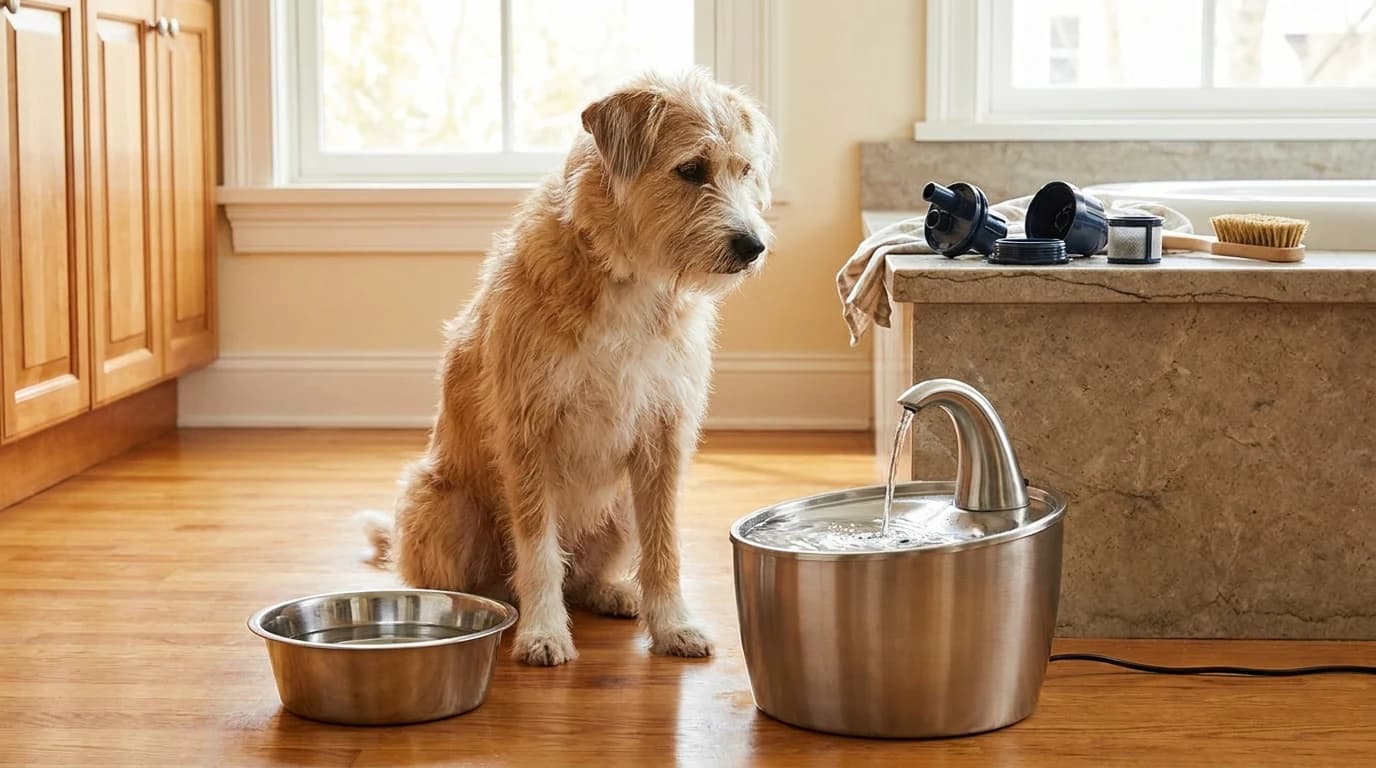
The extra work lives inside the pump. PetSafe's official cleaning instructions require opening the housing and removing the impeller; Petlibro instructs owners of several models to disassemble and clean the pump every two weeks. That hidden cavity is where hair and slippery buildup survive a quick rinse.
Use this realistic cadence:
- Daily: dump stale water, wash the drinking surface, refill.
- Weekly: wash reservoir, lid, and removable channels; inspect seams and corners.
- About every two weeks: open the pump, remove the impeller if the instructions allow it, scrub small passages, and change the filter on the maker's schedule.
- Any time flow drops: stop and clean it. Low flow is a maintenance signal, not a reason to let the pump strain.
If that sounds unreasonable, buy a simple stainless bowl. A clean bowl is better than a fountain whose filter is overdue and whose pump housing has never been opened. Our bowls and fountains ranking is the next step if the maintenance tradeoff still works for you.
What most fountain roundups get wrong
They compare capacity, material, and filter life at checkout. They rarely price the second year or ask whether the pump can be opened with ordinary fingers and a small brush. Yet inspectability is the feature that decides whether the fountain remains pleasant after month three.
Before buying, find the cleaning manual. Count the parts. Confirm filters and pumps are still sold separately. If you cannot see how the impeller comes out, you are evaluating a sealed maintenance problem.
The bottom line
A fountain is worth it when it matches a dog's demonstrated preference or makes a multi-pet household easier to manage. It is not a general health upgrade for a dog that already drinks normally. Run the side-by-side trial, price two years rather than the box, and be honest about the pump-cleaning routine.
Most importantly, do not use a purchase to explain away a drinking change. A veterinarian should evaluate a dog that suddenly drinks much more or less than usual.
Frequently Asked Questions
- Do dog water fountains actually make dogs drink more?
- They may for an individual dog that prefers moving or cooler water, but there is no strong dog-specific evidence that fountains reliably increase intake across healthy dogs. Treat one as a preference experiment, keep a regular bowl available, and watch what your dog actually chooses.
- How often should I clean a dog water fountain?
- Clean the drinking surfaces daily, following the FDA and CDC schedule for water bowls. Follow the maker's instructions for the internal parts; major fountain makers commonly instruct owners to disassemble and clean the pump about every two weeks, more often with multiple pets or visible debris.
- Is a fountain better for a dog with kidney or urinary disease?
- Those dogs need dependable access to fresh, clean water, but a fountain is not a treatment by itself. Ask the dog's veterinarian whether increasing intake is part of the care plan and what method fits the dog. Keep a backup bowl even if the fountain is preferred.
Research Sources
- Could Your Dog Benefit From Using a Pet Water Fountain? — American Kennel Club
- Effect of water source on intake and urine concentration in healthy cats — Journal of Feline Medicine and Surgery / PubMed Central
- Proper Storage of Pet Food & Treats — U.S. Food and Drug Administration
- About Cleaning and Disinfecting Pet Supplies — Centers for Disease Control and Prevention
- Nutrition for Dogs with Chronic Kidney Disease — VCA Animal Hospitals

PawBench Editorial
Published by Hilly Shore LabsPawBench’s editorial team researches dog products from primary veterinary sources, manufacturer specifications and aggregated buyer sentiment, alongside the lived ownership of Maggie, an Australian Labradoodle. We do not run hands-on product tests.
264 dog products scored · 1,160,091 buyer review-aspect mentions aggregated · cites AVMA, FDA, AAFCO, Cornell, WSAVA, AKC, ASPCA.
Recommendations are based on published veterinary guidelines, manufacturer specifications, and verified customer feedback. See our editorial standards.