Dog Bloat (GDV): Warning Signs and Why Minutes Matter
Quick Answer
Bloat (gastric dilatation-volvulus, GDV) is a true emergency where every minute counts — the stomach fills with gas and twists, cutting off blood flow, and it is fatal without surgery. The earliest and most important sign is a dog repeatedly trying to vomit but bringing up nothing (unproductive retching), usually with restlessness, pacing, drooling, and an anxious dog that can't get comfortable. A visibly swollen, hard belly, panting, pale gums, weakness, or collapse mean it has already progressed. This is the one stomach problem where you do NOT watch at home for 24 hours: if you even suspect bloat, call the nearest emergency vet and drive there immediately. With prompt surgical care, survival is over 80%, but the odds fall the longer it takes to get help. Highest risk: large, deep-chested dogs (Great Danes most of all), fast eaters, dogs fed one big meal a day, and dogs with a relative that has bloated.
On this page7 sections
Our Verdict
Bloat (gastric dilatation-volvulus) is the emergency where waiting costs lives. The earliest sign is a dog retching repeatedly but bringing up nothing, paired with restlessness, drooling, and an inability to get comfortable — don't wait for the classic swollen belly, which is a later sign. This is the one stomach problem where you skip the at-home watch window entirely: if you suspect bloat, call your nearest emergency vet and drive there now. With prompt surgery, survival exceeds 80%, but the odds drop the longer you wait. Deep-chested big dogs, fast eaters, once-a-day feeders, and dogs with a relative that has bloated are highest-risk — for them, feed smaller meals, slow the eating, and ask your vet whether a prophylactic gastropexy makes sense.
Bloat (GDV) Risk Profile: Who's Most Likely to Bloat
No dog is immune, but these factors stack the odds. The more a dog matches the higher-risk column, the more worth it the prevention steps are — and the faster you should react to early signs.
| Product | Higher risk | Lower risk |
|---|---|---|
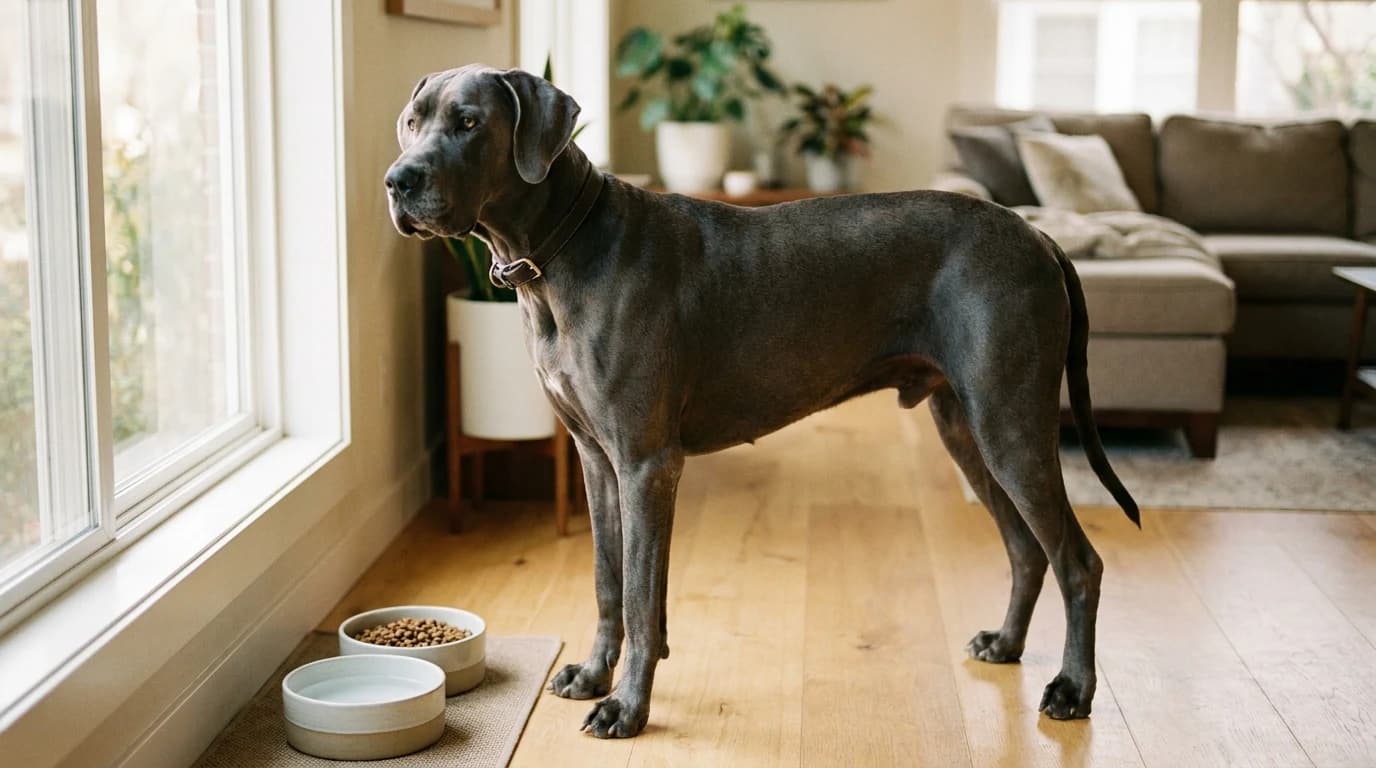
| Body build | Large/giant, deep narrow chest (Great Danes 5-8x; also St. Bernards, Weimaraners, setters, standard poodles, Dobermans) | Small breeds with a shallow, wide chest |
| Eating speed | Gulps food fast (~5x the risk) | Eats slowly, or uses a slow-feeder |
| Meal pattern | One large meal a day (~2x the risk) | Two or more smaller meals a day |
| Family history | A parent, sibling, or offspring has bloated | No known family history of GDV |
| Age & temperament | Older dog; nervous, anxious, or hurried eater | Younger; calm, relaxed at mealtimes |
| Prevention done | No gastropexy in an at-risk dog | Prophylactic gastropexy (recurrence drops to ~3-5%) |
How PawBench is paid: we earn an Amazon Associates commission on qualifying purchases. We don’t accept sponsored placements, paid reviews, or free products in exchange for coverage. Picks are ranked on documented owner outcomes and primary-source research, never on commission rate. Read the full methodology.
Bloat is the emergency where waiting an hour can cost a dog its life. The clinical name is gastric dilatation-volvulus (GDV) — the stomach fills with gas, balloons, and then twists on itself, sealing the gas in and choking off blood flow. The American College of Veterinary Surgeons calls it "a rapidly progressive life-threatening condition that requires immediate medical attention." There is no home remedy and no waiting it out.
This is a recognition guide, not a treatment one — because for bloat, the only thing an owner can do is get to a vet fast. Knowing the signs before it happens is the entire game.
Key takeaways
- GDV is fatal without surgery, and survivable with it. Cornell's Riney Canine Health Center puts the survival rate at over 80% with prompt medical and surgical care — and notes outcome depends partly on how long it takes to get help.
- The earliest sign is a dog trying to vomit and bringing up nothing — unproductive retching. Don't wait for the classic swollen belly; by then it's far along.
- Deep-chested big dogs are the highest-risk group, but no dog is immune. AKC reports Great Danes are 5 to 8 times more likely to bloat than low-risk builds.
- This is the one stomach problem where you skip the 24-hour "watch at home" window entirely. If you suspect bloat, the plan is: car, vet, now.
What's actually happening inside
It helps to know why minutes matter so much. As the stomach distends, per the ACVS and AKC, it presses on the large veins that return blood to the heart — so blood pools in the back half of the body and the dog slides toward shock. When the stomach twists (the volvulus), it drags the spleen with it and can cut off the stomach's own blood supply, killing tissue. The AKC notes the oxygen-starved pancreas then releases hormones that can stop the heart — which is why a dog can look stabilized after surgery and still crash. None of this reverses on its own. It only gets worse, fast.
The signs — in the order they tend to appear
Bloat usually announces itself early, but the first signs are quiet enough to brush off. Watch for this progression:
Early (this is your window):
- Retching that brings up nothing — the single most recognizable early sign. The dog heaves repeatedly with no vomit, maybe a little foam or saliva.
- Restlessness and pacing — can't get comfortable, keeps standing up and lying down.
- An anxious look, often glancing back at the belly, or standing and stretching the front end down.
- Drooling more than usual.
As it progresses (already an emergency):
- A visibly distended, firm belly — drum-tight, often behind the ribs.
- Panting and obvious discomfort or pain; whining if you touch the abdomen.
- Weakness, pale gums, collapse. On exam the ACVS notes vets find a racing heart, weak pulse, and poor capillary refill — the signature of shock.
You do not need to see all of these. The ACVS is explicit: if a dog shows any of these signs, it needs to be evaluated immediately. The retching-with-nothing-up plus a restless, uncomfortable dog is enough — go.
Who is most at risk
GDV isn't random. Several large studies converge on a consistent risk profile, summarized by the AKC and Cornell:
The mistake that costs the most time
The dangerous instinct is to treat early bloat like a normal upset stomach — to assume the dog "just needs to throw up" and to wait and see if it passes. It won't. Ordinary vomiting brings something up and the dog usually feels better after; bloat is repeated heaving that produces nothing while the dog grows more restless and distressed. That distinction — productive vomiting versus unproductive retching — is the line between "watch at home" and "drive now."
The second costly mistake is waiting for the textbook swollen belly. In a big, deep-chested, or furry dog, distension can be hard to see until late. By the time the abdomen is obviously ballooned, the clock has already been running. Trust the behavior — the retching, the pacing, the can't-get-comfortable — over the belly.
If you even suspect bloat, call your nearest emergency vet to say you're coming and drive. There is nothing useful to give at home, and home "remedies" only burn the minutes that decide the outcome.
Lowering the odds before it ever happens
You can't eliminate the risk, but the research points to a few levers. Per the AKC and Cornell:
- Feed two or more smaller meals a day, not one big one. Dogs fed once daily are about twice as likely to bloat.
- Slow down fast eaters. Gulpers have roughly five times the risk; a slow-feeder bowl or puzzle feeder helps — and so does reducing mealtime stress and competition, since nervous, hurried eating is itself a risk factor.
- For the highest-risk breeds, ask your vet about a prophylactic gastropexy — a surgery that tacks the stomach to the body wall, often done at the same time as spay/neuter. Cornell notes it drops the recurrence rate to as low as 3-5%, versus up to 80% without it. It doesn't stop the stomach from filling, but it prevents the deadly twist.
The dietary folklore is murkier than the internet suggests — elevated bowls were once blamed, then exonerated, then implicated again, so there's no clean rule there. The two things the evidence agrees on are meal size/speed and, for at-risk dogs, gastropexy. Everything else is secondary to the one habit that actually saves lives: knowing the early signs cold, so you move the moment you see them.
Sources
- American College of Veterinary Surgeons — Gastric Dilatation-Volvulus
- American Kennel Club — Bloat in Dogs
- Cornell University Riney Canine Health Center — Gastric Dilatation Volvulus (GDV) or "Bloat"
Research Sources
- Gastric Dilatation-Volvulus — American College of Veterinary Surgeons
- Bloat in Dogs — American Kennel Club
- Gastric Dilatation Volvulus (GDV) or “Bloat” — Cornell University Riney Canine Health Center

Hilly Shore Labs
Editorial teamIndependent product research team behind PawBench. Reviews are grounded in primary veterinary sources, aggregated buyer sentiment, and the lived ownership of Maggie, an Australian Labradoodle.
200+ dog products researched · 1.1M+ Amazon review-aspect mentions analyzed · cites AVMA, FDA, AAFCO, Cornell, WSAVA, AKC, ASPCA.
All product reviews are independently researched. Recommendations are based on published veterinary guidelines, manufacturer specifications, and verified customer feedback. See our editorial standards.