How to Read Dog Food Labels: What the Ingredients Actually Mean
Quick Answer
Ignore the front of the bag. Check the AAFCO nutritional adequacy statement, look for a named animal protein as the first ingredient, and verify the guaranteed analysis meets your dog's life stage needs.
On this page10 sections
Our Verdict
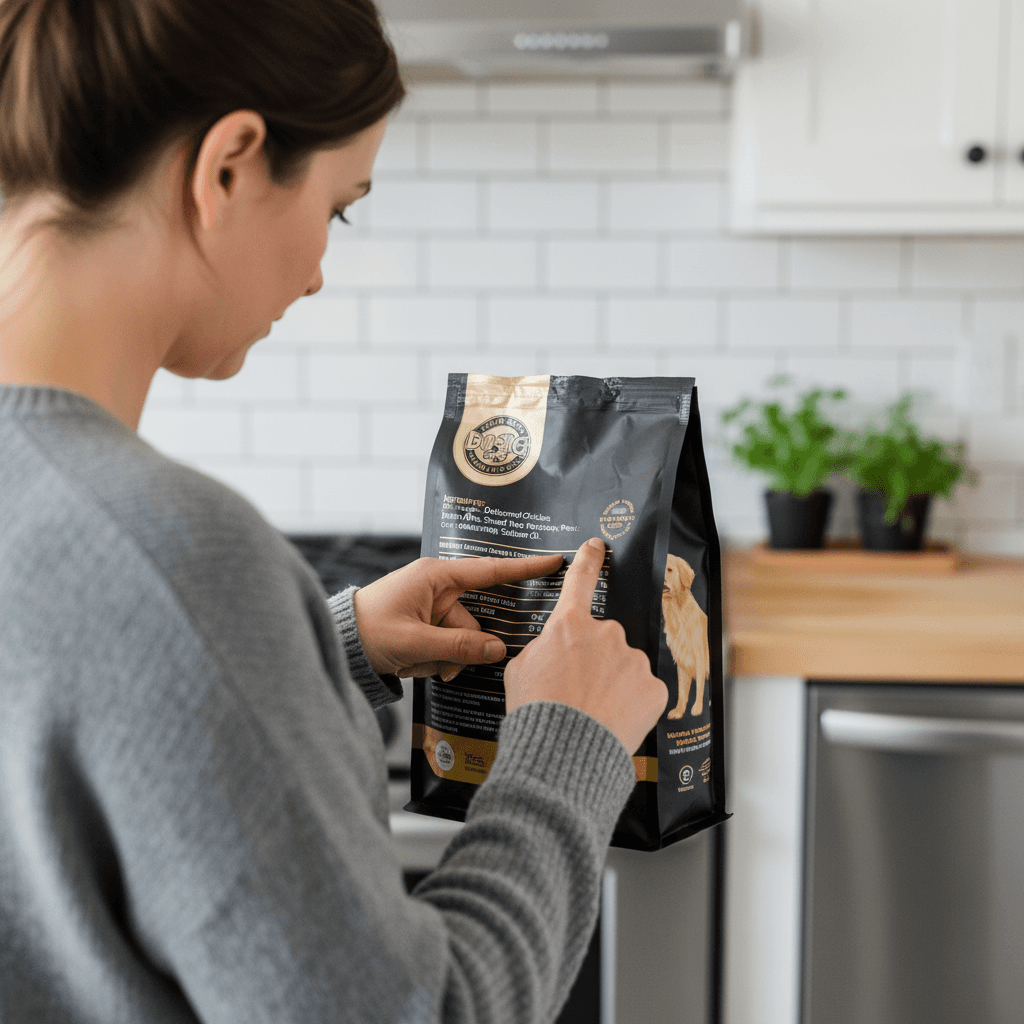
Ignore the front of the bag entirely. The only things that matter are the AAFCO nutritional adequacy statement, the first five ingredients, and whether the guaranteed analysis meets your dog's life-stage needs. Everything else is marketing.
How PawBench is paid: we earn an Amazon Associates commission on qualifying purchases. We don’t accept sponsored placements, paid reviews, or free products in exchange for coverage. Picks are ranked on documented owner outcomes and primary-source research, never on commission rate. Read the full methodology.
Dog food packaging is designed to make you feel good about your purchase — not to help you make an informed decision. The front of the bag is pure marketing. The back is a mix of regulatory requirements and deliberate obfuscation. Unless you know exactly what to look for, you're making a decision based on vibes and price.
This guide teaches you to read dog food labels the way a veterinary nutritionist would: systematically, skeptically, and with an understanding of what the regulations actually require manufacturers to disclose.
The Four Parts of a Dog Food Label
Every dog food label has four sections regulated by the Association of American Feed Control Officials (AAFCO) and the FDA:
- Product name and brand
- Ingredient list
- Guaranteed analysis
- Nutritional adequacy statement
Everything else — marketing claims, lifestyle imagery, breed recommendations — is unregulated or loosely regulated. Let's break down what matters.
Part 1: The Product Name Rules
The name of a dog food isn't random. AAFCO enforces specific naming rules based on ingredient percentages, and knowing these rules tells you more about a food's composition than any marketing copy.
The 95% Rule
If the product name leads with an ingredient — "Chicken Dog Food" or "Beef for Dogs" — that ingredient must constitute at least 95% of the total weight (excluding water for processing). When water is counted, the named ingredient must still be at least 70%.
This is the gold standard. "Chicken Dog Food" literally means the food is almost entirely chicken. You'll mostly see this on canned/wet foods, since kibble requires grains or starches for structural integrity.
The 25% Rule (Dinner, Platter, Entrée, Formula)
When the name includes qualifying terms like "dinner," "platter," "entrée," "formula," or "recipe" — as in "Chicken Dinner" or "Beef Entrée" — the named ingredient only needs to be 25% of the product (excluding water, 10% minimum including water).
This is where marketing divergence from reality begins. "Chicken Dinner for Dogs" sounds like the food is mostly chicken. It might be only 25% chicken, with the rest being grains, fillers, and other proteins.
The 3% Rule (With)
The word "with" signals the 3% rule. "Dog Food with Chicken" means the food contains at least 3% chicken. That's almost nothing — it could be 95% corn with a splash of chicken broth, and it would legally qualify.
The Flavor Rule
"Chicken Flavor Dog Food" doesn't require any specific amount of chicken at all. The food just needs a "sufficient amount" to be detectable — which can be accomplished with chicken digest, chicken fat, or even artificial flavoring. There is no minimum percentage.
Takeaway: "Chicken Dog Food" and "Chicken Flavor Dog Food" are legally worlds apart, but they sit next to each other on the shelf looking nearly identical. Read the actual name carefully.
Part 2: The Ingredient List
Ingredients are listed in order of weight before processing. The first ingredient weighs the most in the recipe. This is useful but can be manipulated.
The Moisture Manipulation
Whole chicken is about 70% water. Chicken meal is about 10% water. A food listing "chicken" as the first ingredient might actually contain less chicken protein than a food listing "chicken meal" as the first ingredient — because most of that whole chicken weight is water that evaporates during cooking.
This doesn't mean chicken meal is better than whole chicken — it means the ingredient order doesn't tell the whole story. Look at the overall protein content in the guaranteed analysis, not just ingredient order.
Ingredient Splitting
Some manufacturers split a single ingredient into sub-categories to push it down the list. For example, a food might contain 30% rice total — but by listing "brown rice" (15%) and "brewers rice" (15%) separately, both appear lower on the list than the first-listed protein source. The combined rice content exceeds the protein, but the label doesn't show that.
Watch for multiple forms of the same ingredient: corn, corn gluten meal, ground corn. Ground wheat, wheat flour, wheat middlings. If you see variations of the same ingredient appearing multiple times, the total proportion of that ingredient is likely higher than any single listing suggests.
Ingredients That Sound Bad But Aren't
- Chicken by-products: Includes organs (liver, heart, gizzard) that are actually more nutrient-dense than breast meat. By-products aren't "waste" — they're the parts humans don't prefer but dogs thrive on.
- Chicken meal: Chicken that's been rendered and dried. Higher protein concentration per gram than whole chicken. Perfectly safe and nutritious.
- Beet pulp: A fiber source, not a filler. It's the dried residue after sugar extraction from beets — no sugar remains. It supports digestive health.
- Brewers rice: A broken-grain by-product of rice milling. Less aesthetically appealing than whole brown rice but nutritionally comparable.
Ingredients That Sound Good But Are Meaningless
- "Natural": AAFCO defines this as "derived solely from plant, animal, or mined sources" — which describes virtually every ingredient in every dog food. It's meaningless.
- "Holistic": No regulatory definition whatsoever. Pure marketing.
- "Human-grade": Technically, this means the food was produced in a facility that meets human food production standards. Very few dog foods legitimately qualify, and the term is frequently misused.
- "Superfood": Not a scientific or regulatory term. Blueberries in your dog's food aren't harmful, but the amount included is typically too small to provide meaningful antioxidant benefit.
Part 3: The Guaranteed Analysis
The guaranteed analysis panel shows four values:
- Crude protein (minimum %)
- Crude fat (minimum %)
- Crude fiber (maximum %)
- Moisture (maximum %)
Understanding "Crude"
"Crude" means the measurement includes all sources of that nutrient, not just digestible ones. Crude protein includes protein from leather and feathers — technically protein, but biologically useless. A quality food will have crude protein levels well above AAFCO minimums because some of that crude protein isn't bioavailable.
AAFCO Minimums
| Nutrient | Adult Maintenance | Growth/Reproduction |
|---|---|---|
| Protein | 18% | 22% |
| Fat | 5% | 8% |
These are minimums, not targets. Most quality foods exceed them significantly — 24-32% protein and 12-18% fat is typical for premium kibble.
Comparing Wet and Dry Food
You can't compare the guaranteed analysis of wet food and dry food directly because of moisture content differences. Dry food is ~10% moisture; wet food is ~75% moisture. To compare, you need to calculate the dry matter basis:
Dry matter protein = (Crude protein %) ÷ (100% - Moisture %)
Example:
- Dry food: 26% protein, 10% moisture → 26 ÷ 90 = 28.9% dry matter protein
- Wet food: 10% protein, 75% moisture → 10 ÷ 25 = 40% dry matter protein
The wet food actually has more protein on a dry matter basis, despite appearing lower on the label.
Part 4: The Nutritional Adequacy Statement
This is the single most important element on the entire label. The AAFCO nutritional adequacy statement tells you two things:
1. Life Stage Compliance
The statement specifies which life stage the food is formulated for:
- "All life stages" — Meets the requirements for growth, reproduction, and adult maintenance
- "Adult maintenance" — Formulated for adult dogs only
- "Growth" or "Growth and reproduction" — Formulated for puppies and pregnant/nursing dogs
Feeding a puppy an "adult maintenance" food can cause developmental problems. Feeding an adult dog a "growth" formula can cause obesity. Match the statement to your dog's life stage.
2. Validation Method
The statement also reveals how the food was validated:
- "Animal feeding tests using AAFCO procedures" — The gold standard. The food was fed to actual dogs in controlled trials for at least 26 weeks, with blood tests confirming nutritional adequacy.
- "Formulated to meet the nutritional levels established by AAFCO" — The food was designed on paper to meet minimum nutrient profiles. No dogs were fed this food in testing. This is cheaper and less reliable.
Always prefer foods validated through feeding trials. If the label says "formulated to meet" rather than "animal feeding tests," the manufacturer saved money by skipping the most important quality check.
Red Flags to Watch For
No AAFCO Statement
If a food lacks an AAFCO nutritional adequacy statement, it's either a treat, a supplement, or a food that doesn't meet minimum nutritional standards. Never use it as a primary diet.
"For Intermittent or Supplemental Feeding Only"
This means the food is not nutritionally complete. It can be used as a topper or treat, but it cannot be the sole diet. Many canned foods carry this designation — check before assuming a canned food is a complete diet.
Vague Protein Sources
"Meat meal" instead of "chicken meal." "Animal fat" instead of "chicken fat." "Animal by-products" instead of "chicken by-products." Vague sourcing means the manufacturer is using whatever's cheapest at the time, which means inconsistent nutrition and potential allergen exposure.
Excessive Marketing, Minimal Credentials
If the bag has three paragraphs about their founder's spiritual journey with dogs but no mention of veterinary nutritionist involvement, formulation methodology, or feeding trials — be skeptical. The best dog food companies (Purina, Hill's, Royal Canin) lead with their research credentials because they have them.
Frequently Asked Questions
Is the first ingredient really the most important?
It's the ingredient present in the greatest quantity by weight before processing. It matters, but it's not the whole picture. Due to moisture content differences (whole meat vs. meal) and ingredient splitting, the first ingredient can be misleading. Look at the first five ingredients together and cross-reference with the guaranteed analysis protein percentage.
What does "complete and balanced" mean on a dog food label?
It means the food meets AAFCO's minimum nutrient requirements for the specified life stage and can serve as the sole diet. This is the phrase you want to see. "Complete" means all required nutrients are present; "balanced" means they're present in the correct ratios.
Are by-products bad for dogs?
No. By-products include organ meats (liver, heart, kidneys) that are nutritionally superior to muscle meat. They contain higher concentrations of vitamins, minerals, and amino acids. The stigma against by-products is a marketing invention — veterinary nutritionists consistently recommend foods that include them. The key is that by-products should be from named sources ("chicken by-products," not "animal by-products").
Should I avoid foods with corn, wheat, or soy?
Not necessarily. Corn, wheat, and soy are digestible, nutritious carbohydrate and protein sources for most dogs. True allergies to these ingredients are rare — food allergies in dogs are most commonly triggered by animal proteins (beef, dairy, chicken), not grains. The anti-grain movement in dog food is largely marketing-driven, not science-driven.
How do I know if a dog food has been recalled?
The FDA maintains a searchable database of pet food recalls at fda.gov/animal-veterinary/safety-health/recalls-withdrawals. You can also sign up for email alerts. Check any new brand against this database before purchasing. Note that recalls aren't necessarily disqualifying — even the best manufacturers occasionally have quality control issues. Patterns of repeated recalls are the real red flag.
What's the difference between "grain-free" and "gluten-free"?
"Grain-free" means the food contains no grains (corn, wheat, rice, barley, oats). "Gluten-free" means the food contains no gluten, a protein found in wheat, barley, and rye — but it may contain other grains like rice or oats. True gluten sensitivity is extremely rare in dogs (Irish Setters are the only breed with documented genetic gluten sensitivity). For most dogs, neither designation is necessary or beneficial.
The Bottom Line
Dog food labels are a mix of regulated information and unregulated marketing. The front of the bag tells you almost nothing useful. The back contains everything you need — if you know where to look.
Focus on three things:
- The AAFCO nutritional adequacy statement — confirmed through feeding trials, appropriate for your dog's life stage
- The first five ingredients — named protein sources, no vague "meat" or "animal" descriptions
- The guaranteed analysis — protein and fat levels appropriate for your dog's size and activity level
Everything else — "natural," "holistic," "superfood," lifestyle photography of dogs running through meadows — is designed to make you feel good about your purchase. The label's regulatory sections are designed to help you make an informed one.
🏆 Bottom Line: Three things matter most on a dog food label: an AAFCO nutritional adequacy statement for your dog's life stage, a named protein as the first ingredient, and a recognizable manufacturer with feeding trial history. Everything else — the marketing claims, the packaging — is noise.
Related Reading
-
Dog Food — Our complete dog food rankings and reviews
-
Dog Health — Supplements and nutrition support
-
Puppy Essentials — Puppy-specific feeding guides
-
Best Dog Food for Small Breeds — Apply your label-reading skills to small breed picks
-
How to Switch Dog Foods Safely — What to do after choosing a better food
-
Best Dog Food for Allergies — Limited ingredient labels decoded
Sources
- AAFCO — Official labeling and ingredient listing requirements for pet food. aafco.org.
- U.S. FDA — "Pet Food Labels — General." Center for Veterinary Medicine, 2023.
- Tufts University Clinical Nutrition Service — "Understanding Pet Food Labels." 2022.
- National Research Council (NRC) — "Nutrient Requirements of Dogs and Cats." National Academies Press, 2006.
- American Kennel Club (AKC) — "How to Read a Dog Food Label." akc.org, 2023.
Related: label reading covers commercial food, but kitchen snacks need a different risk lens. Use our human foods safe vs. toxic for dogs quick list before sharing leftovers.
Research Sources
- Reading Labels — Association of American Feed Control Officials, 2024
- Understanding Pet Food — Association of American Feed Control Officials, 2024
- WSAVA Guidelines on Selecting Pet Foods — World Small Animal Veterinary Association, 2021
- Safe Pet Food — Association of American Feed Control Officials, 2024
- FDA Investigation into Potential Link between Certain Diets and Canine Dilated Cardiomyopathy — U.S. Food and Drug Administration, 2022

PawBench Editorial
Published by Hilly Shore LabsPawBench’s editorial team researches dog products from primary veterinary sources, manufacturer specifications and aggregated buyer sentiment, alongside the lived ownership of Maggie, an Australian Labradoodle. We do not run hands-on product tests.
331 dog products scored · 1,222,724 buyer review-aspect mentions aggregated · cites AVMA, FDA, AAFCO, Cornell, WSAVA, AKC, ASPCA.
Recommendations are based on published veterinary guidelines, manufacturer specifications, and verified customer feedback. See our editorial standards.