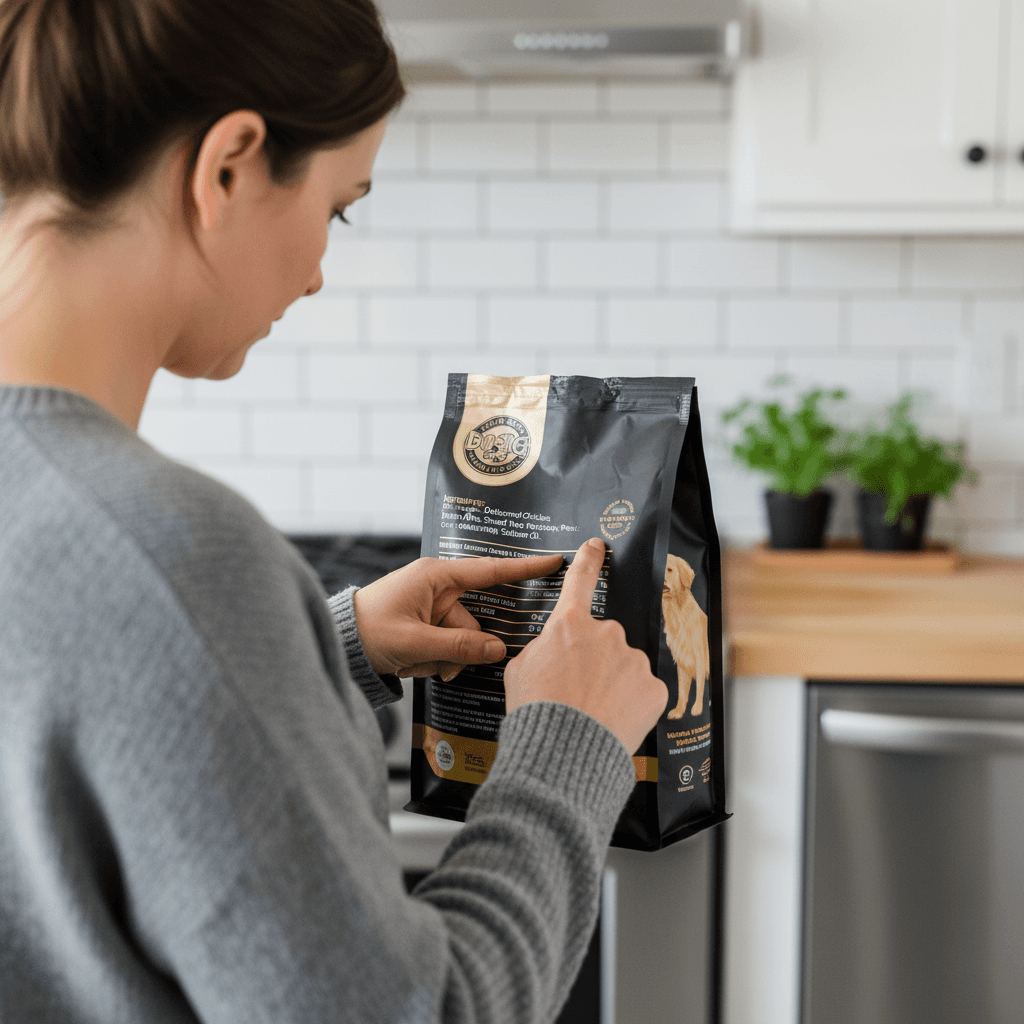
Puppy Food “With DHA for Brain Support”: How to Verify It
Quick Answer
To verify a puppy food really has brain-development DHA, ignore the front of the bag. On the back, confirm the nutritional adequacy statement says complete and balanced for growth (or all life stages) — that meets AAFCO's 0.05% combined EPA + DHA minimum — then check the guaranteed analysis for a specific DHA or DHA + EPA line, or a named coldwater-fish source. A generic “omega-3” line can be flaxseed ALA and is not proof of DHA.
On this page8 sections
Our Verdict
The front-of-bag “DHA for brain support” claim is marketing, not a guarantee. Verify it in two small-print blocks: the nutritional adequacy statement (must say growth or all life stages) and the guaranteed analysis (look for a specific DHA or DHA + EPA line, or a named fish source — not a generic omega-3 line that flaxseed can satisfy).
The 30-second puppy-DHA label decode
Read the back, not the front. The first row you match tells you what the bag really delivers.
| What you see on the back | What it actually means | Verdict for brain DHA |
|---|---|---|
| Adequacy statement says "growth" or "all life stages" + a specific "DHA" or "DHA + EPA" guarantee | Meets the 0.05% EPA+DHA growth floor and names the long-chain omega-3 directly | Real — buy with confidence |
| "Growth"/"all life stages" + fish or fish oil high in ingredients, but only a generic "omega-3" line | Meets the growth floor; a named fish source strongly implies real DHA | Likely real — good pick |
| "Growth"/"all life stages" but the only omega-3 ingredient is flaxseed, and just a generic "omega-3" line | Growth-adequate, but the omega-3 is short-chain ALA that converts to DHA poorly | Unverified — don't rely on it for brain DHA |
| Front says "DHA for brain support" but the adequacy statement says "adult maintenance" | Not held to the growth EPA+DHA minimum at all | Wrong food for a puppy — skip |
| Big "DHA" front badge, no adequacy statement mentioning growth, no DHA line in the guaranteed analysis | Marketing claim with nothing on the regulated part of the label backing it | Skip — unproven |
How PawBench is paid: we earn an Amazon Associates commission on qualifying purchases. We don’t accept sponsored placements, paid reviews, or free products in exchange for coverage. Picks are ranked on documented owner outcomes and primary-source research, never on commission rate. Read the full methodology.
Nearly every premium puppy bag now stamps "DHA for brain development" on the front. The science behind it is real — but the phrase on the bag is marketing copy, not a guarantee. The front of the bag is not where you confirm anything. This is a label-reading walkthrough: how to tell, in about 30 seconds at the shelf, whether a puppy food actually delivers brain-development DHA — or just prints the word.
Key Takeaways
- The front-of-bag "DHA" claim proves nothing. The only parts of the label that mean anything are the nutritional adequacy statement and the guaranteed analysis — both in small print on the back or side.
- The adequacy statement is the real gate. If it says the food is complete and balanced for growth (or "all life stages"), it already meets AAFCO's minimum of 0.05% combined EPA + DHA on a dry-matter basis. That baseline is the floor for brain development.
- "Omega-3 fatty acids" on the guaranteed analysis is NOT the same as DHA. A generic omega-3 line can be satisfied by short-chain ALA from flaxseed — which converts to usable DHA poorly. Look for a specific DHA (or DHA + EPA) guarantee, or a named fish source.
- There's no legal requirement to print an exact DHA number. A food can meet the minimum without ever showing a milligram figure — so verify the adequacy statement and the source, not a number that may not exist.
Skip the Front of the Bag Entirely
Front-of-bag claims — "brain support," "smart puppy," a fish icon — are unregulated impressions, not certified facts. A food can print "with DHA" for a trace amount that has no meaningful effect. Turn the bag over. Everything that legally matters lives in two small-print blocks on the back or side, and per the Association of American Feed Control Officials, the nutritional adequacy statement is "perhaps the most important part of a label."
Step 1 — Find the Nutritional Adequacy Statement
This one sentence is your DHA floor. Per the U.S. Food & Drug Administration, for a food to say "complete and balanced," it must either meet an AAFCO nutrient profile or pass an AAFCO feeding trial. What you want to see is one of these, naming growth or all life stages:
"...formulated to meet the nutritional levels established by the AAFCO Dog Food Nutrient Profiles for growth."
"Animal feeding tests using AAFCO procedures substantiate that [food] provides complete and balanced nutrition for all life stages."
Why this matters for DHA specifically: AAFCO's growth-and-reproduction profile sets a minimum of 0.05% combined EPA + DHA on a dry-matter basis — a figure documented in a 2024 review in Translational Animal Science comparing NRC, AAFCO, and FEDIAF standards (PMC). Adult-maintenance foods have EPA + DHA listed as "not determined," so an adult food is not held to that brain-development floor. If the statement says "adult maintenance," it is the wrong food for a puppy, DHA claim or not.
Step 2 — Read the Guaranteed Analysis for the Right Words
The guaranteed analysis lists minimum/maximum percentages. Here the exact wording is everything, and this is where most owners get fooled:
- "Docosahexaenoic acid (DHA) ... min" — this is the real thing. A specific DHA guarantee is only allowed when the food actually makes a DHA claim, so seeing it is a strong signal.
- "DHA + EPA" or "EPA + DHA" — also good; these are the long-chain omega-3s that build the brain.
- "Omega-3 fatty acids ... min" (generic) — weaker, and often meaningless for brain support. A generic omega-3 guarantee can be met by short-chain ALA (from flaxseed or canola), not DHA at all.
The reason the generic line falls short: per the American Kennel Club, the brain is ~50% fat and DHA makes up "more than 90 percent of the long-chain PUFAs found in the brain." ALA can convert to DHA in the body, but "that conversion is not very efficient." A big "omega-3" number driven by flaxseed does not mean your puppy is getting brain-usable DHA.
Step 3 — Confirm the Source in the Ingredient List
The cleanest confirmation is a named long-chain source high in the ingredients. Per the AKC, coldwater fish — salmon, sardines, anchovies, mackerel, herring, trout — and fish oil are direct DHA sources. So is fish meal. If the front says "DHA" but the only omega-3 ingredient is flaxseed, treat the brain claim as unverified: that's short-chain ALA doing marketing work.
The 30-Second Decode Matrix
Use this at the shelf. Read down; the first row that matches tells you what you're actually holding.
Why You Can't Just "Check the DHA Number"
Here's the part almost no roundup mentions: there is no legal requirement to print the exact quantity of DHA on a pet-food label (PMC). A food can fully meet the growth minimum and never show you a milligram figure. So chasing "which bag has the highest DHA number" is often impossible — the number frequently isn't there. That's why the verification chain is adequacy statement → specific DHA/fish source, not a spec sheet. A growth-labeled food with a real fish source is doing the job whether or not it advertises a figure.
What the Research Does NOT Support
Meeting the growth floor is enough for development. The evidence for DHA and puppies shows modest gains in early learning and trainability — not that a higher number makes a measurably smarter dog, and not that adding a separate DHA supplement on top of a complete growth food does anything extra. If you want the deeper science on effect sizes and where the marketing overreaches, see our companion explainer, Does Your Puppy Actually Need DHA? The label check on this page answers a different question — is the DHA claim on this bag real? — and for that, the two small-print blocks are all you need.
Two homes to keep this in context: our guide to how to read dog food labels covers the rest of the panel, and our puppy essentials category ranks growth-appropriate foods by our PawBench Score.
Frequently Asked Questions
- How do I know if a puppy food really has DHA for brain development?
- Ignore the front of the bag. On the back, confirm the nutritional adequacy statement says the food is complete and balanced for growth or all life stages, then look in the guaranteed analysis for a specific DHA (or DHA + EPA) line, or a named fish/fish oil source high in the ingredients. That combination is the real confirmation.
- Is a food labeled 'omega-3 fatty acids' the same as having DHA?
- No. A generic omega-3 guarantee can be satisfied by short-chain ALA from flaxseed, which converts to usable DHA very inefficiently. For brain-development DHA, look for the specific DHA or EPA + DHA wording, or a coldwater-fish source like salmon, sardines, or fish oil.
- Why doesn't the bag show the exact amount of DHA?
- There is no legal requirement to print the exact quantity of fatty acids on a pet-food label. A food can meet AAFCO's growth minimum without ever showing a milligram figure, which is why you verify the adequacy statement and the source rather than hunting for a number that often isn't there.
- Does my puppy need a special high-DHA food or a DHA supplement?
- For most puppies, no. Any food labeled complete and balanced for growth already meets AAFCO's 0.05% combined EPA + DHA minimum. The research supports modest learning and trainability benefits at adequate levels, not extra benefit from megadosing or adding a supplement on top of a quality growth diet.
Research Sources
- “Complete and Balanced” Pet Food — U.S. Food & Drug Administration
- Reading Labels — Association of American Feed Control Officials (AAFCO)
- Boosting Puppy Brains for Trainability With Omega-3 Fatty Acids — American Kennel Club
- The balance of n-6 and n-3 fatty acids in canine, feline, and equine nutrition — Translational Animal Science (PMC)
- A Guide to Dog Food Ingredients and Reading Labels — PetMD

PawBench Editorial
Published by Hilly Shore LabsPawBench’s editorial team researches dog products from primary veterinary sources, manufacturer specifications and aggregated buyer sentiment, alongside the lived ownership of Maggie, an Australian Labradoodle. We do not run hands-on product tests.
254 dog products scored · 1,160,974 buyer review-aspect mentions aggregated · cites AVMA, FDA, AAFCO, Cornell, WSAVA, AKC, ASPCA.
Recommendations are based on published veterinary guidelines, manufacturer specifications, and verified customer feedback. See our editorial standards.