Caring for a Dog on 12-Hour Shifts: The Real Routine
Quick Answer
Work the gap, not the shift. A 12-hour shift is 13 to 14 hours door to door once the commute and handover are counted, against welfare ceilings of no more than four hours (RSPCA) and six to eight for an adult dog (AKC), so no morning routine closes it on its own. The highest-leverage move is a midday visit: accelerometer data published in Scientific Reports puts the average dog's activity nadir around noon, between peaks at roughly 7am and 7pm, so a walker at lunchtime buys a toilet break in the hours your dog was going to sleep through anyway. Around that, do a real aerobic walk before the shift and repeat it on days off so it does not become a departure cue, feed a small meal shortly before leaving, and leave two or three simple correctly-sized food puzzles rather than one complex one, since the AVSAB's advice to supervise puzzle use is impossible across a 13-hour absence. If the food is untouched when you get home, you are looking at separation anxiety rather than boredom, and that needs your vet rather than more gear.
On this page7 sections
Our Verdict
Stop trying to make a 12-hour shift fit advice written for an eight-hour one. Do the door-to-door arithmetic first — shift plus commute plus handover overrun is 13 to 14 hours against published ceilings of four (RSPCA) to eight (AKC). The single highest-value fix is not a better toy or a longer morning walk; it is buying the midday trough, the part of the day accelerometer data shows dogs are least active anyway, with a walker or a neighbour. Then protect the pre-shift walk, keep doing it on days off so it never becomes a departure cue, and favour two simple food puzzles over one intricate one, because the AVSAB's supervision advice is the one instruction a shift worker structurally cannot follow. And check whether the food gets eaten: untouched food after a long absence points at anxiety, not boredom, and changes the whole plan.
Four ways to cover the gap in a 12-hour shift day
What each option actually covers, what it costs you in practice, and the catch nobody mentions. Assembled from the welfare guidance and research cited in this post — not from any product page.
| Option | What it covers | Fit with a rotating roster | The catch |
|---|---|---|---|
| Midday dog walker | One toilet break and a short walk in the noon activity trough | Good — most walkers will take specific dates rather than fixed weekdays | Someone has key access to your home on days you are unreachable |
| Doggy daycare | Six or more hours of the absence, plus company | Poor — booking models assume the same days each week | Adds respiratory-disease exposure; the Bordetella vaccine reduces severity, not risk of infection |
| Neighbour or family drop-in | A toilet break, and eyes on the dog mid-shift | Good if the person also works shifts; fragile if they do not | Unpaid favours degrade quietly — nobody tells you they have stopped coming |
| No midday cover | Nothing between the pre-shift walk and your return | Total — it is the only option a roster cannot break | Doubles the published alone-time ceiling; unworkable for puppies and many seniors |
How PawBench is paid: we earn an Amazon Associates commission on qualifying purchases. We don’t accept sponsored placements, paid reviews, or free products in exchange for coverage. Picks are ranked on documented owner outcomes and primary-source research, never on commission rate. Read the full methodology.
Dog-care advice is written for the person who leaves at nine and is back by six. Morning walk, lunchtime break, evening play — it assumes a workday you do not have. Twelve-hour shifts, rotating days and nights, a commute on either end and a handover that never finishes on time do not bend to fit it. What follows is built around the gap you actually have, which is longer than every published alone-time figure, and around the parts of it you can change.
The arithmetic nobody wants to do
A 12-hour shift is never 12 hours. Add the drive, the arrival buffer and a handover that runs twenty minutes long and you are looking at 13 to 14 hours between the door closing and the door opening. Set that against what the welfare guidance actually says:
| Source | The stated limit | What it is based on |
|---|---|---|
| RSPCA | No longer than four hours | Chances to exercise, toilet and be with people |
| AKC, adult dogs | Six to eight hours | Bathroom breaks; seniors often need more |
| AKC, puppies | One hour per month of age from three months, to a maximum of six | Bladder capacity by age |
| A 12-hour shift | 13–14 hours door to door | Commute, arrival buffer, handover overrun |
Rule of thumb: you are not managing a 12-hour absence. You are managing a 13-to-14-hour one, and the published ceilings are roughly half that.
That gap does not close by trying harder in the morning. It closes only by putting something into the middle of it, or by accepting a compromise and being clear-eyed about which one you picked.
Your dog's clock peaks exactly when you are not there
One piece of research reframes the whole problem. In Scientific Reports, Woods and colleagues fitted accelerometers to companion dogs and modelled their sleep–wake cycles across the full 24 hours. The average dog followed a bimodal diurnal pattern, with activity peaks at roughly 7am and 7pm, a nadir around noon, and its quietest stretch between 11pm and 6am. Dogs were also significantly more active on weekends than weekdays.
Read that against a day shift and the mismatch is exact.
- The 7am peak is yours to spend. It is the one high-energy window that overlaps with you being awake and at home.
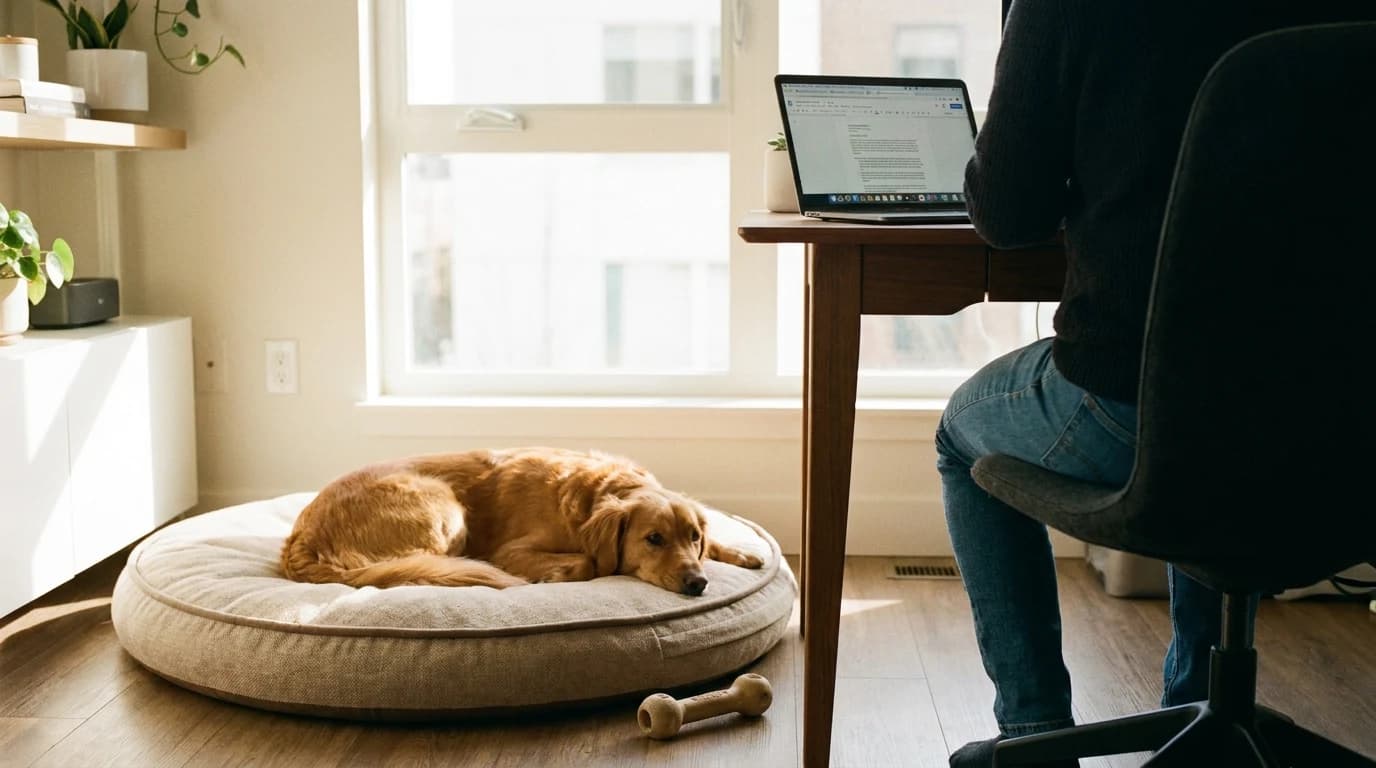
- The noon trough is the cheapest hour to cover. A half-hour visit there buys a toilet break during the part of the day the dog was going to sleep through anyway.
- The 7pm peak is what you come home to. A dog bouncing off the walls at 8pm is not misbehaving; it is on schedule.
What that study cannot tell you
It measured pet dogs in ordinary households, and the weekday–weekend difference is the giveaway: these dogs were tracking human routines, not an internal clock. Nothing in it says what happens to a dog living with someone on nights, and the paper found no variable that predicted night-time activity at all. Treat "the dog will just flip nocturnal to match you" as an assumption, not a finding.
Front-load the exercise — but not only before you leave
The RSPCA advises that you exercise the dog before you go and feed a small meal shortly before leaving, returning from the walk about half an hour before departure so the dog has settled. The ASPCA puts a floor under it: at least 30 minutes of aerobic activity a day. On a shift schedule that means walking before dawn, when you least want to, and it is still the highest-value thing in the routine.
What actually helps:
- A real aerobic walk before the shift, finished about half an hour before you leave.
- A small meal shortly before you go, so the dog settles rather than waits.
- Doing the same walk at the same intensity on days off, so it stays a habit rather than becoming a signal that you are about to disappear.
What people try that does not work:
- A frantic ten-minute garden game while you are putting your shoes on.
- Assuming a dog will "get used to it" — the RSPCA's point is that alone-time is built up gradually, not endured.
- Scolding whatever you find when you get home. The ASPCA is blunt that anxious behaviours are not disobedience or spite.
There is a diagnostic buried in that last point. The ASPCA notes that highly anxious dogs usually will not eat while their people are out, whereas a bored dog eats happily. If the stuffed toy is untouched thirteen hours later, you are not looking at boredom, and no amount of extra exercise fixes it — that is a conversation for your vet and the anxiety playbook, not a gear problem.
Enrichment has to survive 13 hours, not 20 minutes
The AVSAB's guide to food puzzle toys makes the case plainly: dogs would rather work for food than be handed it, and kennelled dogs given puzzle toys bark less, are more active and spend more time eating. Start on the easiest setting with high-value treats so food falls out readily, then move to ordinary kibble, and rotate toys across days once the dog is fluent.
The part shift workers need to sit with is the safety note attached: the AVSAB says to supervise use and size toys correctly so there is no choking risk. You cannot supervise hour nine. That is not a reason to skip enrichment — it is a reason to shape it differently.
| Approach | What it buys you | The 13-hour caveat |
|---|---|---|
| One complex puzzle at departure | Twenty focused minutes right when you leave | Solved early, then it is just an object on the floor |
| Two or three simple, correctly sized items | Staggered interest across the morning | Simple beats clever when nobody is watching |
| Scatter-feeding breakfast instead of bowl-feeding | Foraging time at no extra cost | Not suitable if another pet competes for it |
| Rotating which toys appear on which days | Novelty without buying anything new | Needs you to actually track the rotation |
The constraint is supervision, not cleverness. The AVSAB's own caution is to watch your dog use these toys and size them properly — so on a shift day, favour several simple low-risk options over one intricate one.
If the dog empties everything in the first hour, the answer is not a harder puzzle. It is more of them, spread out, plus something to look at, and a routine that has been deliberately built rather than improvised.
The midday break: walker, daycare, or neither
This is the decision that closes the gap, and shift work makes it hardest, because a rotating roster does not fit a standing booking.
Daycare deserves an honest note rather than a recommendation. Per the AKC, dogs attending daycare, boarding, grooming, dog parks and shows are the ones most likely to benefit from the Bordetella vaccine; kennel cough spreads through droplets when an infected dog coughs or sneezes, or via recently contaminated items. And the vaccine does not completely prevent infection — it reduces severity, shortens illness and lowers the risk of complications such as pneumonia. Daycare solves six hours of your problem and adds an exposure you did not previously have. That is a trade, not a free win.
Nights: sleeping while the dog is awake
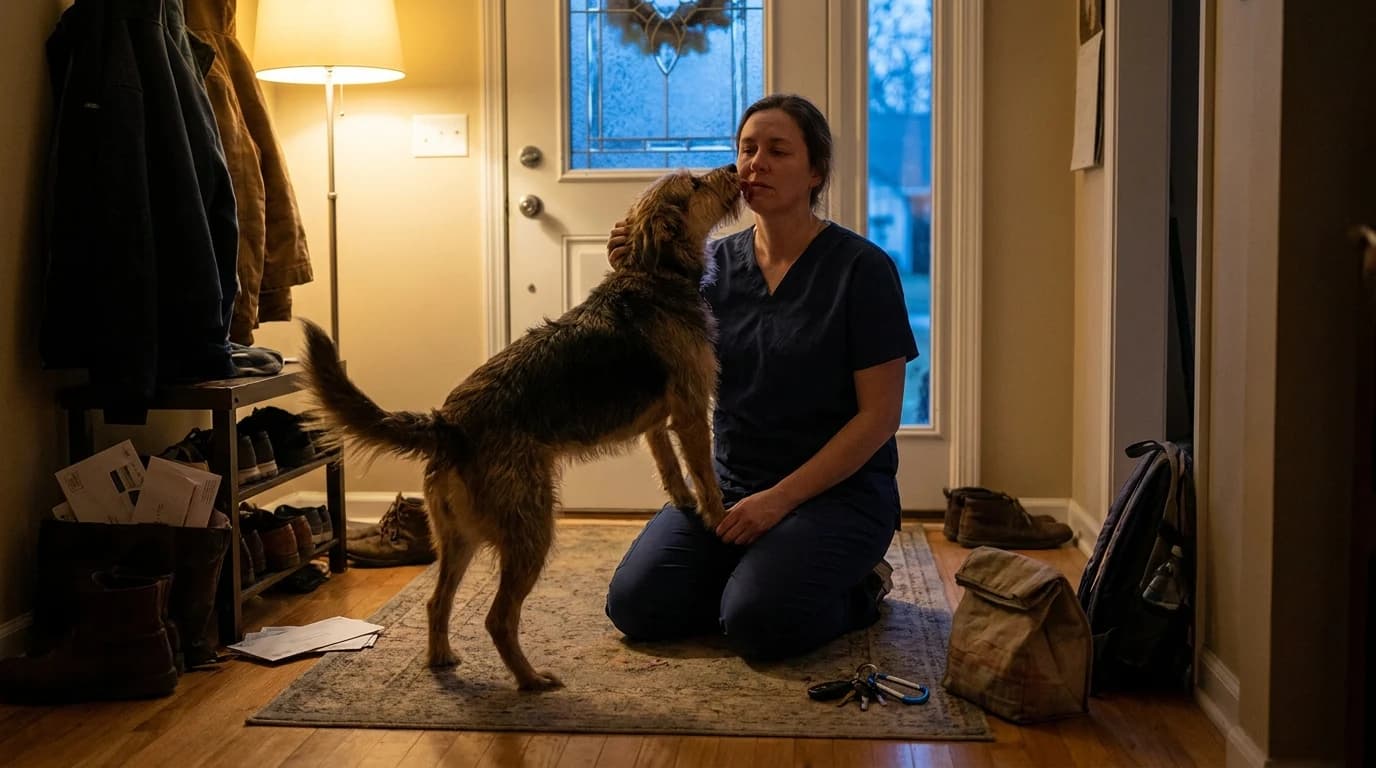
Night shift inverts everything above. You get home around the 7am activity peak, at the moment your dog is at its most alive, and you need to be asleep within the hour.
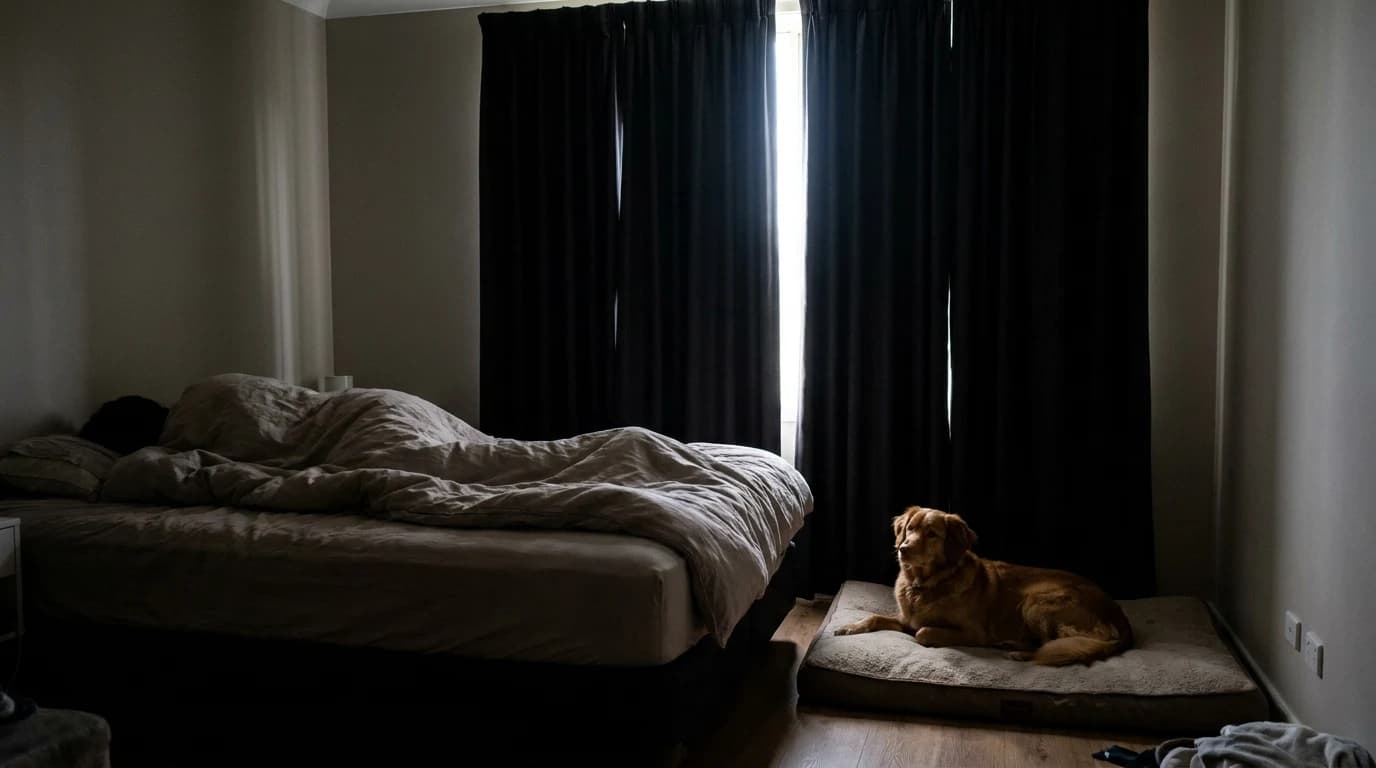
Walk first, then sleep — in that order, without negotiating. A dog that has had its morning will nap alongside you; a dog shut out of the bedroom at 7:30am will spend the next six hours telling you about it. Make the room dog-tolerant rather than dog-free: a bed on the floor beside yours removes the entire argument.
The equipment has a wrinkle too. Blackout and a sound machine both work with a dog in the room. Earplugs are the one that turns against you — the night-shift sleep kits nurses actually assemble make the point that plugs only make sense when there is nothing in the house you need to hear, and a dog is precisely that thing. Block the light at the room, mask the noise at the machine, and leave your ears working.
What to fix first
- Do the door-to-door arithmetic honestly — shift plus commute plus overrun, not the shift length on the roster.
- Buy the noon trough. A single midday visit is worth more than anything else on this list, because it lands where the dog was quietest anyway.
- Protect the pre-shift walk and keep doing it on days off so it never becomes a departure cue.
- Swap one clever puzzle for two simple ones, correctly sized, and check what is left at the end of the day.
- Watch whether the food gets eaten. Untouched food after a long absence points at anxiety rather than boredom, and it changes the plan entirely.
None of this makes a 13-hour absence into a four-hour one. It makes it a 13-hour absence with the right hour broken out of the middle, an exercised dog at both ends, and an owner who knows which of the two problems — boredom or anxiety — they are actually solving.
Frequently Asked Questions
- Can I have a dog if I work 12-hour shifts?
- Yes, but not without midday cover or a compromise you have chosen deliberately. The RSPCA advises dogs are left no longer than four hours, and the AKC puts adult dogs at six to eight hours before they need a bathroom break, while a 12-hour shift runs 13 to 14 hours once you count the commute and a handover that overruns. That gap is closed by a walker, daycare, a neighbour, or a household with someone on an opposite rota — not by a longer morning walk. Puppies are the clearest no: the AKC's rule is roughly one hour per month of age from three months, capping at six hours.
- What time of day should I book a dog walker if I work a day shift?
- Around midday. Accelerometer research published in Scientific Reports found companion dogs follow a bimodal diurnal pattern with activity peaks at roughly 7am and 7pm and a nadir around noon. Both peaks fall on your commute and are unbuyable; the trough is the part of the day your dog was least likely to be doing anything, which makes a midday visit the cheapest hour to cover and the easiest to schedule around a rotating roster.
- Will my dog adapt to my night shift schedule?
- Probably to some degree, but nobody has measured it properly. The Scientific Reports work found dogs were significantly more active on weekends than weekdays, which shows their activity tracks the household's routine rather than a fixed internal clock. The same study found no variable that predicted night-time activity at all, and its subjects were ordinary pet dogs rather than dogs living with shift workers. Plan around walking the dog when you get home and then sleeping alongside it, rather than assuming it will simply invert to match you.
- Is it separation anxiety or just boredom when my dog destroys things on shift days?
- The food test is the quickest signal. The ASPCA notes that highly anxious dogs usually will not eat while their people are out, whereas a bored dog eats happily, and that dogs with separation anxiety often begin showing distress as the owner prepares to leave. If the stuffed toy is untouched after a 13-hour absence, more exercise and better toys will not fix it — that belongs with your vet. If it is empty and the damage looks opportunistic, you are dealing with boredom, which enrichment and a midday visit do address.
- Should my dog sleep in the bedroom when I sleep during the day?
- It is usually the easier arrangement. A dog shut out of the room at 7:30am after being awake all night has an obvious way to object, and you are the one who has to sleep through it. Walking the dog first and then giving it a bed on the floor beside yours removes the argument. On the human side, blackout at the window and a sound machine both work with a dog in the room; earplugs are the item that stops working, because they only make sense when there is nothing in the house you need to hear.
Research Sources
- How to Train Your Dog to Stay Home Alone — RSPCA
- How Long Can a Puppy Be Left Alone? Tips for Separation Anxiety — American Kennel Club
- A functional linear modeling approach to sleep-wake cycles in dogs — Woods et al., Scientific Reports 10:22233 (2020)
- A Guide to Using Food Puzzle Toys with Your Dog — American Veterinary Society of Animal Behavior
- Separation Anxiety — ASPCA
- Bordetella Vaccine: What to Know About the Vaccine for Dogs — American Kennel Club

PawBench Editorial
Published by Hilly Shore LabsPawBench’s editorial team researches dog products from primary veterinary sources, manufacturer specifications and aggregated buyer sentiment, alongside the lived ownership of Maggie, an Australian Labradoodle. We do not run hands-on product tests.
254 dog products scored · 1,160,091 buyer review-aspect mentions aggregated · cites AVMA, FDA, AAFCO, Cornell, WSAVA, AKC, ASPCA.
Recommendations are based on published veterinary guidelines, manufacturer specifications, and verified customer feedback. See our editorial standards.