How Often to Wash a Dog Bowl — and at What Temperature
Quick Answer
The FDA's guidance is to wash food bowls and scoops with soap and hot water after each use, and water bowls daily. The part usually left out is temperature: in the only controlled in-home test of that guidance, washing above 160°F cut aerobic bacterial counts by a further 1.5 log over cold or lukewarm water — hotter than the 120°F the Consumer Product Safety Commission recommends for a home water heater, which in practice means the dishwasher rather than the sink. Bowl material is the wrong thing to agonise over: one study of 96 home bowls found metal higher in bacteria than plastic, and a second found no significant difference between plastic, ceramic and stainless steel.
On this page6 sections
Our Verdict
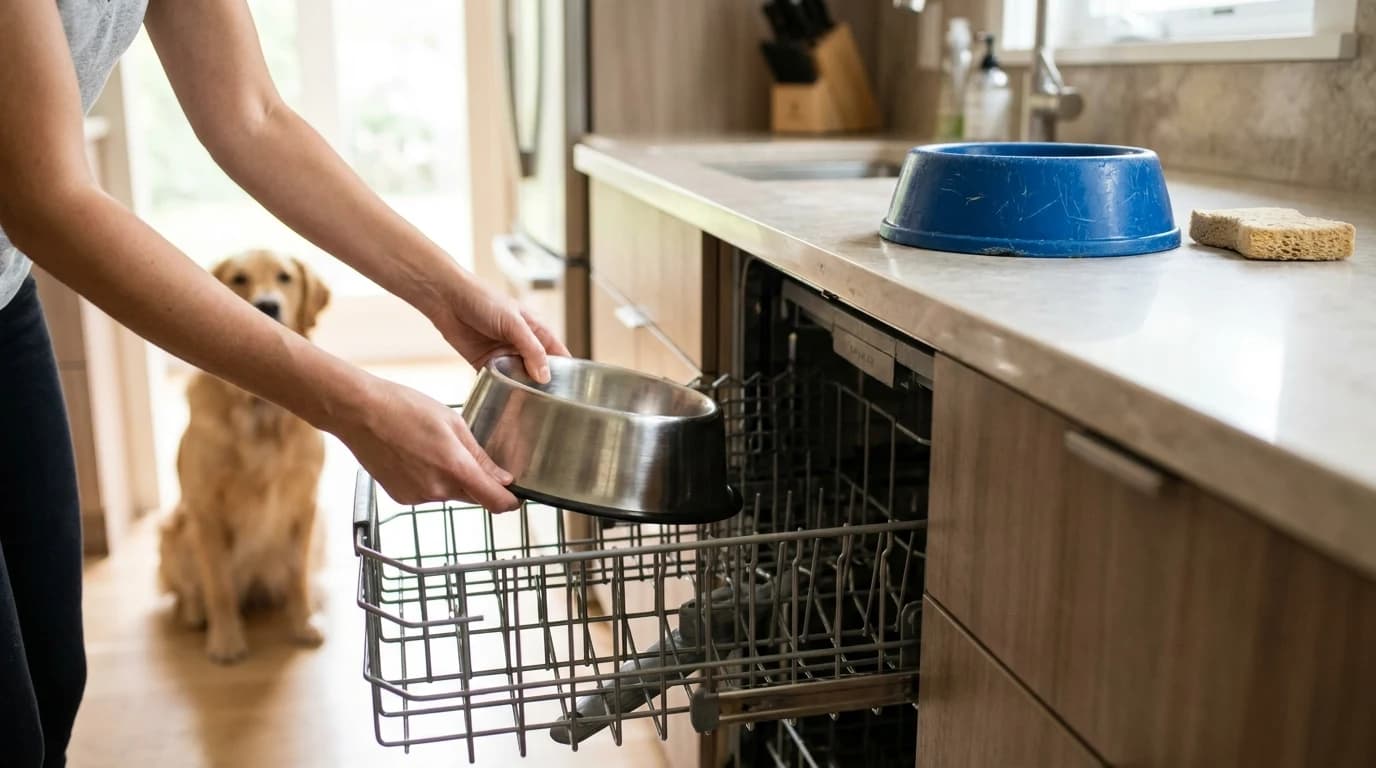
Wash the food bowl after every meal and the water bowl daily, and put both through the dishwasher rather than the sink whenever you can — that single choice is closer to the temperature the research rewards than anything you can do by hand. Do not spend the decision on material. One study of 96 home bowls found metal carrying higher bacterial counts than plastic, another found no significant difference between plastic, ceramic and steel, and neither found the pathogens people are afraid of. Steel is still a reasonable buy, but for the boring reason that it survives a daily hot cycle, not because bacteria avoid it.
Where your household actually sits
| If your situation is… | Pick | Why |
|---|---|---|
| You have a dishwasher and a steel or dishwasher-durable bowl | Bowl goes in daily, on the hottest cycle the bowl tolerates | It is the only routine that reaches the ≥160°F band the trial associated with a further 1.5-log reduction, and it costs no extra effort. |
| No dishwasher, or a top-rack-only plastic feeder | Hand-wash after every meal with soap and the hottest water you can safely handle | Frequency is doing the work here rather than temperature. Both instructed groups in the trial beat the control, so a repeatable warm-water routine still moves the number. |
| You feed wet or fresh food | Wash after every single meal, without exception | Wet-food bowls carried significantly higher aerobic counts than dry-food bowls in the 96-bowl survey — this is the group the every-meal rule is really written for. |
| There is a child under 13, an older adult, or an immunocompromised person in the house | Dishwasher, a dedicated scoop, and feeding prep away from human food surfaces | About a third of surveyed households fit this description, and a third also prepared dog food on a human food-prep surface — the cross-contamination path matters more here than the bowl does. |
| You are shopping for a new bowl right now | Pick for dishwasher durability, not for the material's supposed germ resistance | The two published material comparisons disagree with each other, so there is no reliable hygiene ranking to buy into. Surviving a daily hot cycle is a real, checkable property. |
Use this row to shortcut by situation — it is a starting point for your own research, not a separate recommendation.
What the dog-bowl hygiene research actually establishes
Four sources, what each one was designed to measure, and how much weight the design can carry.
| Product | Design | What it found | How much weight |
|---|---|---|---|
| PLOS ONE 2022 — in-home washing trial | 68 food dishes swabbed, households randomly assigned for one week to FDA guidance, stricter Food Code 2017 rules, or no instructions, then swabbed again | Both instructed groups cut aerobic plate counts significantly (1.4 log and 0.604 log); the no-instruction group drifted up. Washing above 160°F was worth a further 1.5-log drop regardless of group | High — the only controlled test of the guidance itself, though small and one week long |
| PLOS ONE 2022 — owner survey (417 dogs) | Self-reported feeding and bowl-hygiene habits from 417 US dog-owner surveys | 4.7% knew the FDA guidelines existed; 22% washed the bowl about weekly, 12% at least daily, 18% less than every three months or never; 43% stored dog food within five feet of human food | Moderate — self-reported, and a convenience sample, so read it as a baseline rather than a national figure |
| BMC Veterinary Research 2023 — 96 home bowls | Whole-surface sponge swabs of 96 dog food bowls in homes, counts standardised per cm² of bowl area | Metal bowls higher than plastic (2.18 vs 1.23 Log₁₀ CFU/cm², p<0.001); wet-food bowls higher than dry; hand-washed trending higher than dishwasher-washed; no Salmonella, Campylobacter or VTEC detected in any bowl | Moderate — observational and single-timepoint, so it shows association, not cause |
| Hartpury — canine water bowls over 14 days | Six medium-sized dogs, plastic vs ceramic vs stainless water bowls, swabbed at day 0, 7 and 14 with PCR identification of the dominant species | Counts rose significantly over time for every material, but no significant difference between materials; plastic highest descriptively; MRSA and Salmonella isolated, most species from the ceramic bowl | Low to moderate — six dogs is a pilot, and it contradicts the 2023 result on material |
How PawBench is paid: we earn an Amazon Associates commission on qualifying purchases. We don’t accept sponsored placements, paid reviews, or free products in exchange for coverage. Picks are ranked on documented owner outcomes and primary-source research, never on commission rate. Read the full methodology.
Almost every answer to this question stops at a frequency. The published work stops somewhere more useful. In the only controlled test of the FDA's own pet-food hygiene guidance, how hot the water was moved the bacterial count more than the protocol the household was handed — and the temperature that worked is one you cannot safely produce at a kitchen sink.
The guideline hardly anyone has read
The FDA's position is specific, and it treats food bowls and water bowls differently:
- Food bowls and utensils: wash with soap and hot water after each use — every meal, not every day.
- Water bowls: wash daily, and dry both.
- Hands: 20 seconds with soap and hot water, before and after handling the food.
- Never scoop with the bowl. Use a dedicated cup or scoop and keep it out of the food.
Almost nobody is doing this, which is not a scolding — it is the baseline every recommendation below has to work against. In a North Carolina State University survey of 417 dog owners, 4.7% knew the guidelines existed at all.
Washing beats material, and heat beats both
The same team swabbed 68 food dishes, sent each household away for a week with one of three sets of instructions — the FDA guidance, a stricter version drawn from the 2017 Food Code, or nothing at all — then swabbed again.
Both instructed groups came back with significantly lower aerobic plate counts, and the no-instruction group drifted slightly up. But the largest single effect in the study was not which protocol you were handed: washing in water above 160°F rather than cold or lukewarm was worth an extra 1.5-log reduction on its own. The stricter group posted the smaller average drop of the two, and only 8% of participants across both instructed groups said they were likely to keep the full routine going long-term.
Adherence is the variable, not stringency. The tighter protocol produced the smaller average drop, and only 8% expected to sustain it. A routine you abandon in week two loses to a mediocre one you actually repeat.
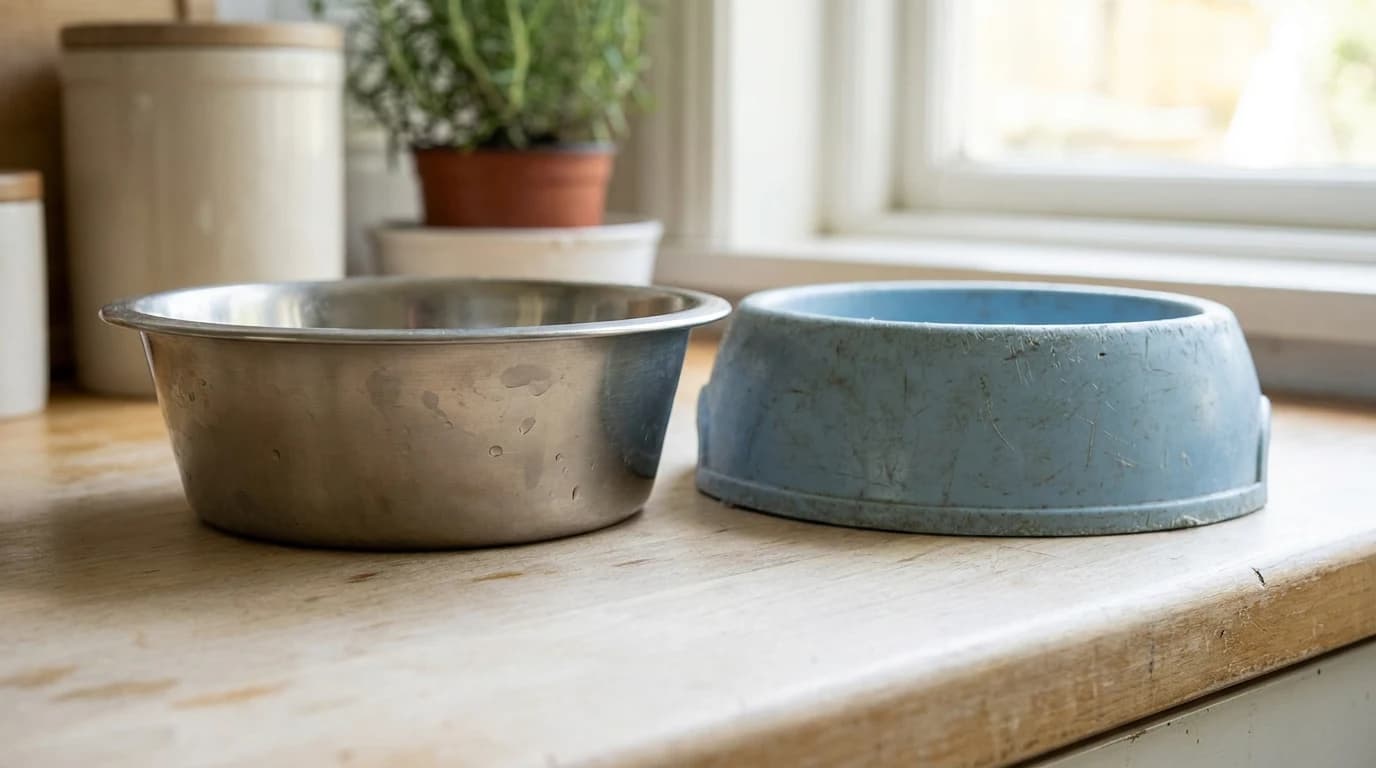
160°F is not a tap-water temperature
This is where the standard advice quietly falls apart. "Hot soapy water" sounds like something you do at the sink, and it is not. The Consumer Product Safety Commission recommends setting a home water heater to 120°F, and notes that 150°F water causes third-degree burns on adult skin in about two seconds. In the same owner survey, 36% washed in what the study classed as warm water — 100–159°F — while 33% used the dishwasher.
| Temperature | What it is |
|---|---|
| 120°F | The recommended setting for a home water heater |
| 100–159°F | The study's warm band — what 36% of owners used |
| 150°F | Third-degree burns on adult skin in about two seconds |
| ≥160°F | The threshold associated with the extra 1.5-log drop |
Which splits the job in two:
- What a sink realistically does: removes visible food, breaks up fresh residue, stops a bowl becoming a science project. Genuinely worth doing after every meal.
- What only a dishwasher does: reaches and holds the range the data rewards. The catch is that most plastic feeders are labelled top-rack only — the cooler rack, farther from the heating element.
Buy for the wash cycle, not for the bacteria. The useful question about a bowl is not which material resists germs. It is whether the bowl tolerates the one appliance in the house that reaches the temperature the evidence supports — which top-rack-only plastic does not.
So is stainless actually cleaner?
This is the claim every buying guide repeats, and the evidence for it is thin to the point of contradiction.
A 2023 study of 96 dog bowls in real homes found metal bowls carrying higher total aerobic counts than plastic ones — 2.18 versus 1.23 Log₁₀ CFU/cm², p<0.001 — with wet-food bowls higher than dry-food bowls, and hand-washed bowls trending higher than dishwasher-washed ones.
A separate 14-day study of canine water bowls ran the opposite design and reached a third answer: no significant difference in bacterial count between plastic, ceramic and stainless steel, with plastic holding the most descriptively — and most of the medically important species isolated, including MRSA and Salmonella, coming off the ceramic bowl.
Two small studies, two directions. One found metal worse; the other found no material difference at all and pointed at ceramic for species diversity. The honest reading is not "buy plastic" — it is that material is not the lever it is sold as.
The one material argument that survives
Not hygiene — durability under heat. A bowl that goes through a hot cycle every day for years without warping or crazing is doing something a top-rack-only plastic bowl cannot. That is a real reason to prefer steel, and it has nothing to do with bacteria clinging differently to the surface.
What the evidence stops short of
None of the 96 bowls in that 2023 survey carried Salmonella, Campylobacter or verotoxigenic E. coli. That should reframe the risk: what builds up in a neglected bowl is bacterial load and biofilm, not a pathogen jackpot waiting to happen.
And a limit worth stating plainly — we could not find a study linking bowl-washing frequency to an actual illness outcome in a dog or an owner. The research measures contamination and stops there. Raw feedingraw dietFeeding uncooked muscle meat, organs, and bones — sometimes with vegetables and supplements. Studies from FDA, AVMA, and WSAVA caution that raw diets carry salmonella and E. coli risk for both pets and household members. Cook or commercially-pasteurize is the safer-handling consensus. is the exception, because the hazard arrives with the food rather than accumulating in the bowl; that is covered in our raw vs. kibble comparison.
A routine that survives a real week
- Scrape, then dishwasher, daily. The hottest cycle the bowl tolerates, bottom rack if it allows it.
- Empty water bowls rather than topping them up. Scrub the whole inner surface before refilling. A fountain also needs its pump housing opened on the manufacturer's schedule.
- Keep a dedicated scoop, stored outside the bowl and used only for dog food.
- Retire scratched plastic. Scratches are where a sponge stops reaching.
- Wash your hands after feeding, not only before. Both halves are in the guidance; the second half is the one people skip.
If you are replacing bowls anyway, sort by dishwasher tolerance first — the bowls and feeders category and our water bowl and fountain picks are the place to start, and the same rule applies to a slow feeder, which has considerably more crevices to clean than a plain bowl does.
Frequently Asked Questions
- How often should I wash my dog's water bowl?
- Daily. The FDA lists water bowls separately from food bowls precisely because the interval is different: food bowls after each use, water bowls once a day. Emptying and scrubbing the whole inner surface matters more than the interval alone — topping up a bowl leaves whatever has built up on the sides in place, and a 14-day study of water bowls found bacterial counts rising significantly over time on plastic, ceramic and stainless alike.
- Is a stainless steel bowl more hygienic than plastic?
- The published evidence does not support that as confidently as buying guides do. A 2023 survey of 96 dog bowls in homes found metal bowls carrying higher total aerobic counts than plastic ones, while a separate 14-day comparison found no significant difference between plastic, ceramic and stainless. Steel is still a sensible buy — it survives repeated hot dishwasher cycles and does not develop the scratches that make a plastic bowl hard to clean — but treat it as a durability advantage rather than an antibacterial one.
- Does putting the bowl in the dishwasher actually help?
- It is the most defensible part of the whole routine. Water above 160°F was associated with a further 1.5-log reduction in aerobic counts in the in-home trial, and that is hotter than the 120°F the Consumer Product Safety Commission recommends for a home water heater — so a sink cannot reach it safely. In the 96-bowl survey, hand-washed bowls also trended higher in Enterobacteriaceae than dishwasher-washed ones, though that comparison fell just short of statistical significance.
- Can a dirty dog bowl make my dog sick?
- That link is weaker than the alarm around it suggests. None of the 96 bowls tested in the 2023 study carried Salmonella, Campylobacter or verotoxigenic E. coli, and we could not find research connecting bowl-washing frequency to a measured illness outcome in dogs or their owners. What the studies establish is that neglected bowls accumulate bacterial load and biofilm, and that washing reduces it. Raw diets are the clear exception, since the pathogen risk arrives with the food itself. If your dog is unwell, that is a veterinary question rather than a cleaning one.
Research Sources
- Tips for Safe Handling of Pet Food and Treats — U.S. Food and Drug Administration
- Proper Storage of Pet Food & Treats — U.S. Food and Drug Administration
- Survey evaluation of dog owners' feeding practices and dog bowls' hygiene assessment in domestic settings — PLOS ONE (Luisana et al., 2022) — North Carolina State University
- Pet feeding habits and the microbiological contamination of dog food bowls: effect of feed type, cleaning method and bowl material — BMC Veterinary Research, 2023
- Microbiological assessment of canine drinking water and the impact of bowl construction material — Hartpury University
- Avoiding Tap Water Scalds (Publication 5098) — U.S. Consumer Product Safety Commission

Hilly Shore Labs
Editorial teamIndependent product research team behind PawBench. Reviews are grounded in primary veterinary sources, aggregated buyer sentiment, and the lived ownership of Maggie, an Australian Labradoodle.
200+ dog products researched · 1.1M+ Amazon review-aspect mentions analyzed · cites AVMA, FDA, AAFCO, Cornell, WSAVA, AKC, ASPCA.
All product reviews are independently researched. Recommendations are based on published veterinary guidelines, manufacturer specifications, and verified customer feedback. See our editorial standards.