How to Get the Dog Smell Out of Your House (for Good)
Quick Answer
Find the reservoir before you clean. Dog odour concentrates in soft, porous surfaces — dog beds, upholstery, carpet and its pad, and the HVAC return filter — not the sealed floor most people mop. Use the HVAC test to tell which: if the smell hits you at the door it is soft furnishings, and if it arrives when the system kicks on it is the filter or ducting. Then work in order — hot-wash textiles, vacuum upholstery with sealed filtration, saturate and extract set-in spots with an enzyme cleaner instead of blotting, and do hard floors and the air path last.
On this page5 sections
Our Verdict
Stop buying odour products and start locating the reservoir. Dog smell collects in soft, porous things — beds, upholstery, carpet pad, and the HVAC return filter — so mopping the floor treats the one surface least likely to be holding it. Work outward in order: textiles hot-washed, upholstery vacuumed with sealed filtration, set-in spots saturated with an enzyme cleaner and extracted rather than blotted, then hard floors and the air path. Skip ozone machines entirely, and if the smell follows the dog rather than living in the room, that is a veterinary question, not a cleaning one.
Match the tool to the surface
| If your situation is… | Pick | Why |
|---|---|---|
| One accident on carpet you can still smell | Nature's Miracle Advanced Stain & Odor Eliminator (Gallon) | Set-in spots need enough volume to reach the pad, which is where a blotted spill actually sits. |
| Small spots on upholstery or a mattress | Rocco & Roxie Professional Strength Stain & Odor Eliminator (32 oz) | Carries the Carpet & Rug Institute Seal of Approval and is sized for spot work rather than saturation. |
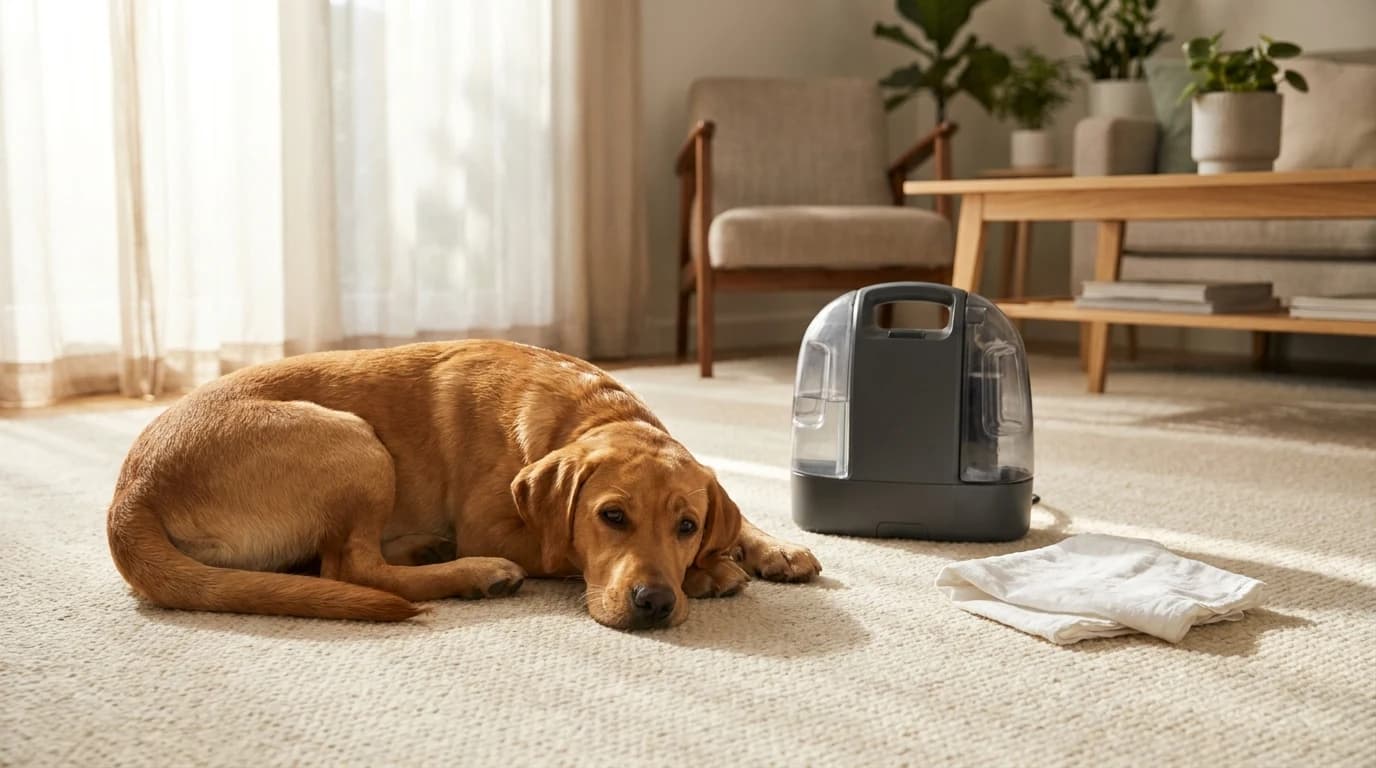
| Smell returns a day after you clean the spot | Bissell Little Green Pet Pro Portable Carpet Cleaner (3909) | Pulls the treated liquid back out of the pad; blotting leaves most of the residue behind. |
| General background dog smell across the whole room | Shark Navigator Lift-Away Professional NV356E | Sealed HEPA filtration keeps the dander it lifts from going straight back into the air. |
Each pick is one of the products ranked below — this row is for shortcutting based on your situation, not a separate recommendation.
Nature's Miracle Advanced Stain & Odor Eliminator (Gallon) 4.7 The volume buy for saturating set-in spots properly. | Rocco & Roxie Professional Strength Stain & Odor Eliminator (32 oz) 4.4 The spot-work bottle, and the one with a real third-party seal. | Bissell Little Green Pet Pro Portable Carpet Cleaner (3909) 4.5 The step almost everyone skips — extraction instead of blotting. | Shark Navigator Lift-Away Professional NV356E 4.5 Sealed filtration is the spec that matters for odour, not suction numbers. | |
|---|---|---|---|---|
| Price | $35.07Buy on Amazon | $23.92Buy on Amazon | $139.99Buy on Amazon | $159.99Buy on Amazon |
| Pros |
|
|
|
|
| Cons |
|
|
|
|
| Active Enzyme | Bacterial enzyme blend (uric acid targeting) | Concentrated bio-enzymatic blend | — | — |
| Volume | 128 oz (1 gallon) | 32 oz | — | — |
| Surface | Carpet, hardwood, upholstery, tile | Carpet, upholstery, hardwood, tile, bedding | — | — |
| Pet-Safe (when dry) | Yes | — | — | — |
| Certification | — | Carpet & Rug Institute Seal of Approval | — | — |
| Suction | — | — | Strong portable (highest in Little Green line) | Strong upright (HEPA-sealed) |
| Bin Capacity | — | — | 48 oz clean / 48 oz dirty | Extra-large XL dust cup |
| Weight | — | — | 9.7 lb | — |
| Cord Length | — | — | Approx. 7 ft | 30 ft |
| Filtration | — | — | — | HEPA + Anti-Allergen Complete Seal |
* Prices are approximate and may vary. Please check the latest price on Amazon.
Where dog smell actually lives
Ranked by how much odour the surface holds against how often it usually gets cleaned. The mismatch between those two columns is the whole problem.
| Product | Why it holds odour | What actually clears it | Realistic cadence |
|---|---|---|---|
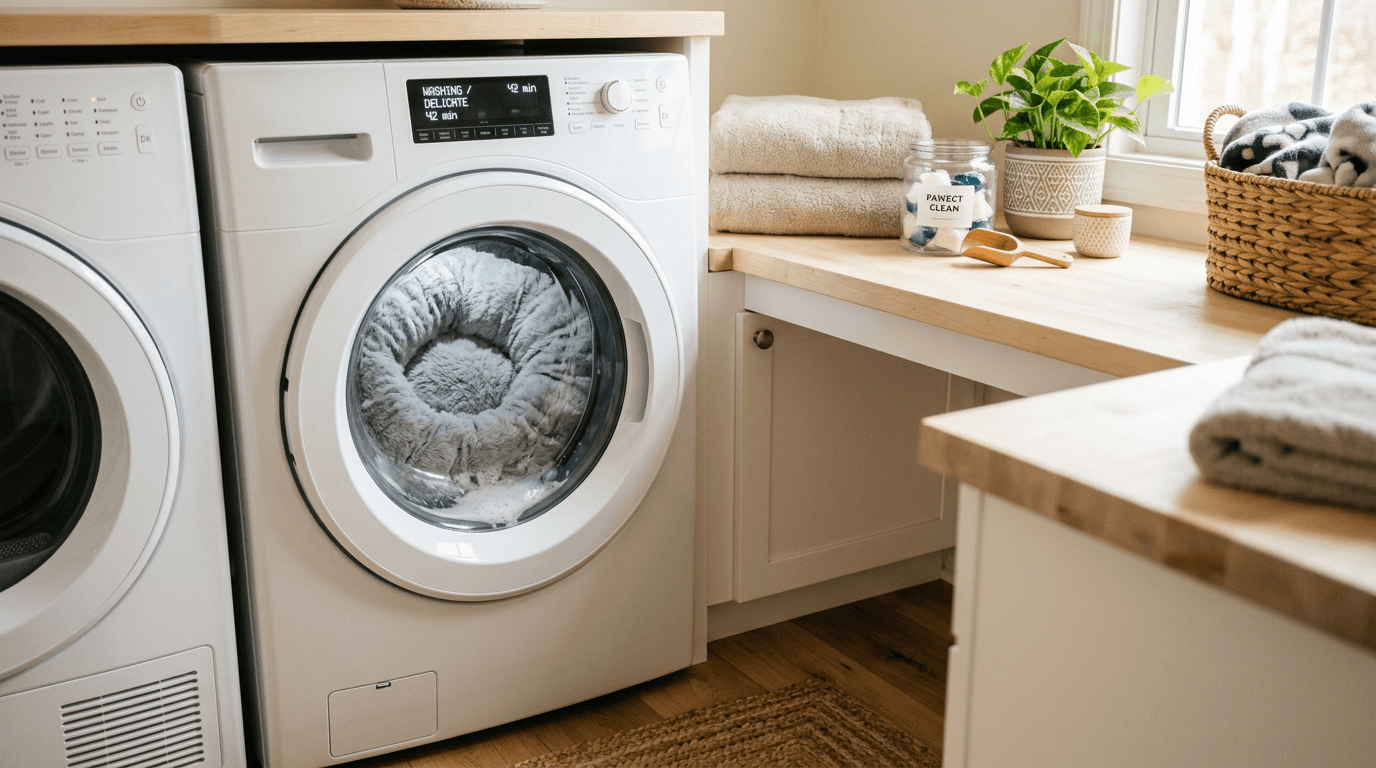
| Dog bed + blankets | Highest contact hours of anything in the house; foam absorbs oils and saliva | Hot wash covers; enzyme cleaner in the load for non-washables | Weekly |
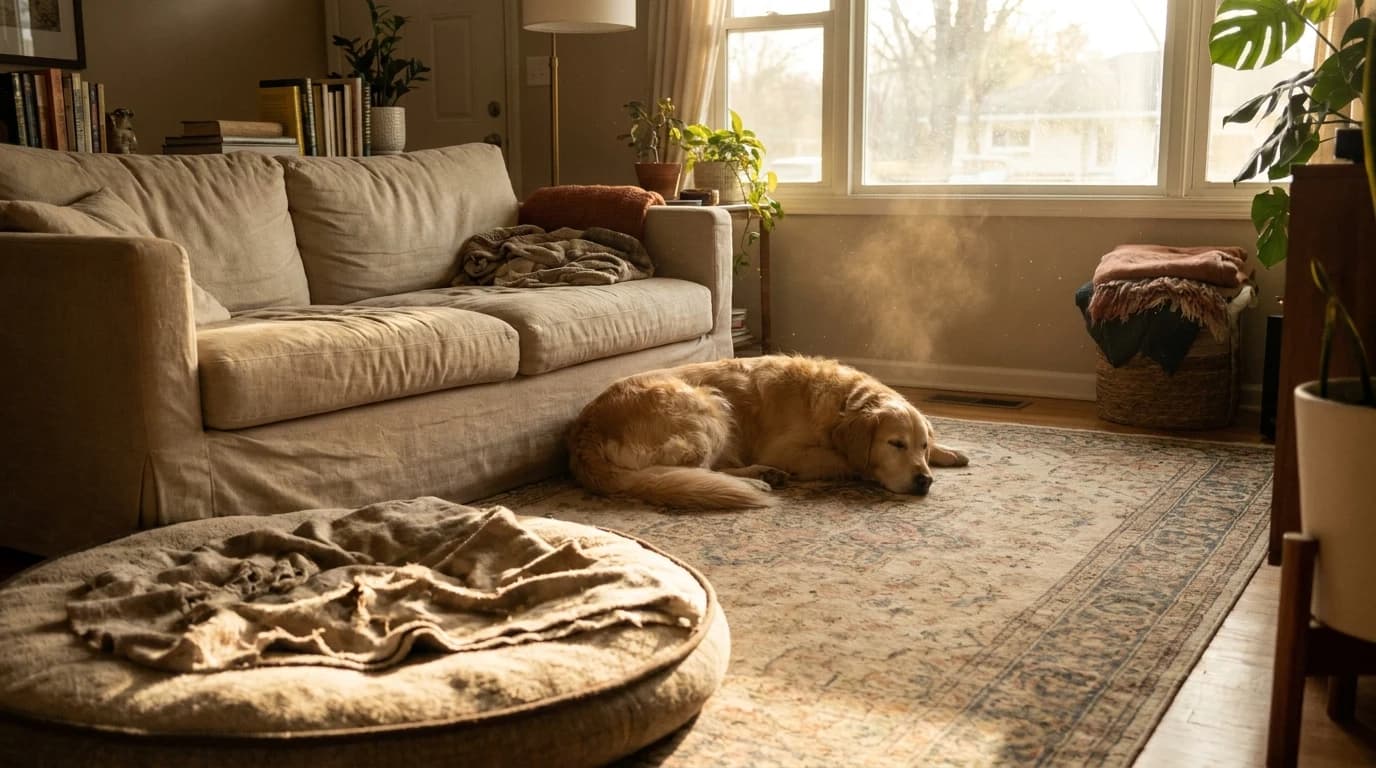
| Sofa + carpet | Porous fibres trap dander and skin oils across a huge surface area | Slow two-direction vacuuming with sealed HEPA filtration | Twice weekly |
| Set-in urine spots | Residue soaks past the fibre into the pad, where blotting cannot reach | Saturate with enzyme, let it dwell, then extract with a spot machine | As they happen, then re-check |
| HVAC return filter | Every airborne particle in the house passes through it and stays | Replacement — filters cannot be cleaned back to new | Every 1-3 months |
| Hard floors | Least absorbent surface in the room; mostly holds tracked-in residue | Floor enzyme, diluted and dried fully before paws return | Weekly |
How PawBench is paid: we earn an Amazon Associates commission on qualifying purchases. We don’t accept sponsored placements, paid reviews, or free products in exchange for coverage. Picks are ranked on documented owner outcomes and primary-source research, never on commission rate. Read the full methodology.
You have mopped twice and the house still smells like dog. That is usually not a product failure — it is a location failure. The reservoir is somewhere you have not touched yet.
Find the reservoir before you clean anything
Dog smell rides on dander, skin oils, saliva and dried urine, and all of those settle into soft, porous things far more readily than into a sealed floor. It shows in the EPA's own remedial advice for indoor animal allergens, which is to wash bedding frequently in hot water and vacuum carpets and upholstery — soft surfaces first, not the floor you can actually see.
There is a free diagnostic that tells you which reservoir you are dealing with before you spend anything on products.
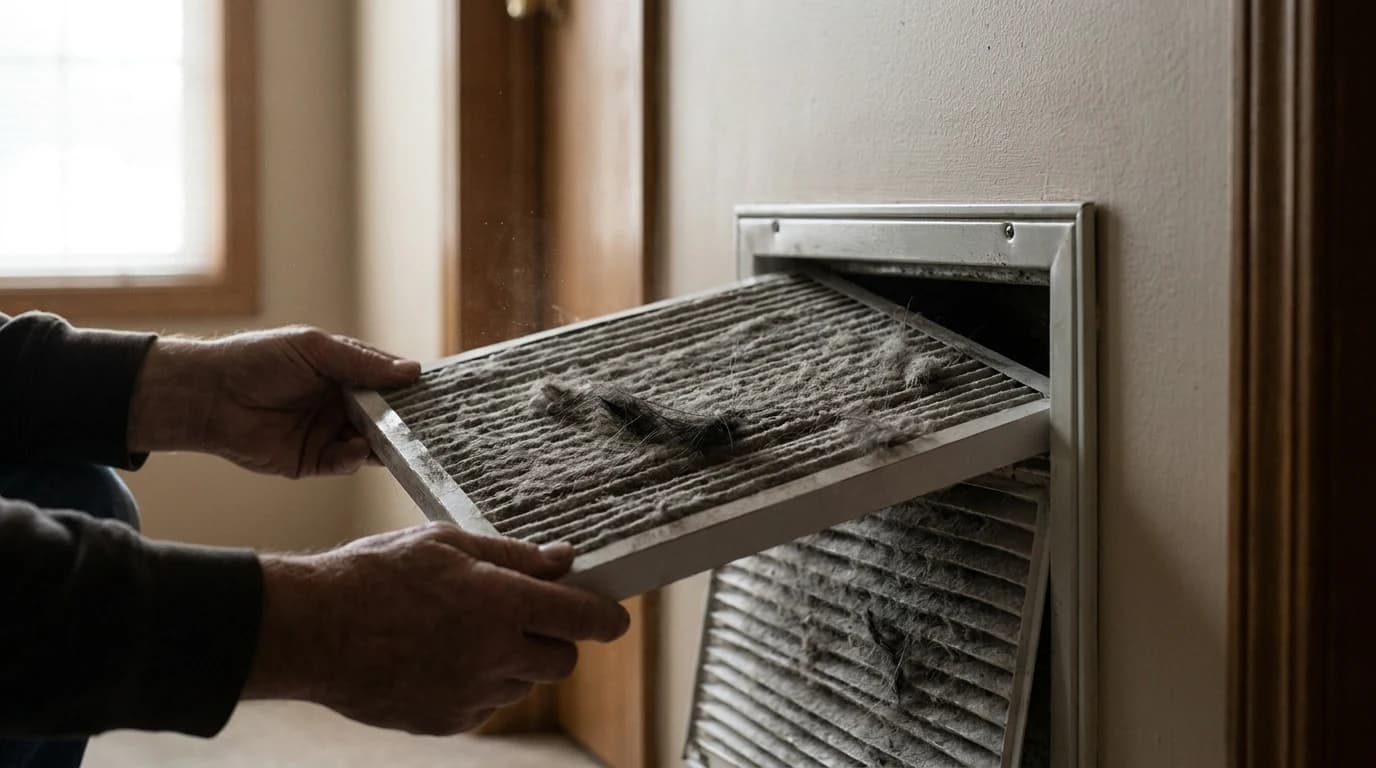
The HVAC test. Air the house out, shut it up with the heating and cooling off for an hour, then walk back in and pay attention to when the smell arrives.
Reading the result
If the smell meets you at the door:
- The reservoir is soft furnishings near the entry
- Beds, rugs, and the sofa your dog leans against are holding it
- Start at step one below and work down in order
If the smell only arrives once the system kicks on:
- The reservoir is the return filter, the ducting, or a rug sitting under a vent
- The airflow is delivering the smell, not the room itself
- Do step four first — every hour spent mopping here is wasted
The four-surface sweep, in order
Order matters, because each pass re-deposits onto whatever sits below it.
- Textiles first. Beds, throws, covers, and whatever your dog sleeps on. Wash hot — our guide to cleaning a dog bed without ruining it covers the by-bed-type detail. For fabric that cannot take a hot wash, an enzyme cleaner rated for laundry such as Biokleen Bac-Out goes in with the load.
- Upholstery and carpet. Vacuum slowly, in two directions, with a sealed-filtration machine like the Shark Navigator Lift-Away NV356E. The EPA notes that cleaning activities often re-suspend fine particles while you work, so open a window and let the room settle before moving on.
- Set-in spots. Saturate, dwell, extract — do not blot. Enzyme first (Nature's Miracle Advanced for large areas, Rocco & Roxie or the 32 oz Nature's Miracle for one-off accidents), then pull it back out of the pad with the Bissell Little Green Pet Pro. Blotting leaves the residue sitting in the underlay.
- Floors and the air path last. A floor enzyme concentrate on hard floors, then change the HVAC return filter. Our piece on whether floor cleaners are safe for dogs covers the dilute-rinse-dry routine that keeps this step from turning into a paw-licking hazard.
Why enzymes — and where that story gets oversold
The case for an enzymatic product over a scented spray is that your dog's nose sets the standard, not yours. The AKC is blunt about it: a dog keeps returning to a spot because even though you might not be able to smell it, they will be able to, which is why it recommends an enzymatic remover to take out the stain and the smell instead of a masking product.
What actually removes the smell:
- An enzyme product given time to dwell, then extracted rather than blotted
- Hot-washing every textile the dog is in contact with
- A fresh HVAC return filter
What only covers it:
- Scented sprays, plug-ins and carpet powders
- A quick mop of the hard floor while the soft surfaces go untouched
- Wiping an enzyme cleaner off before it has had time to work
The claim nobody can source
You will read everywhere that dried urine leaves uric acid crystals which sit inert until humidity rehydrates them and the smell reactivates. It is a tidy story, and it may well be true — but every source we could trace it back to was a cleaning-product vendor or a service company, not published work. Treat it as a plausible marketing explanation rather than an established mechanism.
Dwell time beats elbow grease. The practical advice is unchanged either way: enzymes are still the right tool, and letting them sit is what makes them work.
Skip the ozone odour eliminator
Ozone generators get marketed hard for pet smell. The EPA's position leaves little room: at concentrations that do not exceed public health standards, ozone is not effective at removing many odour-causing chemicals. The same page notes that inhaled ozone can damage the lungs, with relatively low amounts causing chest pain, coughing and throat irritation. A machine that only works at concentrations unsafe for you and your dog is not a fix.
Whatever you do use, let it dry fully before the dog comes back — the ASPCA's household-products guidance is the reference worth reading once.
When the smell is the dog, not the house
If the house is genuinely clean and the smell simply walks around with your dog, stop cleaning and book an appointment. The AKC points to yeast and bacterial skin infections and ear infections as the usual culprits, often downstream of allergies that started the scratching in the first place. That is a diagnosis, not a purchase — talk to your veterinarian rather than buying another bottle.
Frequently Asked Questions
- Why does my house smell like dog when I have cleaned everything?
- Because the surfaces people clean and the surfaces that hold odour are not the same set. Dander, skin oils and saliva settle into soft, porous materials — dog beds, upholstery, carpet and the pad beneath it — while most cleaning effort goes onto hard floors. The HVAC return filter is the other commonly missed reservoir, and it is the one that makes a room smell worse the moment the heating or air conditioning starts up.
- Do enzyme cleaners actually work better than regular cleaners?
- For urine specifically, they are what the American Kennel Club recommends, on the grounds that a dog will keep returning to a spot it can still smell even when you cannot. The practical difference is that an enzymatic product is designed to break residue down rather than perfume over it. They only work if you give them dwell time — applying and immediately wiping is the most common way people conclude they do not work.
- Are ozone generators or air purifiers good for pet odour?
- Ozone generators are not. The EPA states that at concentrations which stay within public health standards, ozone is not effective at removing many odour-causing chemicals, and it also notes that inhaled ozone can damage the lungs. Ordinary filtration is a different matter — a sealed HEPA vacuum and a fresh HVAC filter both help, because they remove the dander carrying the smell rather than trying to react with it in the air.
- How often should I wash a dog bed to keep the smell down?
- Weekly is a realistic cadence for covers and blankets, since the bed accumulates more contact hours than anything else your dog touches. Hot water matters, and foam inserts need vacuuming and full air-drying rather than soaking. If a bed still smells after a correct wash, the odour is usually in the insert rather than the cover.
- When is a dog smell a health problem rather than a cleaning problem?
- When the smell travels with the dog instead of staying in a room. The AKC points to yeast and bacterial skin infections and ear infections as the common medical causes, frequently secondary to allergies that started a cycle of scratching and licking. A sudden change in how your dog smells, or a smell paired with head shaking, redness or discomfort, is worth a veterinary appointment rather than another cleaning product.
Research Sources
- Indoor Air Pollution: An Introduction for Health Professionals — animal dander and allergen control — U.S. Environmental Protection Agency
- Ozone Generators that are Sold as Air Cleaners — U.S. Environmental Protection Agency
- How to Curb Marking Behavior — cleaning soiled areas with an enzymatic remover — American Kennel Club
- Why Does My Dog Smell So Bad? — American Kennel Club
- Poisonous Household Products — ASPCA Animal Poison Control Center

Hilly Shore Labs
Editorial teamIndependent product research team behind PawBench. Reviews are grounded in primary veterinary sources, aggregated buyer sentiment, and the lived ownership of Maggie, an Australian Labradoodle.
200+ dog products researched · 1.1M+ Amazon review-aspect mentions analyzed · cites AVMA, FDA, AAFCO, Cornell, WSAVA, AKC, ASPCA.
All product reviews are independently researched. Recommendations are based on published veterinary guidelines, manufacturer specifications, and verified customer feedback. See our editorial standards.