Can Dogs Eat Ham? Glazed, Deli, Country and the Bone
Dogs shouldn't eat ham regularly, though a small plain sliver is unlikely to hurt a healthy dog. Bones, fat trimmings, salty country ham and some glazes are the real trouble. If you want your dog to join in, Zuke's Mini Naturals Training Treats are a smaller, simpler holiday treat.
Quick Answer
Not as a regular food. The AKC calls ham not advisable because of its sodium and fat, though a small plain sliver probably won't hurt a healthy dog. Never give a ham bone. Skip fat trimmings, country ham and glazed ham. If your dog ate a bone, a sugar-free glaze, raisin sauce or a large amount, call your vet or poison control now.
On this page6 sections
Our Verdict
Keep ham off your dog's plate. A rare plain sliver is unlikely to hurt a healthy dog, but it offers nothing a better treat doesn't. Bones and most of a ham call for a vet right away, and so do xylitol or raisins in the glaze. Trim the fat for yourself, then put the scraps and the bone in a closed outdoor trash container.
Zuke's Mini Naturals Training Treats Owner rating4.6 Tiny holiday treat | Blue Buffalo Bits Chicken Training Treats (19 oz) Owner rating4.7 Bigger bag for a busy house | |
|---|---|---|
| Price | $14.98Buy on Amazon | $14.98Buy on Amazon |
| Pros |
|
|
| Cons |
|
|
| Best for | Small holiday treats | Multi-dog homes |
| Key feature | 3 calories per piece | 19 oz bag |
| Trade-off | Some dogs with chicken sensitivity need another variant | Larger pieces than Zuke's |
* Prices are approximate and may vary. Please check the latest price on Amazon.
Sodium and fat per ounce, by type of ham
USDA FoodData Central values per 100 g, converted by us to 1 oz (28.35 g) and rounded. Plain roasted turkey breast is included as a reference point. These are not safe-dose figures.
| Food | Sodium per oz | Fat per oz |
|---|---|---|
| Turkey breast, plain roasted (reference) (FDC 171496) | 28 mg | 0.6 g |
| Fresh, uncured leg of pork, roasted (FDC 168223) | 17 mg | 5.0 g |
| Sliced ham, regular (FDC 173864) | 231 mg | 2.5 g |
| Honey ham, smoked, cooked (FDC 174611) | 255 mg | 0.7 g |
| Chopped ham, canned (FDC 171626) | 363 mg | 5.3 g |
| Cured boneless ham, roasted (FDC 167872) | 425 mg | 2.6 g |
| Country-style ham, lean, raw (FDC 168282) | 765 mg | 2.4 g |
| Ham fat, separable, heated (FDC 169155) | 192 mg | 14.6 g |
Brands vary widely, so a package label beats these averages. The fat row is cured ham fat alone, and the country-style row is the lean portion only, so whole slices with fat would run differently.
How PawBench is paid: we earn an Amazon Associates commission on qualifying purchases. We don’t accept sponsored placements, paid reviews, or free products in exchange for coverage. Picks are ranked on documented owner outcomes and primary-source research, never on commission rate. Read the full methodology.
Dogs shouldn't eat ham as a regular food, though a small plain sliver is unlikely to hurt a healthy dog. The AKC calls ham "not advisable" because of its sodium and fat, then concedes that an occasional sliver probably won't cause harm. Bones, fat trimmings and some glazes are the real trouble.
Already happened? A bone, a sugar-free glaze, a raisin sauce or most of a ham is worth a call now, not after symptoms. Call your vet, ASPCA Poison Control at (888) 426-4435 (a consultation fee may apply), or Pet Poison Helpline at (855) 764-7661 ($99 per incident).
Find what your dog got into
We could not find an authority that publishes a safe ham amount by dog weight, so this table is not a dose chart. The risks come from the linked sources. The last column is our editorial reading, and your vet's advice overrides it.
| Form | Main problem | Should you share it? | If your dog already ate it |
|---|---|---|---|
| Plain cooked ham, trimmed | Sodium and fat | A rare sliver at most | Watch for vomiting, diarrhea or unusual thirst |
| Deli slices | Sodium, preservatives | Same rare sliver, plain only | Same watch; read the package for onion or garlic |
| Glazed or honey ham | Depends on the glaze | No | Find the recipe or label, then decide whether to call |
| Country or dry-cured ham | Highest sodium of the USDA rows we pulled | No | Call with your dog's weight and the amount |
| Fat trimmings and skin | Hard to digest; pancreatitis risk | No | Call if vomiting, belly pain or appetite loss appears |
| Raw or undercooked ham | Bacteria such as Salmonella | No | Call if your dog seems unwell |
| Ham bone or hock | Splintering, blockage | Never | Call now |
| Most of a ham, plus string or netting | Quantity and wrapping | Not applicable | Call now |
Salt and fat don't rise together
Most ham guides treat "ham" as one food. USDA FoodData Central shows otherwise, and the per-ounce table on this page lays out the spread. Three things stand out:
- Trimmings are the fat problem. The separable fat holds roughly six times the fat of roasted cured ham, ounce for ounce.
- Country-style ham is the salt problem. Its sodium is about 27 times that of plain roasted turkey breast.
- Deli doesn't mean mild. Sliced ham still carries about eight times the sodium of that turkey. Lean cuts cut the fat, not the salt.
Trimming the fat therefore solves only half of it, and a low-fat label says nothing about the salt.
What each one can do
| Too much salt | Too much fat | |
|---|---|---|
| Possible signs | AKC lists vomiting, diarrhea, excessive thirst and urination, and lethargy | VCA lists nausea, vomiting, fever, lethargy, abdominal pain, diarrhea and decreased appetite |
| At the serious end | ASPCA lists tremors, seizures and even death | VCA says severe attacks can bring shock and death |
Fat isn't a guaranteed trigger. VCA says pancreatitis may follow a fatty meal in some cases, and that many cases appear spontaneous. Merck believes dietary indiscretion is a common risk factor in dogs. VCA also describes a "praying position," rear up with front legs and head lowered, that is worth knowing.
Read the glaze before the meat
Glazes vary more than the ham under them. Sort yours by ingredient:
Call now
- Xylitol. Check anything sugar-free. FDA says it can drop blood sugar within 10 to 60 minutes. FDA names baked goods rather than glazes, so applying this to a sugar-free glaze is our inference.
- Raisins. Raisin sauce is a classic ham side. Pet Poison Helpline warns of stomach upset followed rapidly by kidney injury and failure.
Call with the recipe in hand
- Onion or garlic. Merck ties dog cases most often to concentrated forms such as powders and soup mixes. Anemia signs can take several days to show, so a normal dog tonight is not an all-clear. Pet Poison Helpline says Japanese breeds such as Akitas and Shiba Inus are more sensitive.
Skip it, no panic
- Brown sugar, honey, pineapple. None appears on ASPCA's list of foods to avoid. That is an absence, not a clearance, and they still sit on salty, fatty meat.
The bone deserves its own warning
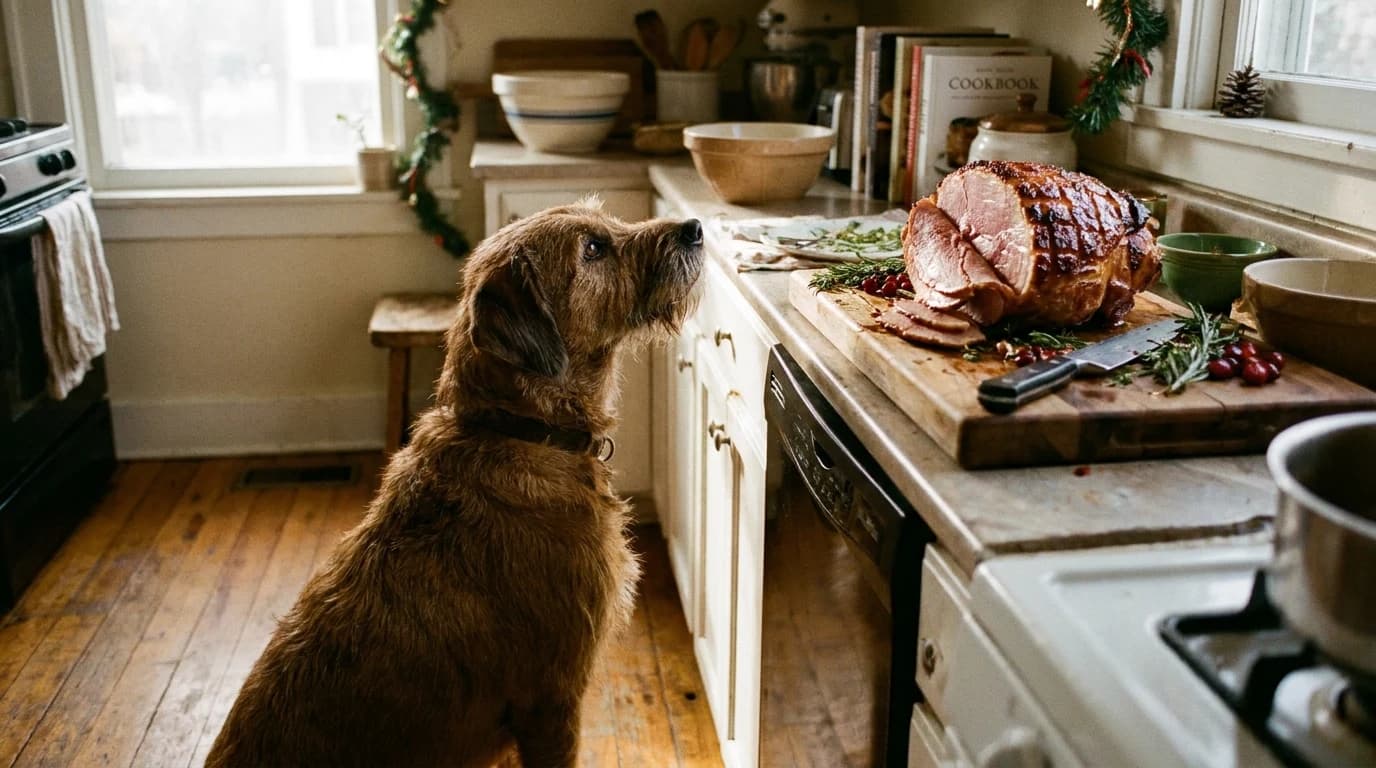
A ham bone looks like the obvious gift, and it is the worst thing on the board.
- Cooked bones break apart. The AKC says they splinter into shards that can cause choking and serious damage to the mouth, throat or intestines.
- Blockages can mean surgery. ASPCA warns that bone injury or obstruction may require it.
- Fatty pork bones add pancreatitis risk. AKC's example is pork ribs. It does not name ham bones, so extending that to a ham bone is our reading.
Secure the leftovers too. AVMA advises putting bones and anything used to wrap or tie the meat in a sealed bag, inside a closed outdoor trash container.
The first ten minutes
- Take the rest away and note what was eaten, how much, and when.
- Find the packaging or recipe. The ingredient list decides how urgent this is.
- Don't make your dog vomit on your own. ASPCA says to contact a vet or poison control first, and warns that salt can dangerously raise blood salt levels. After a ham, that is a particularly bad idea.
- Call if the table says to, or if any sign above appears. Our vomiting and diarrhea guide covers when a mild case becomes urgent.
Check with your vet first: for any dog with a past pancreatitis episode or on a prescribed diet, skip ham entirely unless your vet says otherwise. That is our cautious reading, and AKC separately warns against sharing it with overweight dogs.
What to give instead
The AKC's advice is to choose a healthier treat. Three easy options:
- A bit of plain meat. ASPCA says any bite of meat should be boneless and fully cooked. Our Thanksgiving plate guide covers the rest of the table.
- A very small treat. Zuke's Mini Naturals run about 3 calories a piece, so your dog can join in without much added.
- A bigger bag for a busy house. Blue Buffalo Bits are soft, bite-sized and chicken-based, so skip them for a dog with a chicken sensitivity.
For the wider list of holiday hazards, see our safe and toxic foods guide.
Frequently Asked Questions
- Is ham toxic to dogs?
- Plain ham isn't a classic toxin, but the AKC calls it not advisable and warns that excess salt can be toxic to dogs. The risk depends on the amount, the dog's size and what was added to the ham.
- Can dogs eat ham bones?
- No. The AKC says cooked bones splinter into shards that can damage the mouth, throat or intestines, and ASPCA warns that obstruction may require surgery. Call your vet if your dog swallowed any.
- Can dogs eat deli ham?
- It isn't a good choice. Sliced ham still carries about eight times the sodium of plain roasted turkey breast in USDA data. Check any package for onion or garlic before sharing even a sliver.
- Can dogs eat honey-glazed ham?
- Skip it. Honey isn't on ASPCA's list of foods to avoid, but the ham is still salty, and a glaze may hold onion, garlic, raisins or xylitol. Check the recipe if your dog already ate some.
- My dog ate ham and seems fine. What now?
- For a small plain piece, watch for vomiting, diarrhea, unusual thirst or low energy, and call your vet if any appear. For a bone, a large amount, xylitol, raisins, onion or garlic, call even if your dog seems fine.
Research Sources
- Can Dogs Eat Ham? — American Kennel Club
- Can Dogs Eat Bones? — American Kennel Club
- People Foods to Avoid Feeding Your Pets — ASPCA Animal Poison Control Center
- Thanksgiving Safety Tips — ASPCA
- Is It Ever Safe to Induce Vomiting? — ASPCA
- ASPCA Poison Control — ASPCA
- Pet Poison Helpline home page (phone number and fee) — Pet Poison Helpline
- Raisins — Pet Poison Helpline
- Garlic — Pet Poison Helpline
- Holiday Pet Safety — American Veterinary Medical Association
- Pancreatitis in Dogs and Cats — Merck Veterinary Manual
- Garlic and Onion (Allium spp) Toxicosis in Animals — Merck Veterinary Manual
- Pancreatitis in Dogs — VCA Animal Hospitals
- Paws Off Xylitol; It's Dangerous for Dogs — U.S. Food and Drug Administration
- FoodData Central database (search the FDC IDs in the table) — USDA FoodData Central

PawBench Editorial
Published by Hilly Shore LabsPawBench’s editorial team researches dog products from primary veterinary sources, manufacturer specifications and aggregated buyer sentiment, alongside the lived ownership of Maggie, an Australian Labradoodle. We do not run hands-on product tests.
331 dog products scored · 1,202,303 buyer review-aspect mentions aggregated · cites AVMA, FDA, AAFCO, Cornell, WSAVA, AKC, ASPCA.
Recommendations are based on published veterinary guidelines, manufacturer specifications, and verified customer feedback. See our editorial standards.