Your Dog's Microchip Works. The Phone Number Might Not.
Quick Answer
Probably not, unless you have checked it since the day it was implanted. In the 53-shelter study Ohio State summarises, microchipped dogs went home 52.2% of the time against 21.9% for strays generally — but among the reunions that failed, 35.4% failed on a wrong or disconnected phone number, 24.3% on owners who never responded, 17.2% on chips registered outside the manufacturer's database, and 9.8% on chips never registered at all. All of that happens after the scan has already succeeded. The check takes ten minutes: get the chip number off your vet record, run it through AAHA's free registry lookup, and confirm every registry it returns is holding a phone number you still answer.
On this page6 sections
Our Verdict
Stop treating the implant as the safeguard. In the only US shelter dataset of its kind, an unreadable chip is essentially never the recorded reason a reunion failed — the causes were a wrong phone number, an unanswered call, a registry mismatch and a registration nobody completed, and together they account for 86.7% of the listed failures. All four are free to fix, and none of them stays fixed on its own, because registries fold and phone numbers change. Put it in the diary once a year, and hang an engraved tag on the collar so coming home never depends on anyone owning a working scanner.
Why microchipped dogs still did not go home
The reasons shelters recorded in the 53-shelter study Ohio State summarises. Every one of them happens after the chip has already been read — none is a failure of the implant.
| Recorded reason | Share of listed failures | Where it happens | What prevents it |
|---|---|---|---|
| Incorrect or disconnected phone number | 35.4% | After the registry has been reached | Re-confirm the number held by every registry, once a year |
| Owner never returned the call or letter | 24.3% | After the owner has been contacted | Answer unknown numbers while a dog is missing; list a second contact |
| Chip registered outside the manufacturer's database | 17.2% | During the registry lookup | Run the number through AAHA's lookup and note every registry returned |
| Chip never registered at all | 9.8% | Before anyone calls anyone | Register at the moment of implant — an unregistered chip is an inert number |

How PawBench is paid: we earn an Amazon Associates commission on qualifying purchases. We don’t accept sponsored placements, paid reviews, or free products in exchange for coverage. Picks are ranked on documented owner outcomes and primary-source research, never on commission rate. Read the full methodology.
A microchip is not a tracker, and it is not a promise. It is one number under the skin that only pays off if a stranger can follow it back to your phone. Researchers have measured every step of that handoff, and the results are lopsided: the implant almost never fails. The paperwork does.
Where the chain actually breaks
The study everyone still quotes is Lord and colleagues in the Journal of the American Veterinary Medical Association, 2009, summarised by Ohio State's College of Veterinary Medicine: 53 US shelters logged every animal arriving with a chip. Median return-to-owner rates ran 2.4 times higher for microchipped dogs than for strays generally — 52.2% against 21.9%.
Then they logged why the rest failed, and the pattern is the point. The single largest cause was a wrong or disconnected phone number. Next came owners who never returned a call or a letter, then chips registered in a database other than the manufacturer's, then chips never registered at all. Those four causes account for 86.7% of the listed failures — and every one of them sits downstream of a scan that already worked.
The scanner is rarely the problem. In the recorded failures the chip was found and read. What broke afterwards was a phone number, a registry choice, or a form nobody finished.
"Get your dog chipped" is the easy half, and it is the half the whole internet repeats. The half that decides whether he comes home is administrative, free, and almost nobody does it twice.
Read the number like a serial number
Your dog's chip number is not arbitrary. WSAVA's microchip identification guidelines set out the ISO standard: a compliant chip carries a 15-digit number whose first three digits are a manufacturer or country code, transmitting at 134.2 kHz. Older US chips are different animals — a 10-character alphanumeric code at 125 kHz, or a 128 kHz variant. AAHA's lookup tool accepts 9, 10 or 15 digits, which tells you how many formats are still circulating. It also flags one specific ambiguity: numbers beginning 900 often cannot be traced to a single company, so the tool returns several.
| What you see | What it is | What it means for you |
|---|---|---|
| 15 digits starting 900 | ISO chip on a shared prefix | Expect a list of possible companies, not one answer |
| 15 digits, another prefix | ISO chip; the first three digits are a manufacturer or country code | Usually points at one registry — start there |
| 10 characters, letters and digits | Legacy US 125 kHz chip | Still valid, still readable, still accepted by the lookup |
| 9 digits | Older legacy chip | Accepted; confirm it against your vet's record |
The registry is a market, not a database
There is no national registry. AAHA's lookup lists roughly three dozen separate companies holding chip-to-owner records, and nothing obliges the chip inside your dog to be registered with the company that made it. That is the 17.2% bucket, in one sentence.
Worse, registries are businesses, and businesses close. AAHA's tool currently carries a notice that Save This Life ceased operations and was disconnected from the lookup, advising owners to get their number from their vet and re-register elsewhere. Nobody emails you when that happens.
A registration is an account at a company, not a permanent filing. The number in your dog lasts his whole life. The record pointing it back at you does not.
What the lookup will and will not do
The free lookup is the right first step, and it is narrower than most people assume.
- It will name the registries associated with your chip number, most recent first.
- It will not show owner contact details, or let you edit them.
- It will list companies that may have sold an unregistered chip, so a shelter can request trackback information on whoever bought it.
- It will not stand in for phoning the registry — AAHA states plainly that it does not manage registries and cannot resolve chip problems itself.
The tool tells you where to call. You still have to call.
The scan is not guaranteed either
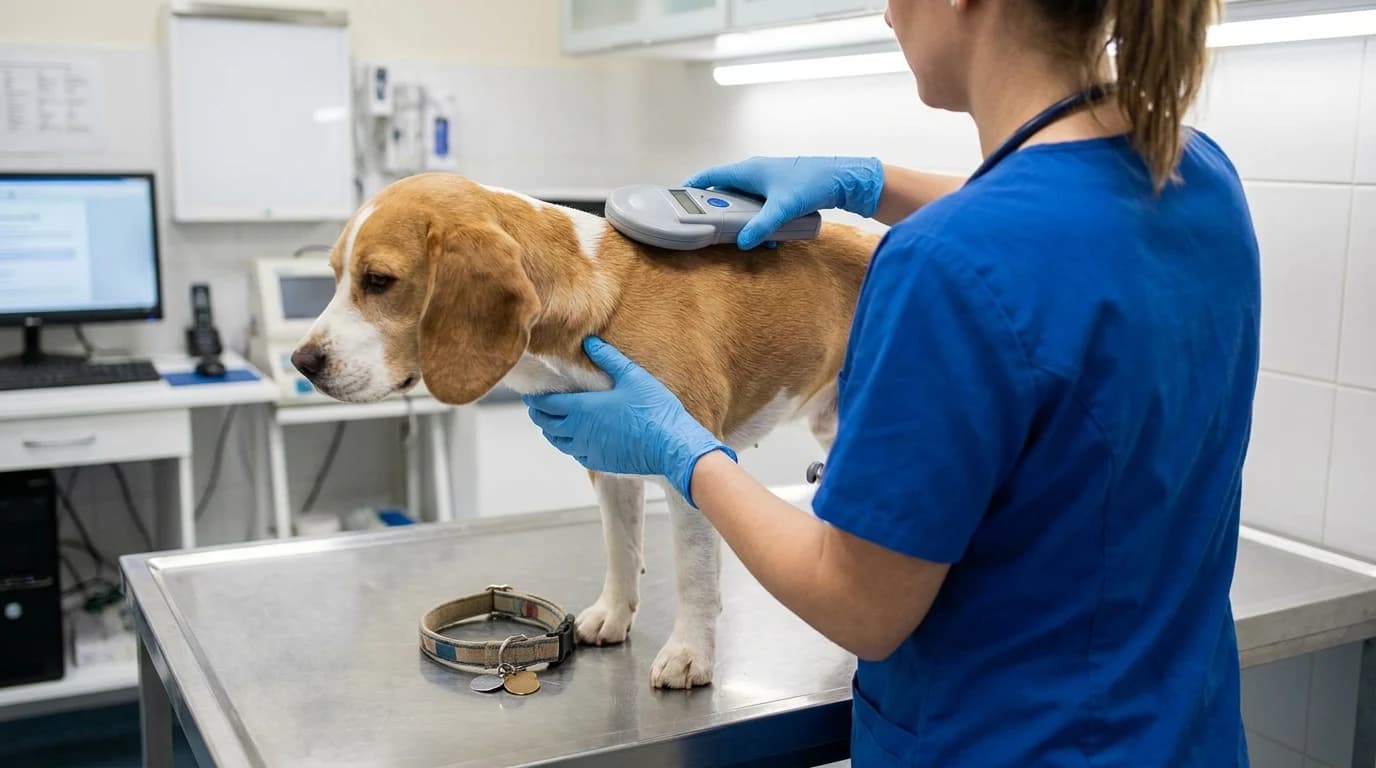
The US never adopted a national standard, so three frequencies circulate at once — 125 kHz still predominant, 128 kHz, and the ISO 134.2 kHz — plus encrypted and unencrypted versions of the 125 kHz protocol. Ohio State's scanner trials concluded that no single scanner reads every chip with 100% sensitivity, and named the conditions that degrade a read:
- A metal collar left on during the scan
- Scanning beside computers, metal tables or fluorescent lighting
- A tired scanner battery
- One pass instead of several
If your dog is ever handed in somewhere, "we scanned him and there was nothing" is not the same statement as "he has no chip." Ask whether the scanner was a universal one, and whether he was scanned more than once.
The evidence limit worth naming
Those percentages are the best evidence available, and they are also the only evidence available. The AVMA was still citing that same 2009 study in 2024, because no comparable US replication has been published since. The data behind it was gathered when fewer companies held these records than hold them now. Read the figures as a map of where failures cluster, not as a current forecast — and note that every change since points the same way: more registries, more fragments of the same record.
The ten-minute check
- Find the number. Vet record, adoption paperwork, or ask for a scan at the next appointment.
- Run it through the lookup and write down every registry it returns, not only the first.
- Contact each one. Confirm the number on file is the phone in your pocket today.
- Add a second contact who is not you — a partner, a neighbour, anyone who answers.
- Hang an engraved tag on the collar. Visual ID needs no scanner, no registry and no phone call.
- Answer unknown numbers while a dog is missing. A quarter of the failed reunions were owners who never picked up.
None of that costs anything, and none of it is what the chip was sold to you as. A chip is recovery infrastructure, not live tracking — it reports your dog's location exactly once, after somebody else already has him. If you want to know where he is right now, that is a different device entirely.
Frequently Asked Questions
- Is a dog microchip a GPS tracker?
- No. A microchip is a passive RFID tag with no battery and no location function. It does nothing at all until someone passes a scanner over your dog and then contacts the registry that number points to. It tells you where your dog is exactly once, after another person already has him. Live location is a separate, battery-powered device and a separate decision.
- How do I find out which registry has my dog's microchip?
- Get the chip number from your vet record or adoption paperwork, then enter it into AAHA's free Universal Pet Microchip Lookup Tool at petmicrochiplookup.org. It returns the registries associated with that number, most recent first. It will not show or change your contact details — you then contact each registry yourself. Numbers beginning 900 frequently return several possible companies rather than one, so work through the whole list.
- What happens if my dog's microchip was never registered?
- The chip is still readable, and it is still worth chasing. In the Ohio State summary of the shelter data, 9.8% of the failed cases involved chips that were never registered. AAHA's lookup handles this by listing companies that may have sold the chip, so a shelter can request trackback information on the purchaser — usually the clinic that implanted it. You can also register the existing number with a registry yourself at any point; no new implant is needed.
- A shelter scanned my dog and found nothing. Does that mean there is no chip?
- Not necessarily. The US never adopted a single microchip standard, so 125 kHz, 128 kHz and ISO 134.2 kHz chips are all in circulation, and Ohio State's scanner trials found that no single scanner reads every chip with 100% sensitivity. Reads are also degraded by metal collars, nearby computers or metal tables, fluorescent lighting and weak batteries. Ask whether a universal scanner was used and whether the dog was scanned more than once.
Research Sources
- The Microchip World: Recent Advances and Options for Shelters and Veterinarians — Linda K. Lord, DVM, PhD — Ohio State University College of Veterinary Medicine
- Universal Pet Microchip Lookup Tool — American Animal Hospital Association (AAHA)
- Microchip Identification Guidelines — World Small Animal Veterinary Association (WSAVA)
- On Check the Chip Day, the AVMA stresses importance of up-to-date microchip registration — American Veterinary Medical Association (2024)

PawBench Editorial
Published by Hilly Shore LabsPawBench’s editorial team researches dog products from primary veterinary sources, manufacturer specifications and aggregated buyer sentiment, alongside the lived ownership of Maggie, an Australian Labradoodle. We do not run hands-on product tests.
254 dog products scored · 1,160,974 buyer review-aspect mentions aggregated · cites AVMA, FDA, AAFCO, Cornell, WSAVA, AKC, ASPCA.
Recommendations are based on published veterinary guidelines, manufacturer specifications, and verified customer feedback. See our editorial standards.