Dog Paw Balm: When It Helps and When It Won't
Musher's Secret Paw Wax is the balm to buy for a dog walking salted winter sidewalks, applied before the walk as a barrier. For pads that are merely dry and rough, Natural Dog Company Paw Soother is the softest after-walk repair balm, while Bag Balm Vermont's Original is the heaviest, for external use only. A dog chewing at a single paw needs a vet, not a tin.
Quick Answer
Paw balm is a barrier and a moisturiser: it genuinely helps dry, rough, scaly pads, it protects against road salt and snow packing when applied before a walk, and it does nothing at all for the problems people most often buy it for. Red swollen paws, constant licking, a boil in the toe webbing, a split that bleeds, thickened horn-like pads, or blistering after hot pavement are infection, allergy, injury or keratin disorders — a vet's territory, and sealing any of them under wax delays the fix. The other split worth knowing is that a firm wax belongs on the paw before the walk and a softer balm belongs on it afterwards; they are different products for different jobs.
On this page6 sections
Our Verdict
Buy a tin for the narrow thing it does well and stop expecting it to do the rest. For a dog walking salted winter sidewalks, a firm wax applied before the walk plus a wipe-down afterwards is the whole protocol, and it is the one the ASPCA's own cold-weather guidance describes. For pads that have simply gone dry and rough, a softer balm worked in at bedtime — thinly, into the pad rather than the fur, with five minutes bought before the dog can lick it off — is worth the ten minutes a week. What a balm cannot do is treat pododermatitis, an interdigital furuncle, a torn pad, a burn or hereditary hyperkeratosis, and the reader most likely to be disappointed by a tin is the one whose dog is chewing at a single foot. That is not a moisture problem, and the cheapest version of that vet visit is the early one.
Which tin, by what you're actually dealing with
| If your situation is… | Pick | Why |
|---|---|---|
| You walk on salted or gritted sidewalks all winter | Musher's Secret Paw Wax | A firm food-grade wax applied before the walk is the barrier job the ASPCA describes; the residue phase on hardwood is the price of it. |
| Pads are already dry, rough and scaly, with no splits | Natural Dog Company Paw Soother | The softest and oiliest of the four, which is what a repair-after-the-walk balm should be — and the one that most needs the five-minute lick window. |
| Mild seasonal dryness, and a dog who hates having paws held | Burt's Bees for Dogs Paw & Nose Lotion | A lotion rather than a balm: thinnest, fastest to absorb, least barrier, and it covers the nose in the same pass. |
| Rough pads on a dog who does not lick their feet | Bag Balm Vermont's Original | The heaviest and most occlusive option here, but its own label says for external use only — so it is the wrong choice for a licker. |
Each pick is one of the products ranked below — this row is for shortcutting based on your situation, not a separate recommendation.
Musher's Secret Paw Wax Owner rating4.6 The pre-walk barrier wax, built for sled dogs. | Natural Dog Company Paw Soother Owner rating4.6 The softest after-walk repair balm of the four. | Burt's Bees for Dogs Paw & Nose Lotion Owner rating4.5 A lotion, not a balm — thinnest and fastest to absorb. | Bag Balm Vermont's Original Owner rating4.7 The heaviest, most occlusive option — and external use only. | |
|---|---|---|---|---|
| Price | $24.99Buy on Amazon | $18.29Buy on Amazon | $5.99Buy on Amazon | See price on AmazonSee buying options |
| Buyer sentiment | Functionality Quality Paw protection Snow protection Buyers praise functionality, quality, paw protection and snow protection. Based on 3,802 user mentions | — | — | — |
| Pros |
|
|
|
|
| Cons |
|
|
|
|
| Format | Firm wax in a tub | Soft balm in a tin | Pump lotion | Heavy ointment in a tin |
| Job | Barrier, applied before the walk | Repair, applied after the walk | Light daily moisturising | Occlusive repair on a dog that does not lick |
| Base | Natural food-grade waxes | Coconut oil and calendula | Rosemary and olive oil | Petrolatum, lanolin, paraffin wax, 8-hydroxyquinoline sulfate |
| Size | 200 g (7 oz) | 2 oz tin | 4 fl oz | Tin |
* Prices are approximate and may vary. Please check the latest price on Amazon.
What each paw-balm ingredient is actually doing
The ingredient list on a paw-balm tin is short and repetitive across brands. This is what each component contributes, how it behaves if your dog licks it off, and the situation where it is the ingredient that matters. Compiled from the manufacturers' own stated ingredient lists and the veterinary sources cited at the foot of this article.
| Ingredient | What it does | If it gets licked | When it's the one that matters |
|---|---|---|---|
| Beeswax | Stiffens the balm and forms the film that sits on top of the pad | Food-grade waxes are the basis of the lick-safe claim on wax products such as Musher's Secret | Pre-walk barrier work — salt, snow, grit |
| Shea or cocoa butter | Emollient; softens and adds body without making the balm runny | Ordinary food fats, and present in small amounts | Rough, thickened pads that need softening rather than sealing |
| Coconut, olive or hemp seed oil | Carrier oil; thins the balm so it can be worked into the pad | Food oils; the usual issue is a loose stool if a dog licks off a lot | Dry, scaly pads with no splits — the softest balms lean hardest on oils |
| Lanolin | Wool-derived occlusive; holds water in the pad rather than adding it | Bag Balm's lanolin-and-petrolatum tin carries a for-external-use-only label | Stubborn chapping on a dog that does not lick their feet |
| Petrolatum | The reference occlusive; a pure physical barrier with no active ingredient | The ASPCA names petroleum jelly first among vet-approved pre-walk paw protectants | Winter salt and de-icer exposure, on a budget |
| Vitamin E (tocopherol) | Antioxidant; mostly keeps the oils in the tin from going rancid | Present in trace amounts in a balm | Shelf life more than skin outcome — treat marketing claims sceptically |
| Essential oils (tea tree, eucalyptus, peppermint) | Fragrance and marketing; no barrier or moisturising function | Pet Poison Helpline: under 1-2% tea tree oil is generally considered non-toxic as labelled, but higher concentrations are toxic and a few concentrated drops can poison a dog | Never. This is the column to read before you buy an unfamiliar tin |
How PawBench is paid: we earn an Amazon Associates commission on qualifying purchases. We don’t accept sponsored placements, paid reviews, or free products in exchange for coverage. Picks are ranked on documented owner outcomes and primary-source research, never on commission rate. Read the full methodology.
Paw balm sells on a photograph: a cracked pad, a tin, a fixed dog. What it actually is is a wax-and-oil barrier that holds moisture in and keeps grit, salt and dry air out. That covers a real slice of paw problems — and almost none of the ones people most often buy it for. A dog chewing at one foot every evening does not have a moisture problem, and no balm will touch what is causing it.
So the first question is not which tin. It is whether the thing on your dog's paw is a balm problem at all.
Is it a balm problem or a vet problem?
Work down this table before you buy anything. The right-hand column is the one that decides.
| What you're seeing | Usual cause | Does balm help? | Vet? |
|---|---|---|---|
| Pads dry, rough, faintly scaly — no splits | Dry winter air, indoor heating, hard ground | Yes — this is the actual job | No |
| A split that bleeds, or a loose flap of pad | A tear or puncture | No — never on an open wound | Yes |
| Whole paw red and swollen, licked constantly | Pododermatitis — infection, allergy, immune, hormonal or a tumour | No | Yes |
| A shiny reddish-purple boil in the toe webbing | An interdigital furuncle, usually deep bacterial infection from ingrown hairs | No | Yes |
| Limping after a snowy walk, ice balls in the fur | Snow packing between the pads, plus de-icing salt | Yes — before the walk, and wipe after | No |
| Thick, horny, cracking overgrowth on all four pads | Footpad hyperkeratosis | Softens the surface at best | Yes |
| Pads discoloured or blistered after hot pavement | A burn — see our hot-pavement guide | No | Yes |
Two of those rows are worth reading twice. Merck notes that a furuncle caused by a foreign object is usually solitary and often on a front foot, and VCA's first-aid guidance treats licking or limping as the signal of a torn, punctured or burned pad. Both describe one foot, worked at hard.
The tell: dry-pad problems are symmetrical and quiet. Dogs work on one foot when something is in it or wrong with it — and that is the version a balm cannot reach.
Wax before, balm after
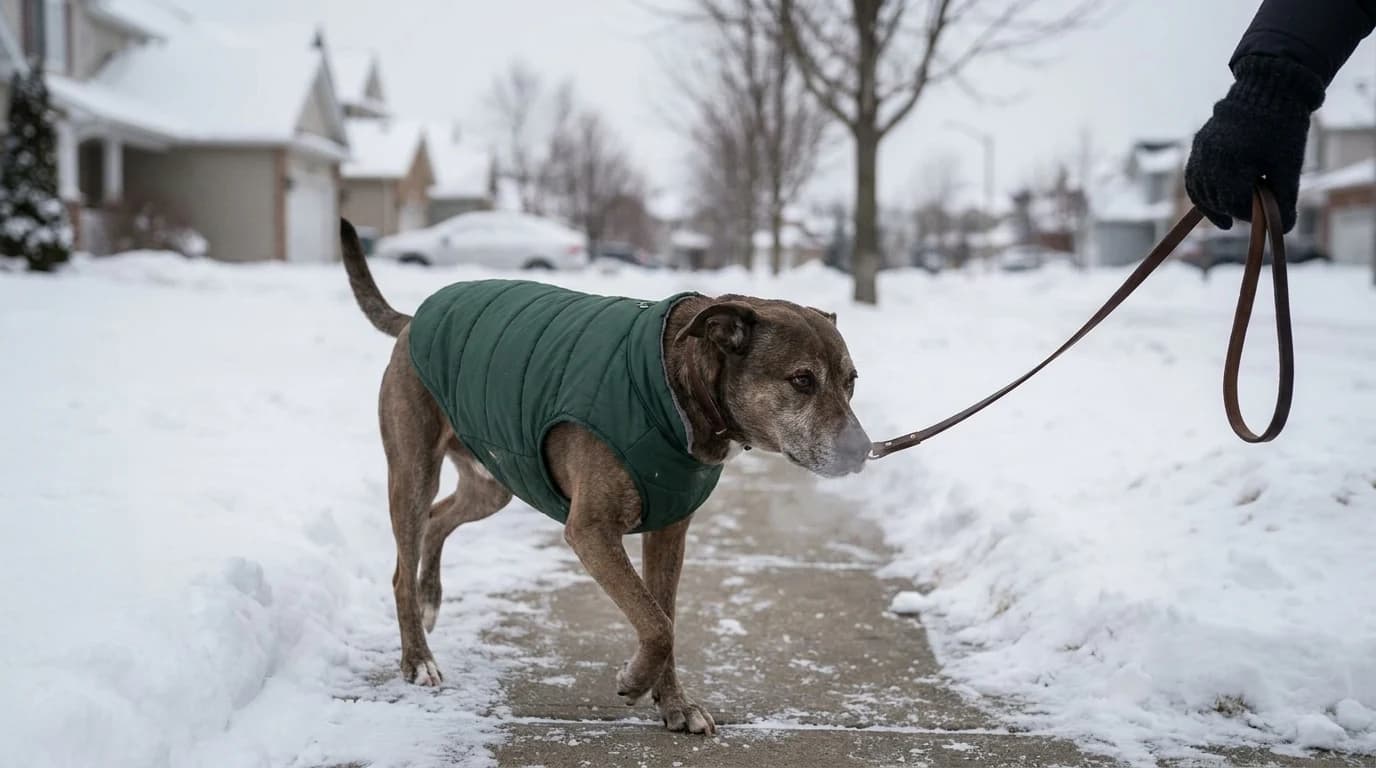
These are two products doing two jobs, and the shelf blurs it. The ASPCA's cold-weather guidance is to massage petroleum jelly or another vet-approved paw protectant into the pads before going outside, to protect against salt and chemical de-icers. That is a barrier, applied ahead of the insult. Repair is the opposite errand: a softer, oilier balm worked in after the walk, on a clean paw, with the dog settling for the night.
A pre-walk wax earns its place for:
- Salted and gritted sidewalks
- Snow packing into balls between the pads
- Sand, hot trail dust, rough gravel
- Dogs that will not tolerate boots
An after-walk balm earns its place for:
- Dry, scaly pads with no splits in them
- Pads gone rough after a season on hard surfaces
- Chapping from repeated cold-street-to-warm-house cycling
Rule of thumb: if the problem is something the paw is about to walk into, apply before. If the problem is the pad itself, apply after.
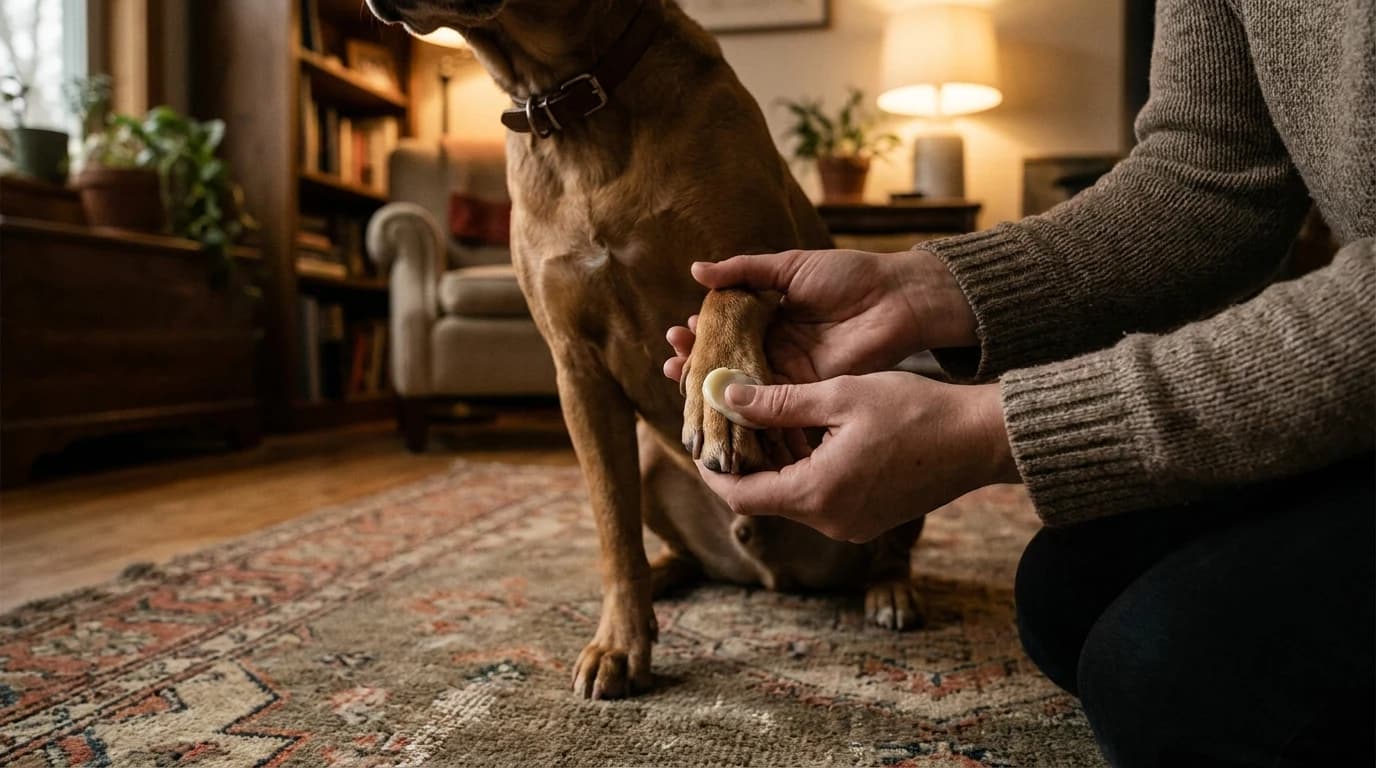
How to make it actually stay on the paw
The usual complaint is that it wipes off on the floor and does nothing. Application is most of the product.
- Wipe first. The ASPCA advises pulling the snow balls out from between the pads and towelling the feet after a winter walk. Sealing road salt against skin is worse than doing nothing. Trimming the hair between the toes cuts down how much clings there in the first place.
- Use less than you think. A film you can barely see. A visible layer is a layer that ends up on your hallway floor.
- Work it into the pad, not the fur. Thumb pressure, one pad at a time, and don't skip the small pads or the webbing between them.
- Buy five minutes. Distract, feed, or slip a sock over the foot until it absorbs. Most balms are formulated to be lick-safe, but a dog who licks it straight off has had a snack and no barrier.
- Do it at bedtime. The dog is settled, and won't be back on grit for hours.
What not to put on your dog's paws
- Essential oils, tea tree above all. Pet Poison Helpline notes that pet products containing under 1–2% tea tree oil are generally considered non-toxic when used as labelled, but that higher concentrations are toxic to pets — a few concentrated drops, applied topically or swallowed, can cause severe poisoning, with signs ranging from drooling and tremors to organ injury.
- Fragranced human hand cream. It was never formulated to be eaten, and paws get eaten.
- Anything on an open wound. A torn pad holds stitches poorly and heals slowly; sealing one under wax is not first aid.
- Human ointments you haven't read. Bag Balm — the classic tin — is petrolatum, lanolin, paraffin wax and 8-hydroxyquinoline sulfate, and its own label says for external use only.
If you'd rather not think about it: plain petroleum jelly is the first thing the ASPCA names. It is the cheapest option in this article, and it is on that list for a reason.
Winter: what ice melt actually does to paws
The winter case for a barrier is less about cold than about chemistry. Pet Poison Helpline's breakdown of de-icers is the clearest guide to what your dog is walking through:
- Calcium salts are the harshest. Pet Poison Helpline calls them the most severe irritants of all ice-melt ingredients, irritating skin and paws on contact as well as the gut if swallowed.
- Rock salt is mostly an eating problem. Sodium chloride on the pads mainly causes vomiting and diarrhoea if licked or eaten in quantity; large ingestions can cause sodium poisoning.
- "Pet safe" is a label, not a promise. The urea-based products usually sold as pet-safe can still cause drooling and stomach upset, and magnesium chloride can still irritate.
Tufts veterinarian Jonathan Babyak's calibration is useful here: a dog licking a little salt off its pads will, at worst, get an upset stomach. The balm's job is the contact irritation and the drying, and the wipe-down afterwards is what stops the licking.
A winter routine that uses the right product at the right time:
- Before the walk: a thin film of firm wax into the pads and between them.
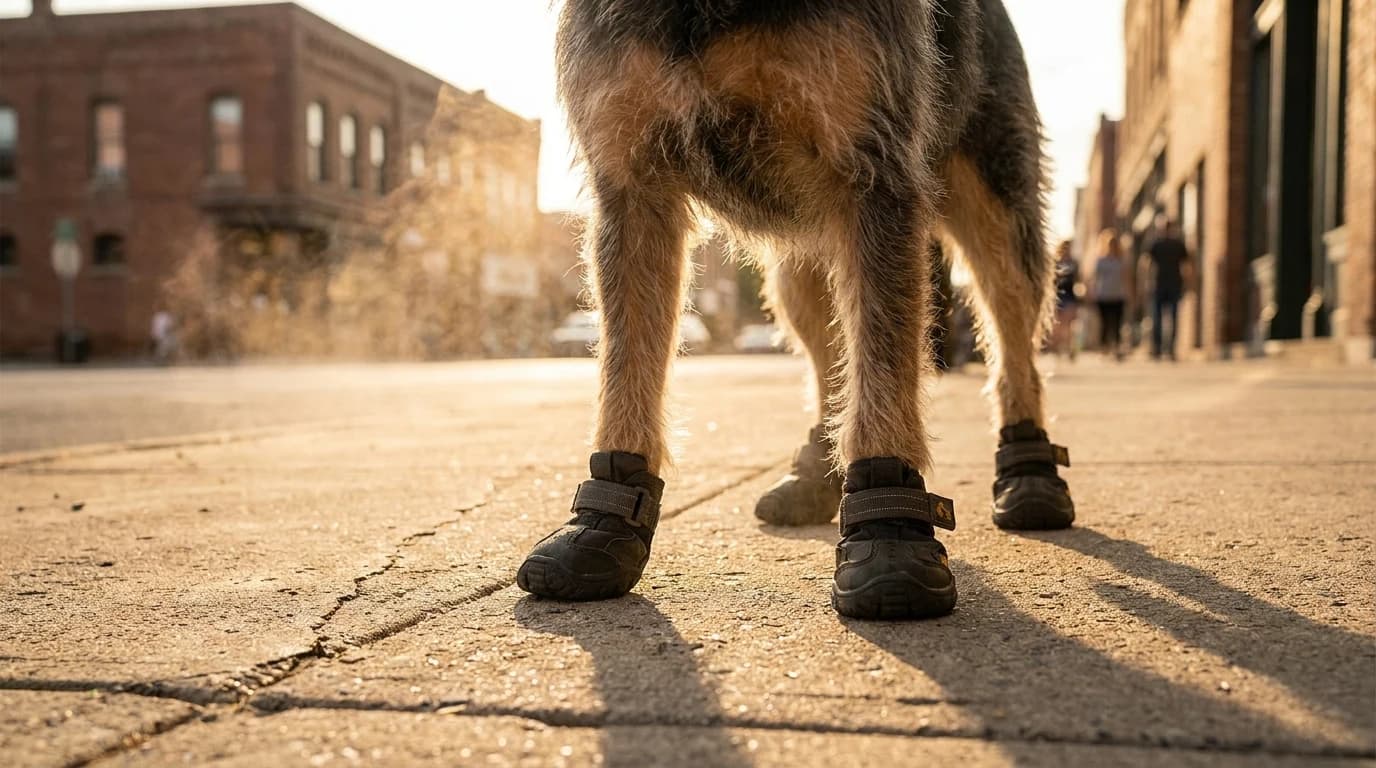
- On treated sidewalks every day, or if pads are already cracked: consider boots instead; a boot keeps calcium salts off the pad entirely, where wax only thins the contact.
- After the walk: wipe or rinse the feet with a damp cloth, dry between the toes, and check for redness.
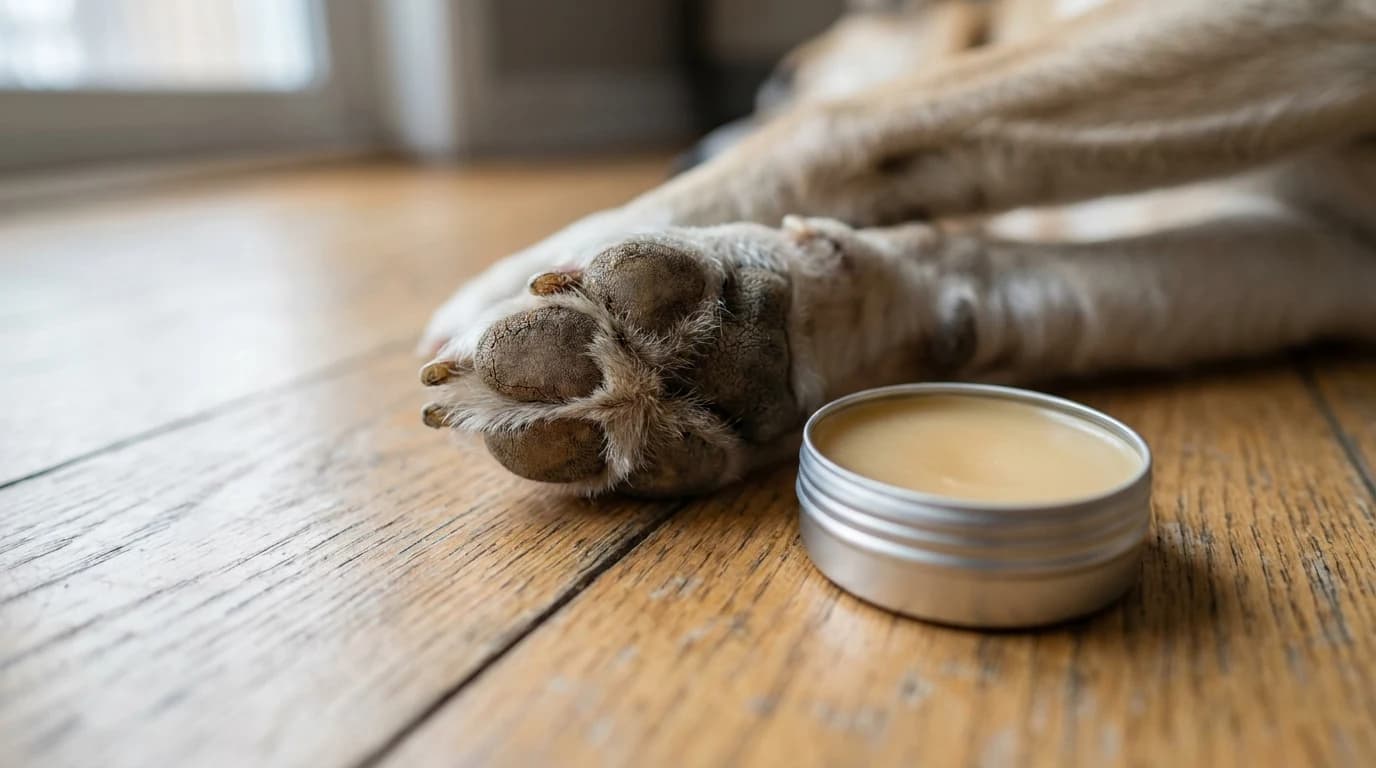
- At bedtime, only if pads are dry: a softer balm, worked into the pad.
For cold itself, see how cold is too cold for dogs.
The four worth considering
- Musher's Secret is the pre-walk wax: a firm, food-grade wax blend built for sled dogs. Expect a brief waxy-floor phase on hardwood.
- Natural Dog Company Paw Soother is the after-walk tin — coconut oil and calendula, the softest of the four, and the one that most needs that five-minute window.
- Burt's Bees Paw & Nose Lotion is a lotion, not a balm. Thinnest, fastest to absorb, least barrier. Right for mild seasonal dryness on a dog who hates being handled.
- Bag Balm is the heaviest and most occlusive of the four, and the only one whose own tin says external use only — which makes it the wrong pick for a determined licker.
If you're reaching for a tin because your dog won't stop working at one foot, the tin is not the purchase. That's a vet visit, and the early version of it is cheaper than the late one.
Frequently Asked Questions
- Can I use Vaseline on my dog's paws?
- Yes, and it is the option the ASPCA names first. Its cold-weather guidance is to massage petroleum jelly or another vet-approved paw protectant into the paw pads before going outside, to protect them from salt and chemical de-icing agents. It is a pure occlusive barrier with no active ingredient, which is exactly what pre-walk protection asks for. The caveat is that it stays greasy for a while, so it marks floors, and a dog who licks it straight off gets the barrier removed along with a mouthful of petroleum jelly. Apply thinly, work it into the pad rather than the fur, and give it a few minutes before the walk.
- How often should I apply paw balm?
- Match the frequency to the job rather than the tin's instructions. As a pre-walk barrier against salt, snow or hot ground, it goes on before every exposure — the film wears off during the walk, which is what it is for. As a repair balm for dry, rough pads, most owners land on nightly for a week or two until the pads soften, then two or three times a week through the dry season. If pads are still cracking after a couple of weeks of consistent use, the problem is probably not dryness, and that is the point to have a vet look at the feet rather than to buy a stronger balm.
- Is coconut oil on its own enough?
- For mild dryness it is a reasonable emollient, and it is the base of several commercial paw balms. What it is not is a barrier. Coconut oil stays soft at room temperature, absorbs or transfers quickly, and does not form the film that keeps road salt, grit and snow off the pad, so it is a poor substitute for a firm wax before a winter walk. It is also the version most likely to be licked straight off, since it tastes like food. Treat it as the cheapest after-walk moisturiser rather than as protection.
- Why does my dog lick the balm off?
- Usually because most paw balms are formulated from food-grade waxes and edible oils so that licking is not dangerous, which also makes them taste like something worth licking. The practical fix is to buy five minutes: apply at bedtime when the dog is settling, use a thin film rather than a visible layer, and distract with a chew or slip a sock over the foot until it absorbs. What matters more is whether the licking started before the balm did. Persistent licking of the feet is one of the signs VCA lists for pododermatitis, which has infectious, allergic, immune-mediated, hormonal and neoplastic causes — none of which a balm addresses. If your dog was already working at one foot, that is a vet question.
- What's the difference between paw wax and paw balm?
- A wax is firm and sits on top of the pad as a barrier, so it goes on before a walk on salt, snow, sand or grit. A balm is softer and oilier and is worked into dry, rough pads afterwards, ideally at bedtime. Musher's Secret is the classic wax; the softer tins are repair balms. Many owners in cold climates keep one of each.
- Is paw balm safe if my dog licks it?
- Most dog paw balms are made from food-grade waxes and food oils and are formulated to be lick-safe, and plain petroleum jelly is the option the ASPCA names first. The exceptions are products labelled for external use only, such as Bag Balm, and anything with essential oils, especially tea tree, which Pet Poison Helpline warns can be toxic in concentrated amounts. Apply a thin film and give it a few minutes before the dog can lick.
- Does paw balm protect against ice melt?
- It reduces contact, which helps with salt and irritation, but it is a thin barrier. Pet Poison Helpline calls calcium-based de-icers the most severe irritants to paws. On sidewalks treated every day, boots are the stronger protection. Either way, wipe the feet after every winter walk, which also stops the dog licking de-icer off its pads.
Research Sources
- First Aid for Torn or Injured Foot Pads in Dogs — VCA Animal Hospitals
- Pododermatitis in Dogs — causes, clinical signs and treatment — VCA Animal Hospitals
- Abscesses Between the Toes (Interdigital Furunculosis) in Dogs — Merck Veterinary Manual (Pet Owner Version)
- Congenital and Inherited Skin Disorders in Dogs — familial footpad hyperkeratosis — Merck Veterinary Manual (Pet Owner Version)
- Cold Weather Safety Tips — paw protectants, de-icers and post-walk wipe-downs — ASPCA
- Tea Tree Oil — toxicity to pets — Pet Poison Helpline
- Ice melts and dogs: which ingredients irritate paws, and what 'pet safe' does not mean — Pet Poison Helpline
- How do I protect my dog in winter from extreme cold, ice, salt, and deicers? — Tufts Now, Tufts University

PawBench Editorial
Published by Hilly Shore LabsPawBench’s editorial team researches dog products from primary veterinary sources, manufacturer specifications and aggregated buyer sentiment, alongside the lived ownership of Maggie, an Australian Labradoodle. We do not run hands-on product tests.
331 dog products scored · 1,222,724 buyer review-aspect mentions aggregated · cites AVMA, FDA, AAFCO, Cornell, WSAVA, AKC, ASPCA.
Recommendations are based on published veterinary guidelines, manufacturer specifications, and verified customer feedback. See our editorial standards.