Why Do Dogs Eat Grass? The Sick-Dog Theory Doesn't Fit
Quick Answer
Almost certainly not because it is ill. In the UC Davis surveys the AKC summarises, only about 22% of dogs frequently vomited after eating grass and only 9% frequently showed signs of illness beforehand, and the researchers concluded plant-eating is normal canine behaviour. The youngest dogs graze the most and are the least likely to be unwell, which is the opposite of what self-medication would predict. The exceptions worth acting on are a frantic morning graze that brings up yellow bile — an empty-stomach pattern a feeding-schedule change usually fixes — and grazing that is newly appearing in an adult dog alongside weight loss, appetite change or lethargy. The documented risks are on the lawn rather than in the habit: herbicide-treated grass and roundworm eggs that stay infective in soil for years.
On this page5 sections
Our Verdict
Stop treating grass-eating as a symptom. In the surveys behind every article on this topic, roughly four grazing sessions in five end with no vomiting at all, and the dogs doing it most are the youngest — backwards for self-medication. Investigate only when the habit is new in an adult dog and arrives with weight loss, appetite change or lethargy. Spend the worry instead on what the grass has been sprayed with and what has been left on it: herbicide-treated lawns carry the only odds ratio in this subject, and roundworm eggs stay infective in soil for years.
Five explanations for grass-eating, weighed against the evidence
What each theory would have to be true for, and what the published surveys and veterinary sources actually show. Nothing here comes from a product page.
| Explanation | It would predict | What the sources show | Standing |
|---|---|---|---|
| Self-medication for nausea | Most grazing dogs look unwell first and vomit afterwards | About 9% frequently appeared ill beforehand; about 22% frequently vomited after (AKC, summarising UC Davis) | Contradicted as a general explanation |
| Nutritional or fibre deficiency | Better-supplemented dogs graze less | Dogs given plant-based dietary supplements ate no less grass; VCA notes commercially fed dogs should not be deficient | Unsupported, though fibre remains a plausible motive |
| Bile on an empty stomach | A narrow pattern: frantic morning grazing, yellow foam, then a normal dog | AKC's chief veterinary officer describes exactly this pattern and a feeding-schedule fix | Supported for that specific pattern only |
| Inherited foraging behaviour | Common, ageless, mostly consequence-free, unrelated to health | 68% of surveyed dogs ate plants daily or weekly, youngest most of all; researchers called it normal behaviour | Best fit to the survey shape |
| Boredom or under-stimulation | Grazing concentrated in unsupervised yard time, responsive to enrichment | Named by AKC as a driver; no survey data isolates it, so it stays a clinical impression | Plausible, untested |
How PawBench is paid: we earn an Amazon Associates commission on qualifying purchases. We don’t accept sponsored placements, paid reviews, or free products in exchange for coverage. Picks are ranked on documented owner outcomes and primary-source research, never on commission rate. Read the full methodology.
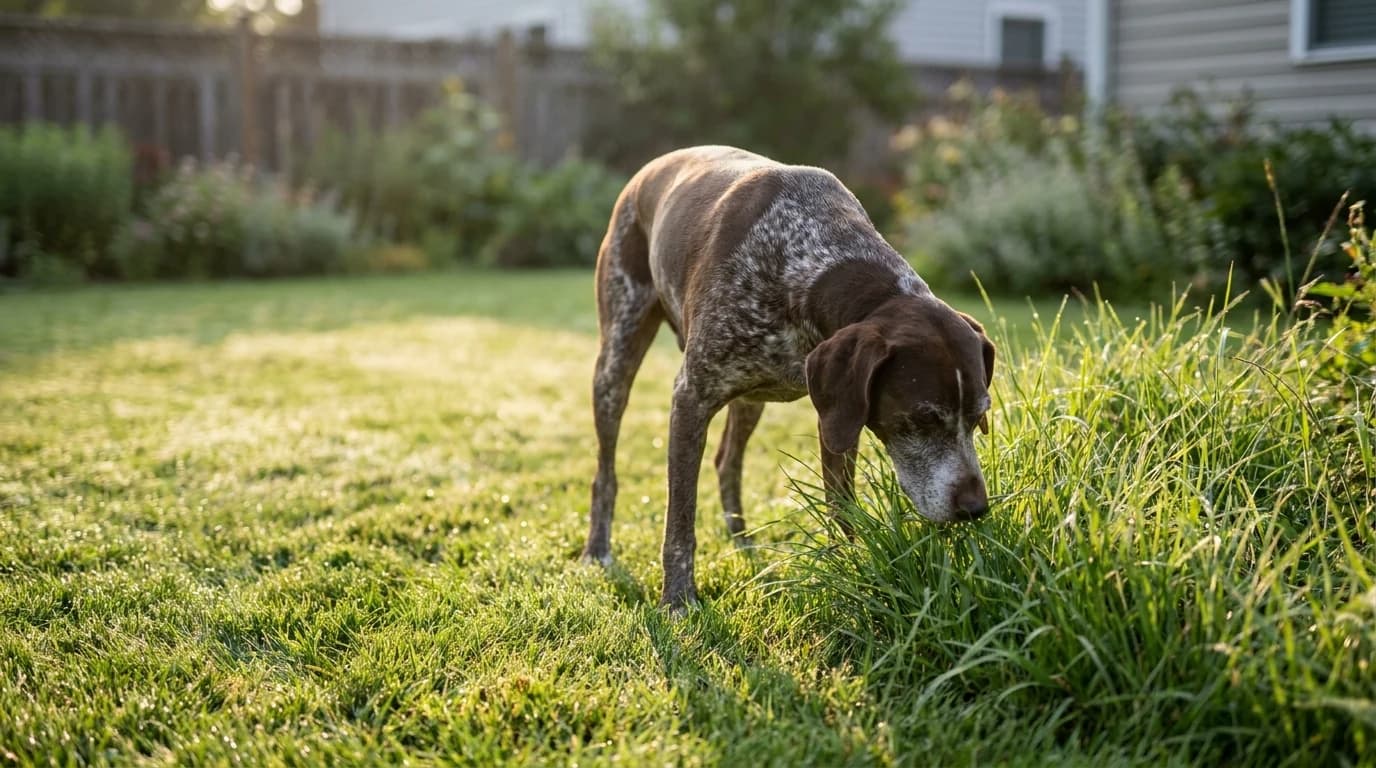
Your dog stops mid-walk and crops the verge like a small cow. Every owner reaches for the same explanation — her stomach must be off — and it is the explanation the survey data fits worst. The behaviour is near-universal, usually uneventful, and the parts of it worth worrying about are not happening inside the dog at all. They are on the lawn.
The number that breaks the theory
If grazing were self-medication, vomiting would be the point of it. Mostly, nothing happens.
The AKC's summary of the UC Davis School of Veterinary Medicine surveys reports that about 22% of the dogs studied frequently vomited after eating grass, and only 9% frequently showed signs of illness beforehand — with the researchers concluding that plant-eating is a normal behaviour of domestic dogs. VCA's veterinary write-up reads the same work and puts it at under 25% vomiting afterwards and around 10% appearing unwell first.
| Reading of the surveys | Frequently vomited after | Frequently looked ill first |
|---|---|---|
| AKC, citing the UC Davis work | about 22% | about 9% |
| VCA Animal Hospitals | under 25% | around 10% |
That is a base rate, not a diagnosis. Roughly four grazing sessions in five end with nothing at all. A behaviour that delivers its supposed purpose a fifth of the time is a weak candidate for deliberate self-treatment.
The age pattern runs backwards
The detail that does the most damage to the sick-dog story is which dogs graze hardest. Summarising the same UC Davis surveys — 1,571 usable owner responses — Stanley Coren writes in Psychology Today that 68% of dogs ate plants daily or weekly, and that the youngest dogs ate grass most often while being the least likely to look ill beforehand or to vomit afterwards.
- Self-medication predicts the opposite. The heaviest grazers ought to be the sickest dogs. They are the youngest and healthiest ones.
- The deficiency theory took a hit in the same data. Dogs given plant-based dietary supplements did not eat less grass.
- What survives is duller. Taste, texture, fibre, boredom and an inherited foraging habit — none of which need a cure.
What we could not read
The paper behind those figures — Sueda, Hart and Cliff's Characterisation of plant eating in dogs (2008) — sits behind a publisher paywall, and the open summaries disagree on rounding: 22% against "under 25%", 9% against 10%. Every number in circulation on this topic, ours included, is a secondhand reading of one study. Treat them as an order of magnitude, not a measurement.
The one grass habit that is telling you something
One pattern is worth separating out: a dog that goes straight out first thing, grazes frantically, brings up yellow foam, and is then entirely fine. AKC chief veterinary officer Dr Jerry Klein describes that foam as bile sitting in an empty stomach, irritating enough that dogs may eat grass to help release it — nearer to reaching for an antacid than to being ill. The fix is usually a schedule change rather than a treatment, and it is worth raising with your vet instead of self-diagnosing.
Grazing that is genuinely new in an adult dog is a different question, and it is answered by the company it keeps:
- Watch: occasional grazing in a dog that is eating, drinking and behaving normally.
- Book a call: a new habit alongside weight loss, appetite change, lip-licking, bloody stool or lethargy — the cluster the AKC tells owners to check for.
- Same day: repeated unproductive retching or a distended abdomen. That belongs to bloat and to the vomiting-and-diarrhoea triage, not to grass.
What is actually on the grass
The grazing is benign. The substrate is the half of this topic with published risk attached — and it is the half almost nobody searching this question is thinking about.
| On the lawn | Why a mouthful matters | What actually helps |
|---|---|---|
| Phenoxy and other herbicides | The strongest association in the literature, and the residue is on the blade itself | Know your own treatment schedule; keep the dog off until the label's re-entry interval has passed |
| Herbicide plus insecticide programmes | Combined exposure carried the largest effect of any category measured | Ask a lawn service exactly what is applied and when — combined programmes are the default, not the exception |
| Roundworm and hookworm eggs | Infection happens by swallowing eggs off contaminated ground, which is precisely what grazing is | Year-round parasite prevention and routine faecal checks |
The herbicide row is not a hunch. In a case-control study of 83 Scottish Terriers with bladder transitional cell carcinoma against 83 controls, Purdue researchers found the risk raised on herbicide-treated lawns (odds ratio 3.62) and higher again where both herbicides and insecticides had been used (7.19), while insecticides alone were not significant. One breed, one questionnaire, one association — but it is the only part of this subject with an odds ratio attached to it.
The parasite row is simpler and harder to escape. CAPC's ascarid guideline states that the eggs are hardy, survive and stay infective for years, are not killed by common disinfectants, and infect dogs that ingest them from a contaminated environment. There is no version of cleaning that off a lawn. You cover it with prevention instead.
Nothing about the grazing itself needs fixing. What was sprayed on the blade, and what was left on it, is the half of this you can actually change.
Five minutes, once, and then stop worrying about it
- Find out what goes on your own lawn — product names and dates, not "something for weeds".
- Learn the re-entry interval on those labels and treat it as a hard gate for the dog, not a suggestion.
- Assume treated on verges, parks and other people's front lawns, and redirect there rather than negotiating.
- Keep parasite prevention current — it is the only control you have over the egg problem.
- Give the mouth a better job if the grazing looks like boredom: a puzzle feeder or snuffle mat beats a lawn every time.
Then let it go. A dog eating grass is doing something four out of five of its peers do every week, with no consequence, for reasons that are probably as dull as liking the taste.
Frequently Asked Questions
- Does my dog eat grass because he has an upset stomach?
- Usually not. In the UC Davis surveys the AKC summarises, only about 9% of dogs frequently showed signs of illness before eating grass and only about 22% frequently vomited afterwards, and the researchers concluded that plant-eating is normal behaviour in domestic dogs. VCA reads the same work as under 25% vomiting and around 10% appearing unwell first. The one nausea-linked pattern that does hold up is a frantic first-thing-in-the-morning graze that produces yellow bile, which points at an empty stomach rather than illness.
- Is eating grass bad for dogs?
- The grass itself is generally not the problem; what is on it can be. VCA warns that herbicides and pesticides sprayed on grass can be toxic and that grass exposes dogs to intestinal parasites such as hookworms and roundworms. A Purdue case-control study of Scottish Terriers found bladder cancer risk raised on herbicide-treated lawns, and CAPC notes roundworm eggs remain infective in the environment for years and resist common disinfectants. Knowing your lawn treatment schedule and keeping parasite prevention current addresses both.
- Should I stop my dog from eating grass?
- There is no health reason to stop an otherwise well dog grazing on untreated grass you know the history of. It is worth redirecting on verges, parks and other people's lawns, where you cannot know what has been applied or what has been left behind. If the grazing looks like boredom rather than appetite, an enrichment fix — a puzzle feeder, a snuffle mat, more company in the yard — is a better lever than a correction.
- When should grass-eating make me call the vet?
- When it is new in an adult dog and arrives with company: weight loss, appetite change, lip-licking, bloody stool or lethargy are the signs the AKC tells owners to check for. Repeated unproductive retching or a distended abdomen is a same-day emergency and is about bloat rather than grass. A long-standing habit in a dog that is otherwise eating, drinking and behaving normally does not need an appointment.
Research Sources
- Why Does My Dog Eat Grass? — American Kennel Club
- Why Dogs Eat Grass — VCA Animal Hospitals
- Why Dogs Eat Grass — a Myth Debunked — Stanley Coren, Psychology Today
- Herbicide exposure and the risk of transitional cell carcinoma of the urinary bladder in Scottish Terriers — Glickman et al., Journal of the American Veterinary Medical Association (2004)
- CAPC Guidelines: Ascarid (Toxocara canis) — Companion Animal Parasite Council

PawBench Editorial
Published by Hilly Shore LabsPawBench’s editorial team researches dog products from primary veterinary sources, manufacturer specifications and aggregated buyer sentiment, alongside the lived ownership of Maggie, an Australian Labradoodle. We do not run hands-on product tests.
254 dog products scored · 1,160,974 buyer review-aspect mentions aggregated · cites AVMA, FDA, AAFCO, Cornell, WSAVA, AKC, ASPCA.
Recommendations are based on published veterinary guidelines, manufacturer specifications, and verified customer feedback. See our editorial standards.