Foxtails in Dogs: Where the Awns Actually End Up
Quick Answer
Usually not in the paw. In the ten-year record of 754 dogs at UC Davis's veterinary teaching hospital, the most common sites in dogs were the ear canal, the skin and the space beneath it, and the nasal canal; a 1983 review of 182 cases put the external ear canal first at 51%. "Foxtail" is also a nickname rather than a species — UC IPM's animal-injury warnings sit on hare barley and ripgut brome, whose awns run up to two inches with barbed, sharp bases, not on the Setaria grasses actually filed under the name. Check ears first and front feet second, and treat sudden sneezing, head shaking or a swollen toe after a walk in dry grass as an appointment: an awn cannot reverse out on its own, and imaging does not reliably find one.
On this page6 sections
Our Verdict
Reverse the usual check order. Two case series thirty-nine years apart both rank the ear canal ahead of the paw, while almost every foxtail article leads with between-the-toes. The published outcomes are reassuring — short-term results are good and most cases are managed as outpatients — so this is not a reason to stop walking in August. It is a reason to check the head first, keep feathering short on long-coated dogs, and stop reading a clean scan as an all-clear: ultrasound located an awn in 72.8% of scanned cases, and in confirmed lung perforations CT showed the awn itself in only half.
Where grass awns lodge in dogs, across two case series
The 1983 hospital-year review reports one percentage and then a list of other common sites; the 2009-2018 UC Davis series reports rank order for dogs rather than percentages. Signs are as UC Davis describes them by location. Nothing here comes from a product page.
| Site | 1983 series (182 cases) | 2009-2018 series (754 dogs) | Reported sign |
|---|---|---|---|
| External ear canal | 51% of cases — the single largest site | Most common location in dogs | Head shaking, pawing at the head, head tilt |
| Skin and the space beneath it | Lumbar area listed among the other common sites | Second most common location in dogs | Swelling, an open sore or abscess; lethargy, fever and loss of appetite once infected |
| Nose and throat | Listed among the other common sites | Third most common location in dogs | Persistent sneezing, snorting, nasal discharge, gagging |
| Interdigital webs | Listed among the other common sites | Not separately ranked | Limping on the affected limb; excessive licking of one spot |
| Eye | Listed among the other common sites | Not among the three most common dog sites | Uncontrolled blinking and swelling around the eye |
| Chest cavity | Listed among the other common sites | Suspected intracavitary migration imaged by CT in 78 dogs | Fast or laboured breathing, sometimes long after the walk |
How PawBench is paid: we earn an Amazon Associates commission on qualifying purchases. We don’t accept sponsored placements, paid reviews, or free products in exchange for coverage. Picks are ranked on documented owner outcomes and primary-source research, never on commission rate. Read the full methodology.
A foxtail is not one plant, and the paw is not where most of them end up. Both halves run against the standard warning, and both come out of published case records rather than a product page. Late August is the sharp end of the season: seed heads that were green in spring have dried, hardened and begun to shatter, and a barbed fragment travels one way only — inward.
The grass you are scanning for is probably the wrong grass
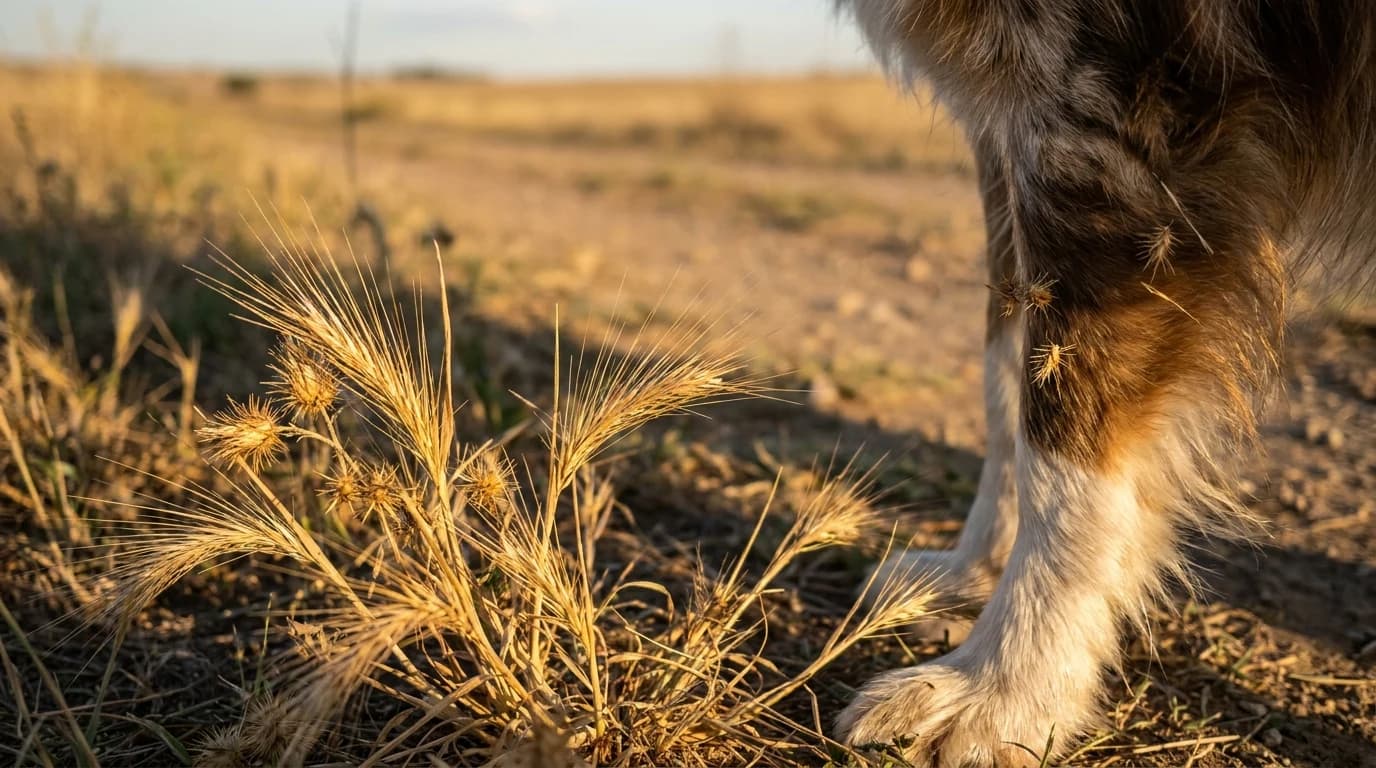
"Foxtail" is a nickname, not a species. UC IPM's weed gallery files three Setaria grasses under that name — yellow, green and giant — summer annuals of cropland, roadsides and turf. Its animal-injury language sits on entirely different pages. Of hare barley it writes that at maturity the spikelets carry "stiff, barbed, needle-like awns, and sharp bases that can injure the mouth, eyes, nasal passages, ears, and skin of animals" — and that the seed head breaks into several pieces, which is the delivery system. Of ripgut brome: needle-like awns one to two inches long, on flowers whose "tiny, rough teeth" can injure livestock and pets.
| Grass | Awn | Timing | What UC IPM says about animals |
|---|---|---|---|
| Hare barley (Hordeum murinum) | Stiff, barbed, sharp-based | Flowers April–June; the spike shatters at maturity | Can injure mouth, eyes, nasal passages, ears and skin |
| Ripgut brome (Bromus diandrus) | Needle-like, 1–2 in (2.5–5 cm) | Cool-season annual, brittle by summer | Rough teeth that "can injure livestock and pets" |
| Foxtail barley (Hordeum jubatum) | Needle-like, to about 1/3 in (7 mm) | Often moist, disturbed ground | Same genus, far shorter awn |
| Yellow and green foxtail (Setaria spp.) | Short bristles | Summer annuals | The grass actually named foxtail, and not the one those warnings describe |
So the silhouette to avoid is a bristly barley-like spike or a drooping oat-like head trailing inch-long needles, not the soft brush the name suggests. UC Davis describes the group just as loosely, as "foxtail grasses, barley and millets", and adds the point that matters today: they are most dangerous once dried and hardened.
Ears first, and it has been ears for forty years
UC Davis's teaching hospital pulled ten years of confirmed cases — 754 dogs, 2009 to 2018. The most common sites in dogs were the ear canal, the skin and the space beneath it, then the nose. Foxtail-associated disease turned up in 0.25% of dogs seen, most of them young to middle-aged, most presenting in summer.
That order is not new. A 1983 review of 182 cases at one hospital across one year found the external ear canal involved in 51%, with the interdigital webs, eye, nose, lumbar area and chest behind it — and grass awns accounted for 61% of every foreign-body case that hospital saw that year.
Two datasets, thirty-nine years apart, put the ear canal first. The between-the-toes check that leads almost every foxtail article is the second thing to do, not the first.
The five minutes after the walk
- Ears — a head flick, one ear carried low, or scratching that starts on the walk home. Look at the canal opening, not only the flap.
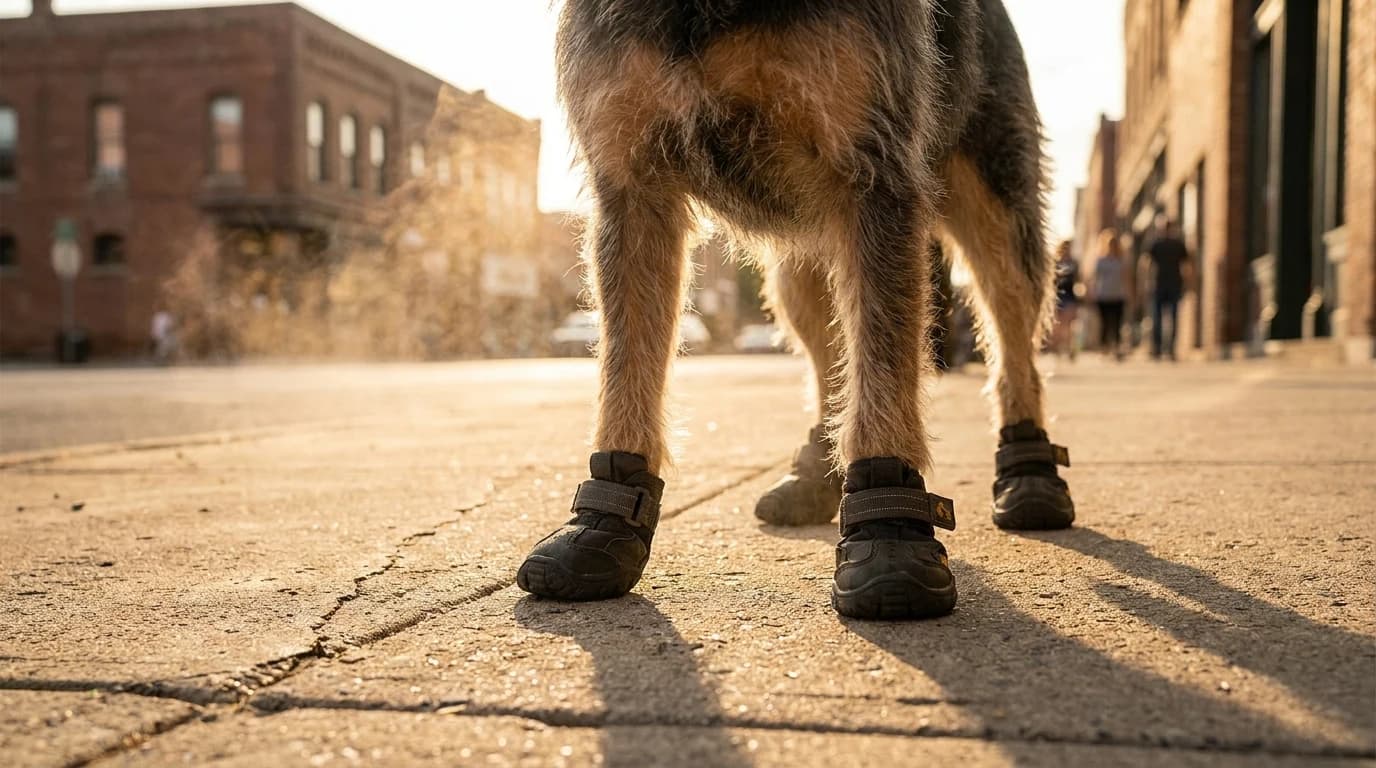
- Front feet before back — in the interdigital work below, front limbs dominated in both groups. Spread every web and hunt for a wet, licked, slightly raised spot. (Trail boots close the web entirely, at the cost of a hotter foot in August.)
- Nose — sudden violent sneezing that settles into a one-sided discharge.
- Eyes — squinting, or blinking that a rinse does not fix.
- Armpits, groin, tail base — UC Davis's own list, and where a long coat parks fragments a quick look misses.
- The coat itself — a fine comb through the feathering, plus hair kept short between the toes and around the ears on long-coated dogs, is UC Davis's stated prevention advice.
A clear image is not an all-clear
Plant material images poorly, and the numbers cut both ways.
What imaging does well:
- Ultrasound located an awn in 72.8% of the 114 cases scanned in the UC Davis series.
- In 22 dogs with confirmed lung perforation, CT pinpointed the perforation site in 21.
What it does not do:
- Show the awn itself, which appeared in 11 of those same 22 dogs.
- Rule one out. UC Davis lists surgical exploration among the ways these are finally diagnosed.
"The scan was clear" answers a narrower question than it sounds like. History and signs drive this diagnosis; imaging confirms it far more reliably than it finds it.
The toe that keeps swelling
An awn abscess between the toes and ordinary interdigital furunculosis look the same in the room. A 59-dog comparison recorded licking in roughly 70% of both groups and a discharging interdigital wound in 63% of each, then found the separation on ultrasound: a main linear element longer than 0.83 cm flagged a migrating awn with 91% sensitivity and 87% specificity. The two need different treatment. A course of antibiotics that half-works and relapses is itself a finding, worth saying at the recheck.
How worried to be, honestly
The case series and UC Davis land in the same unglamorous place: outcomes are good short-term, and most cases are outpatient. The tail of the distribution is what earns the reputation. Among thoracic grass-awn cases, 22.5% present as spontaneous pneumothorax, and once an awn is inside it cannot reverse out — UC Davis records migration into the brain, lungs and other organs. Neither fact justifies panic at a dry field; both justify treating a new sneeze or a swollen toe in August as an appointment, not a wait-and-see.
What nobody has measured
The prevention list — avoid the fields, leash through them, trim the feathering, comb after walks, a collar-mounted face net — is expert consensus, and we found no published study testing whether any of it lowers case rates. Sensible is not the same as proven. Two more limits: 0.25% is one referral hospital in a foxtail-heavy corner of California, not a national rate; and the 1983 breed pattern — more cases in Springer Spaniels, Golden Retrievers, Brittanys and Airedales, fewer in German Shepherds, Miniature Poodles and Dachshunds — is a single hospital year, confounded by which breeds walked through that door.
If your walks cross dry grass until the first rains, the cheap version costs nothing:
- A leash, and the paved side of the path.
- Feathering kept short on the feet and ears.
- A comb by the door, and the after-walk paw habit hot pavement already earns.
- The ear check — the half most owners skip, and the half the case records keep putting first.
Frequently Asked Questions
- Can a foxtail work its way back out on its own?
- No. UC Davis is explicit that the seed head's shape is built to burrow into soil, so once it is in the body it cannot reverse direction and come out by itself. The only treatment is removal, and that includes fragments: if part of the seed head is left behind, the remnant can keep migrating.
- Should I pull one out myself?
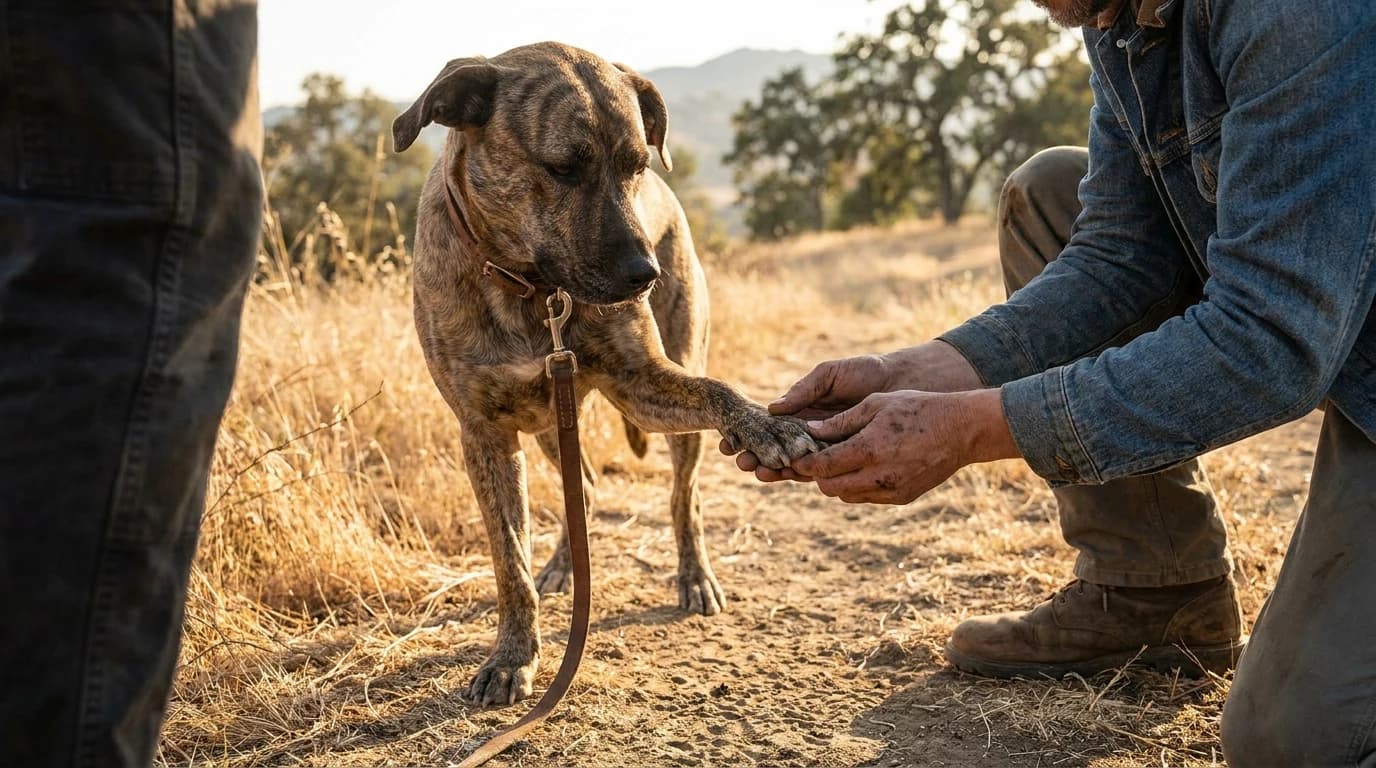
- Only if it is sitting on the surface and you can see all of it. UC Davis says an easily accessible foxtail can be removed with tweezers, provided you are confident the whole seed head came out; if you think any part remains, call your vet. Anything embedded, or surrounded by redness and swelling, is a veterinary job, and the earlier it is found the less likely surgery becomes.
- Is this only a California problem?
- The published data is Californian — the largest case series comes from UC Davis's teaching hospital and the weed descriptions come from UC's California gallery — so the prevalence figures should not be read as national. The grasses themselves are not exclusive to California, and UC Davis notes that cases turn up year-round in warm climates rather than only in a summer window.
- My dog's X-ray was clear. Does that rule out a foxtail?
- Not on its own. Plant material images poorly: in the UC Davis series, ultrasound run by a boarded radiologist located an awn in 72.8% of the cases it was used on, and in a series of 22 dogs with surgically confirmed lung perforation, CT showed the awn itself in only 11. Diagnosis leans on exposure history and signs, with imaging confirming more often than finding — and surgical exploration is sometimes what settles it.
Research Sources
- Foxtails and Dogs — Amy Young and Erik Olstad, DVM — UC Davis School of Veterinary Medicine, Animal Health Topics
- Clinical and clinicopathological characteristics, treatment, and outcome for dogs and cats with confirmed foxtail foreign body lesions: 791 cases (2009-2018) — Philp, Epstein & Hopper — Journal of Veterinary Emergency and Critical Care (2022)
- Grass awn migration in dogs and cats: a retrospective study of 182 cases — Brennan & Ihrke — Journal of the American Veterinary Medical Association (1983)
- CT is helpful for the detection and presurgical planning of lung perforation in dogs with spontaneous pneumothorax induced by grass awn migration: 22 cases — Veterinary Radiology & Ultrasound (2020)
- Ultrasonographic findings may be useful for differentiating interdigital abscesses secondary to migrating grass awns and interdigital furunculosis in dogs — Veterinary Radiology & Ultrasound (2023)
- Hare barley (Hordeum murinum ssp. leporinum) — Weed Identification Gallery — UC Statewide Integrated Pest Management Program

PawBench Editorial
Published by Hilly Shore LabsPawBench’s editorial team researches dog products from primary veterinary sources, manufacturer specifications and aggregated buyer sentiment, alongside the lived ownership of Maggie, an Australian Labradoodle. We do not run hands-on product tests.
254 dog products scored · 1,160,091 buyer review-aspect mentions aggregated · cites AVMA, FDA, AAFCO, Cornell, WSAVA, AKC, ASPCA.
Recommendations are based on published veterinary guidelines, manufacturer specifications, and verified customer feedback. See our editorial standards.